A study of certain organic inputs on phenological, yield and quality related traits of Strawberry (cv. Camarosa) in pot culture
DOI:
https://doi.org/10.31783/elsr.2023.917782Keywords:
antioxidants, organic, strawberry, vitaminAbstract
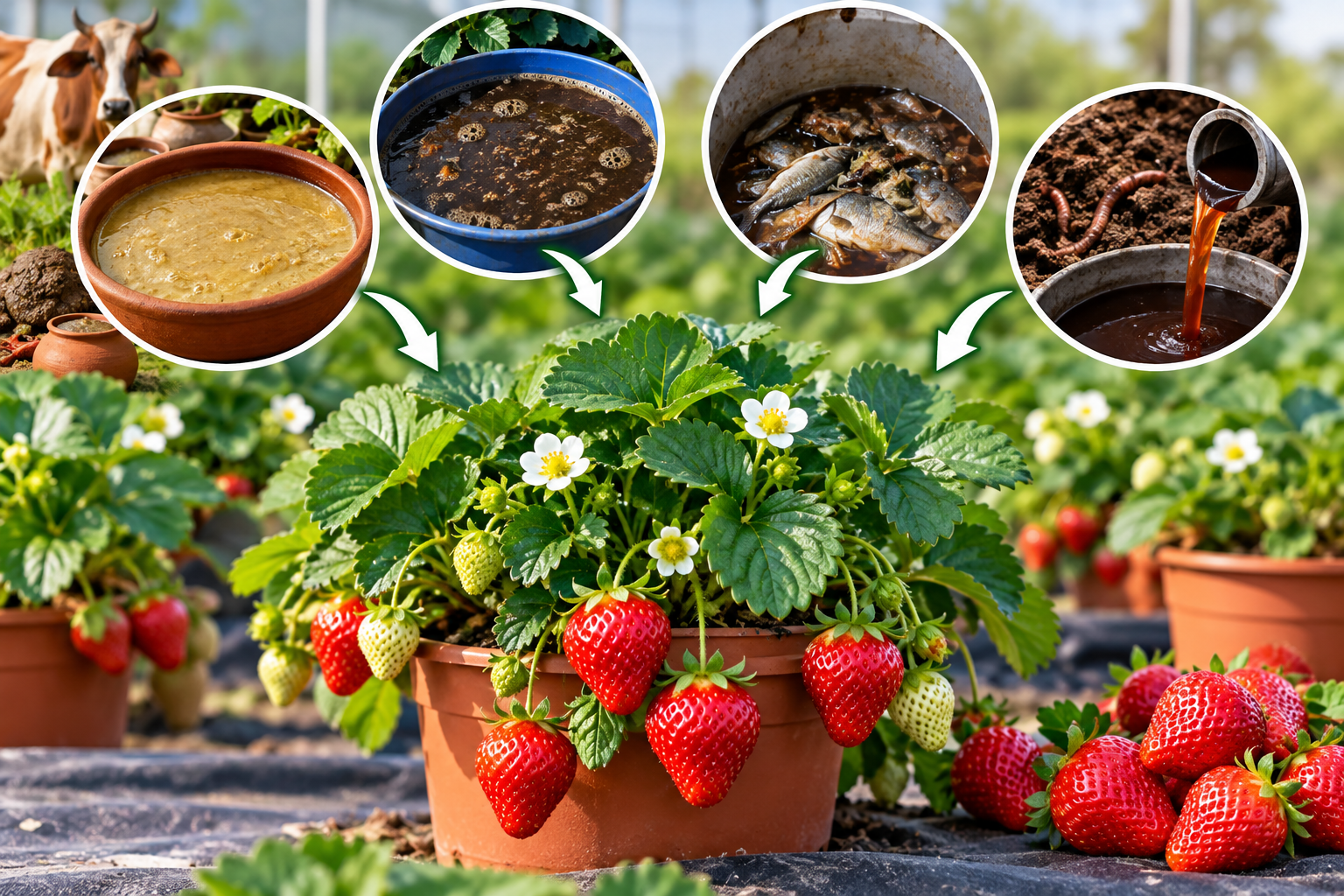
Organic agriculture is on a pacing rate at the present time at the global level to protect nature and promote good health conditions for people. Keeping this in mind, the study was conducted using four different organic amendments on Strawberry (cultivar camarosa) which included T1=Panchagavya, T2=Jeevamrutham, T3=Fish meal extract, T4=Vermiwash and T5= Controlled during 2017-2018 at School of Agriculture, Lovely Professional University, Punjab. Panchagavya recorded the highest values for plant height, number of leaves, leaf area, number of runners, plant spread, pedicel thickness, number of flowers and fruits, fruit set%, fruit length and grith, fruit weight, yield per plant, TSS, fruit firmness and TSS: titrable acidity and showed less value for days to flowering. Panchagavya performed better than other treatments followed by fish meal amino acid, vermi wash, jeevamrutham and controlled. The better performance of panchagavya is due to the presence of beneficial microbes mostly lactic acid bacteria, yeast, actinomyces and certain fungi and it is having good amount of both macro (N, P, K and Ca) and micro (Zn, Fe, Cu, Mn) nutrients.
References
[1] M. Thakur and B. Shylla (2018). Influence of different growing media on plant growth and fruit yield of strawberry (Fragaria × ananassa Duch.) cv. Chandler grown under protected conditions. Int. J. Curr. Microbiol. Appl. Sci., 7: 2724-2730.
[2] A. Green (1971). Soft Fruits. In Hulme, A. C. (ed.). The biochemistry of fruits and their products. Academic Press. New York. 2: 375-410.
[3] M. M. Maher, B. Shylla, D. D. Sharma, U. Sharma and M. A. Kuchay (2020). Yield and quality of polyhouse grown strawberries as affected by soilless media and jeevamrit. Int. J. Chem. Stud., 8: 585-589.
[4] J. Sun, Y. F. Chu, X. Wu and R. H. Liu (2002). Antioxidants and antiproliferative activities of common fruits. J. Agric. Food Chem., 50: 7449−7454.
[5] R. R. Sharma and V. P. Sharma (2004). The Strawberry. ICAR, New Delhi, India.
[6] S. H. Hakkinen and A. R. Torronen (2000). Content of flavonols and selected phenolic acids in strawberries and Vaccinium species: Influence of cultivar, cultivation site and technique. Food Res. Int., 33: 517-524.
[7] Anonymous (2019). Production Statistics - Crops, Crops Processed.
[8] AOAC (1995). Official methods of analysis (16th edition), Association of Official Analytical Chemists, Washington, DC, USA.
[9] V. Tiwari, S. Maji, S. Kumar, G. Prajapati and R. Yadav (2016). Use of kitchen waste-based bio-organics for strawberry (Fragaria x ananassa Duch) production. Afr. J. Agric. Res., 11: 259-265.
[10] J. Vallimayil and R. Sekar (2012). Investigation on the effect of panchagavya on Sounthern Sunnhemp mosaic virus (SSMV) infected plant systems. Global J. Env. Res., 6: 75-79.
[11] P. U. Amareswari and P. Sujathamma (2014). Jeevamritha as an alternative of chemical Fertilizers in rice production. Agric. Sci. Dig., 34: 240-242.
[12] S. Geetha and A. Devaraj (2013). Effect of microbial fertigation and panchagavya on the growth of Vitis vinifera graftings. Int. J. Biosci. Res., 2: 1-6.
[13] S. Sreethu and S. Singh (2020). Effect of nitrogen and panchagavya on growth and yield of baby corn yield of baby corn (Zea mays L.). The Bioscan, 15: 243-246.
[14] E. L. D. Amalraj, G. P. Kumar, S. K. M. H. Ahmed, R. Abdul and N. Kishore (2013). Microbiological analysis of panchagavya, vermicompost and FYM and their effect on plant growth promotion of pigeon pea (Cajanus cajan L.) in India. Org. Agric., 3: 23-29. doi: https://doi.org/10.1007/s13165-013-0042-2.
[15] S. Jandaik and V. Sharma (2016). Antifungal potential of panchagavya against soil borne fungal pathogens associated with Capsicum nurseries. Int. Inven. J. Agric. Soil Sci., 4: 22-26.
[16] E. J. Weinert, S. A. Miller, D. M. Ikeda, K. S. Chang, J. M. McGinn, M. W. DuPonte and C. Global (2014). Natural farming: Fish amino acid. Sustain. Agric., 12: 1-3.
[17] B. Priyanka, D. Anoob, M. Gowsika, A. Kavin, S. K. Sri, R. V. K. Kumar and R. S. Gomathi et al., (2019). Effect of fish amino acid and egg amino acid as foliar application to increase the growth and yield of green gram. J. Pharm. Innov., 8: 684-686.
[18] K. Sundararasu and A. Jeyasankar (2014). Effect of vermiwash on growth and yield of brinjal, Solanum melongena (egg plant or aubergine). Asian J. Sci. Technol., 5: 171-173.
[19] B. Esakkiammal, L. Lakshmibai and S. Sornalatha (2015). Studies on the combined effect of vermicompost and vermiwash prepared from organic wastes by earthworms on the growth and yield parameters of Dolichous lab lab. Asian J. Pharm. Sci. Technol., 5: 246-252.
[20] S. Suthar (2010). Potential of domestic biogas digester slurry in vermitechnology. Bioresour. Technol., 101: 5419-5425.
Downloads
Published
Issue
Section
License
Copyright (c) 2023 Author (s)

This work is licensed under a Creative Commons Attribution-NonCommercial-NoDerivatives 4.0 International License.
Copyright © The Author(s). This is an open access article distributed under the terms of the Creative Commons Attribution-NonCommercial-NoDerivatives 4.0 International License (CC BY-NC-ND 4.0), which permits unrestricted non-commercial use, distribution, and reproduction in any medium, provided the original author(s) and source are properly credited, and the work is not modified or adapted.