
Thiourea fertilization effect on nutrient content and uptake of soybean cultivar
DOI:
https://doi.org/10.31783/elsr.2023.919197Keywords:
cultivar, nutrient uptake, soybean, thioureaAbstract
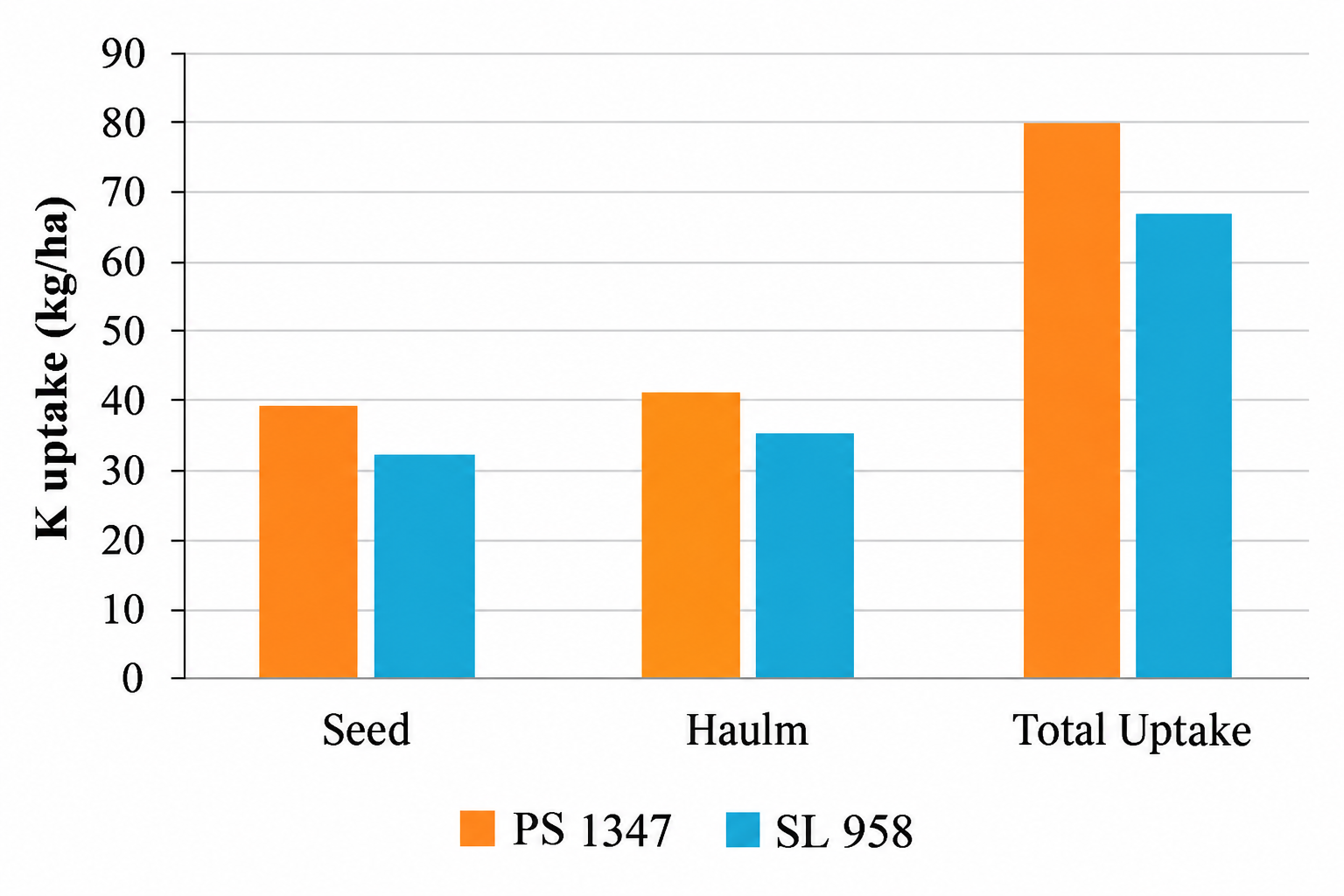
In the kharif season of 2020, an experimental trial was executed at Govind Ballabh Pant University of Agriculture and Technology which is situated in Pantnagar, India. The objective of this study was to evaluate how soybean's nutrient content and uptake responded to the application of thiourea through foliar means. The experiment was laid out in factorial randomized block design and comprised of two soybean cultivars viz., PS 1347 and SL 958 and five foliar sprays viz., control, water spray, thiourea spray @ 250 ppm, 500 ppm, and 750 ppm which were replicated four times. This study demonstrates the potential of foliar thiourea application to enhance the sulfur content and uptake of soybean cultivars in the kharif season. The findings of the study indicated that the N, P, and K content of soybean were not impacted by the type of variety used or by the foliar sprays administered. However, it was observed that the highest S content in both seeds (0.375%) and haulm (0.179%) was recorded when thiourea was applied through foliar means at a rate of 750 ppm. This result was statistically equivalent (0.368% in seed and 0.173% in haulm) to the outcome obtained from a 500 ppm foliar spray and both of these treatments were found to be more effective than the other foliar spray methods tested.
References
[1] National Food Security Mission. Present status of oilseed crops and vegetable oils in India. 2018. https://www.nfsm.gov.in/StatusPaper/NMOOP2018.pdf. Accessed on 1st March 2023.
[2] M. Pandey, A. K. Srivastava, S. F. D’Souza and P. Suprasanna (2013). Thiourea, a ROS scavenger, regulates source-to-sink relationship for enhanced crop yield and oil content in Brassica juncea (L.). PloS One, 8: e73921. doi: 10.1371/journal.pone.0073921.
[3] E. Kinaci and N. Gulmezoglu (2007). Grain yield and yield components of triticale upon application of different foliar fertilizers. Interciencia, 32: 624-628.
[4] A. Yassen, E. A. A. A. El-Nour and S. Shedeed (2010). Response of wheat to foliar spray with urea and micronutrients. J Am. Sci., 6:14-22.
[5] F. B. Snell and C. I. Snell (1949). Colorimetric method of analysis. Vol. II. D. Van Nostrand Co. Inc. New York.
[6] M. L. Jackson (1959). Soil Chemical analysis. J. Plant Nutr. Soil Sc., 85: 251-252.
[7] M. A. Tabatabai and J. M. Brenner (1970). A simple turbidimetric method determining total sulfur in plant material. Agron. J., 62: 805-806.
[8] K.A. Gomez and A. A. Gomez (1984). Statistical procedures for agricultural research. John Willey and Sons.
[9] H. V. Korat, P. D. Kumawat, A. V. Savaliya and D. J. Pansuriya (2020). Growth, quality, nutrient content and uptake and soil fertility status of wheat (Triticum aestivum L.) as influenced by thiourea and thioglycollic acid. J. Pharmacogn. Phytochem., 9: 2263-2267
[10] B. S. Meena and D. D. Sharma (2005). Effect of phosphorus sources, solubilizers and bioregulators on growth, yield and phosphorus uptake by pigeonpea (Cajanus cajan). Indian J. Agron., 50:143-145.
[11] S. Choudhary, O. P. Sharma, G. L. Choudhary and L. Jat (2017). Response of urdbean [Vigna mungo (L.) Hepper] to phosphorus fertilization and thiourea on yield, quality, nutrient content and uptake. Int. J. Curr. Microbiol. Appl. Sci., 6: 2841-2847.
[12] A. A. Amin, A. A. Abd El-Kader, M. A. F. Shalaby, F. A. E. Gharib, EL.-S. M. Rashad and J. A. T. da Silva (2013). Physiological effect of salicylic acid and thiourea on growth and productivity of maize plants in sandy soil. Commun. Soil Sci. Plant Anal., 44: 1141- 1155.
Downloads
Published
Issue
Section
License
Copyright (c) 2023 Author (s)

This work is licensed under a Creative Commons Attribution-NonCommercial-NoDerivatives 4.0 International License.
Copyright © The Author(s). This is an open access article distributed under the terms of the Creative Commons Attribution-NonCommercial-NoDerivatives 4.0 International License (CC BY-NC-ND 4.0), which permits unrestricted non-commercial use, distribution, and reproduction in any medium, provided the original author(s) and source are properly credited, and the work is not modified or adapted.