Study of combining ability over the environments in line x tester crosses in Ashwagandha (Withania somnifera L.)
DOI:
https://doi.org/10.31783/elsr.2023.9198102Keywords:
ashwagandha, dry root yield, environmentsAbstract
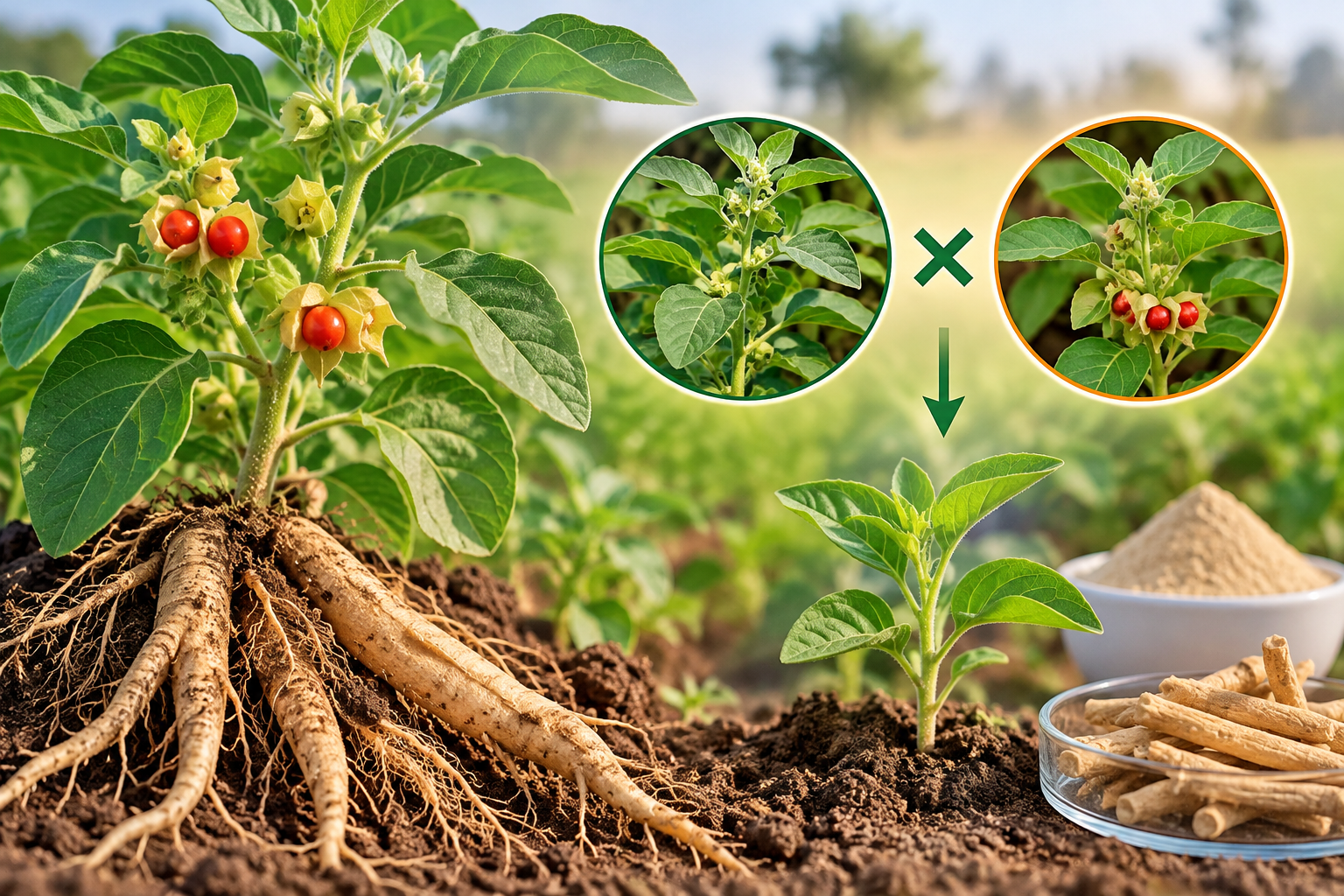
Three different locations were chosen to conduct the experiment to get information on combining ability including 65 genotypes of Ashwagandha. Analysis of variance indicated that experimental material contained considerable variability and both specific combining ability along with general combining ability effects are involved in the genetic expression of characters; furthermore, SCA, as well as GCA, were highly influenced by the environment. The GCA effects over the environments disclosed that among parents, L9, L5, L14, L15, and T3 were excellent hence these are identified as good general combiners in terms of several root attributing traits besides root yield at dry basis, while, six crosses L8xT1, L10xT1, L12xT1, L15xT2, L1xT3, and L4xT3 were reported superior specific combiner for economic important trait dry root yield per plant. The above selected genotypes may be useful for further crop improvement breeding programs.
References
[1] T. P. Aneesh, M. Hisham, M. S. Sekhar, M. Madhu and T. V. Deepa (2009). International market scenario of traditional Indian herbal drugs-India declining. Int. J. Green Pharm., 3: 184-190.
[2] I. Ahmed, R. B. Dubey and S. Husain (2022). Hybrid vigour studies for root yield traits across the environments in Ashwagandha (Withania somnifera L.). Indian J Genet. Plant Breed., 82: 245-248.
[3] B. A. Mir, S. Koul, A. Kuar, S. Sharma, M. K. Kaul and A. S. Soodan (2012). Reproductive behaviour and breeding system of wild and cultivated types of Withania somnifera (L.) Dunal. J. Med. Res., 6: 754-762.
[4] M. K. Kaul, A. Kumar and A. Sharma (2005). Reproductive biology of Withania somnifera (L.) Dunal. Curr. Sci., 88: 1375-1377.
[5] C. K. Atal and A. E. Schwarting (1962). Intraspecific variability in Withania somnifera- I. A. preliminary survey. Llyodia, 25: 78-87.
[6] H. Dhuri (2016). Study of combining ability and heterosis for root quality and yield in Ashwagandha [Withania somnifera (L.) Dunal.]. M. Sc. (Agri.) Thesis, Indira Gandhi Krishi Vishwavidyalaya, Raipur, Chattisgarh (India).
[7] N. Gaurav, A. Kumar, M. Tyagi, D. Kumar, U. K. Chauhan and A. P Singh (2015). Morphology of Withania somnifera (distribution, morphology, phytosociology of Withania somnifera L. Dunal). Int. J. Curr. Sci. Res., 1: 164-173.
[8] G. F. Sprague and L. A. Tatum (1942). General verses specific combining ability in single crosses of corn. Agron. J., 34: 923-932.
[9] O. Kempthorne (1957). An introduction to genetical statistics. John Willey and Sons Incompany, New York. pp323-331.
[10] I. Ahmed, V. L. Gawande, S. S. Nichal and R. D. Ratnaparkhi (2016). Genetic studies for seed yield and its components in safflower (Carthamus tinctorius L.). Elec. J. Plant Breed., 7: 972-978.
[11] V. A. Celine and P. S. Sirohi (1996). Heterosis in bitter gourd (Momordica charantia L.). Veg. Sci., 23: 180-185.
[12] A. Singh, A. Tirkey, D. Nagvanshi, M. G. Minz and M. Sahu (2013). Heterosis studies for fresh root yield and its component in Ashwagandha [Withania somnifera (L.) Dunal]. National seminar on non-timber forest produce, medicinal, aromatic plants & species: Innovation for Livelihood Security. pp23-24.
[13] M. K. Sahu (2015). Genetics of root traits inheritance in Ashwagandha [Withania somnifera (L.) Dunal.]. M. Sc. (Agri.) Thesis, Indira Gandhi Krishi Vishwavidyalaya, Raipur, Chattisgarh (India).
[14] M. A. A. Mondal and M. M. Hossain (2006). Combining ability in potato (Solanum tuberosum L.). Bangladesh J. Bot., 35: 125-131.
[15] H. T. Prakash, P. R. Dharmatti, R. V. Patil, S. T. Kajjidoni and K. Naik (2008). Heterosis for yield in brinjal (Solanum melongena L.). Karnataka J. Agricultural Sci., 21: 476-478.
[16] A. Sao and N. Mehta (2010). Heterosis in relation to combining ability for yield and quality attributes in brinjal (Solanum melongena L.). Electronic J. Plant Breed., 1: 783-788.
Downloads
Published
Issue
Section
License
Copyright (c) 2023 Author (s)

This work is licensed under a Creative Commons Attribution-NonCommercial-NoDerivatives 4.0 International License.
Copyright © The Author(s). This is an open access article distributed under the terms of the Creative Commons Attribution-NonCommercial-NoDerivatives 4.0 International License (CC BY-NC-ND 4.0), which permits unrestricted non-commercial use, distribution, and reproduction in any medium, provided the original author(s) and source are properly credited, and the work is not modified or adapted.