Studies on biodiversity, ethnobotanical uses and physicochemical properties of underutilized fruits in Nagaland and Meghalaya
DOI:
https://doi.org/10.31783/elsr.2023.91114125Keywords:
ethnobotanical uses, physicochemical composition, underutilized fruitsAbstract
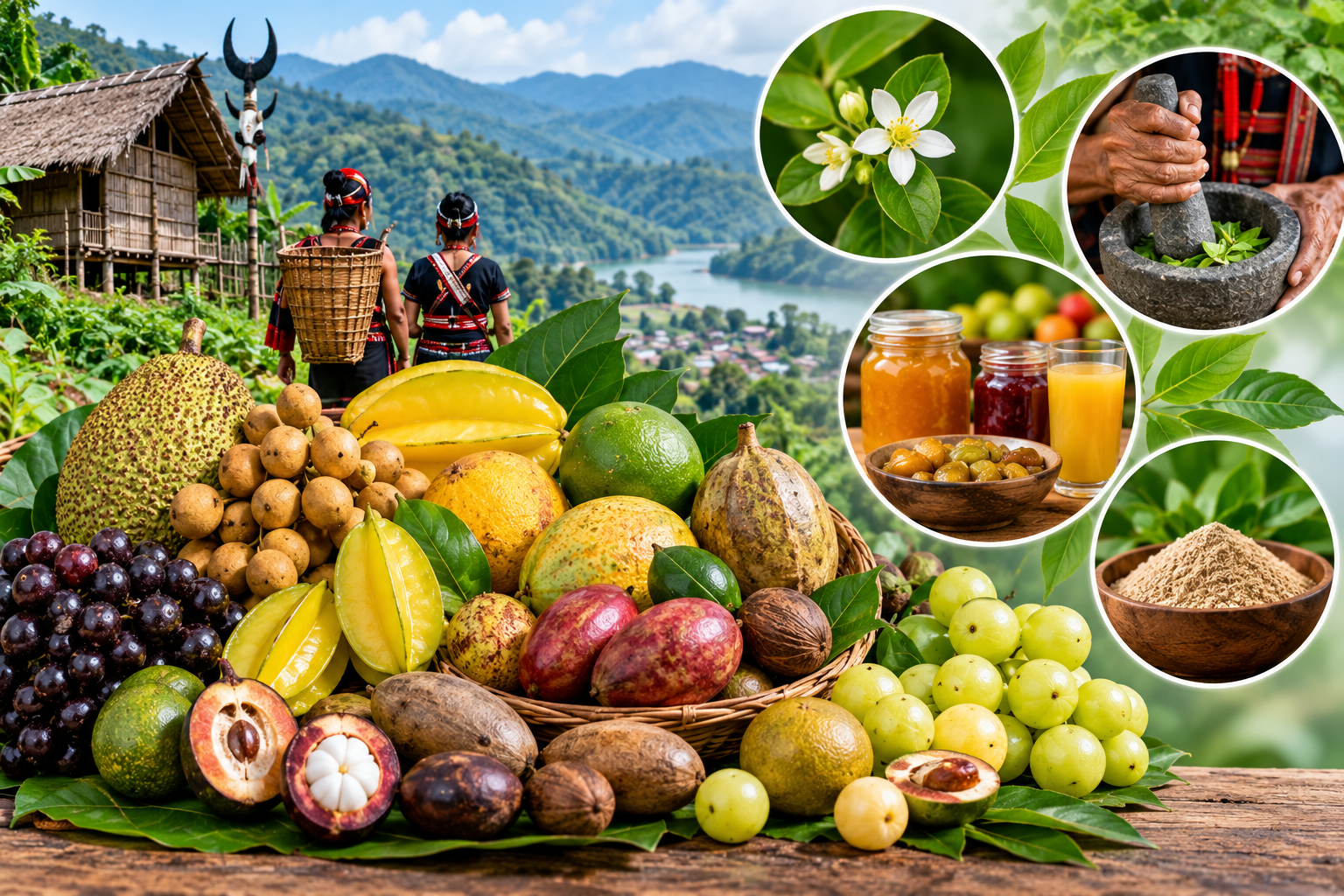
A study was conducted on the bio-diversity and physicochemical properties of underutilized fruit crops in Nagaland and Meghalaya during 2018-19 under the Department of Horticulture, SASRD, Nagaland University. Artocarpus lakoocha, Averrhoa carambola, Baccaurea ramiflora, Canarium strictum, Citrus indica, Docynia indica, Elaeagnus latifolia, Garcinia lanceifolia, Haematocarpus validus, Myrica nagi, Phyllanthus acidus, Prunus napaulensis, Spondias pinnata and Terminalia chebula were found to be in abundance in the local communities and these fruits play an important role in diet of the local tribes and the local communities have their own vernacular names for the particular fruits which were collected from villages through interaction. The village elders, traditional healers, etc. are well-versed in the medicinal uses of these fruits and their different parts. Most of the fruits are consumed or sold in the local market by collecting them from the forests. The fruits are used as fresh or in various processed products such as RTS, pickles, jam, etc., or utilized in various medicinal purposes like paste and powder to treat wounds, boils, rashes, digestive problems, etc. The physicochemical properties showed a wide spectrum of variation in TSS (6.66-26.46 °Brix), total sugar (4.34-12.01%), reducing sugar (2.19-5.96%), titratable acidity (0.44-4.82%), ascorbic acid (4.40-115.50 mg/100g pulp) and anthocyanin (15.27-117.10 mg/100 g pulp) among the various fruits analyzed.
References
[1] A. Nath, N. A. Deshmukh, R. K. Patel, D. Paul, L.K. Misra and B. C. Deka (2013). Problems and prospects of value addition and processing of underutilized horticultural crops of NEH Region. In: N. Prakash, S. S. Roy, P.K. Sharma, S.V. Ngachan (eds.), Developing the potential of underutilized horticultural crops of hill regions, Today &Tomorrow’s Printers and Publishers, New Delhi, pp529-539.
[2] B. D. Sharma and J. C. Rana (2005). Plant genetic resources of Western Himalaya: Status and prospects. Dehradun, Uttarakhand, India, pp457. IBN-10: 8121104432.
[3] J. C. Rana, K. Pradheep and V. D. Verma (2007). Naturally occurring wild relatives of temperate fruits in Western Himalayan region of India: an analysis. Biodivers Conserv., 16: 3963-3991.
[4] H. Rymbai, A. R. Roy, N. A. Deshmukh, A. K. Jha, W. Shimray, G. F. War and S. V. Ngachan (2016). Analysis study on potential underutilized edible fruit genetic resources of the foothills track of Eastern Himalayas, India. Genet. Resour. Crop Evol., 63: 125-139.
[5] R. K. Patel, N. A. Deshmukh, A. Nath, B. C. Deka and R. S. Patel (2013). Sohiong (Prunus nepalensis) and Sohang (Elaegnus latifolia): Potential fruits of Meghalaya needs commercialization. In: N. Prakash, S. S. Roy, P. K. Sharma, S. V. Ngachan (eds.), Developing the potential of underutilized horticultural crops of hill regions, Today &Tomorrow’s Printers and Publishers, New Delhi, pp455-467.
[6] A. O. A. C (1984). Method of analysis of the Association of Official Analytical Chemist, Washington D.C, USA.
[7] S. K. Bishnoi, R. Shinde and P. K. Sarkar (2017). Monkey Jack (Artocarpus lakoocha Roxb.): Hope for sustaining Livelihood. In A. K. Dutta, B. Mondal (Eds.), Fruits for Livelihood: Production Technology and Management Practices, Agrobios (India), Jodhpur, India, pp199-213.
[8] M. F. Hossain, M. A. Islam, S. Akhtar and S. M. Numan (2016). Nutritional value and medicinal uses of Monkey Jack fruit (Artocarpus lakoocha). Int. Res. J. Biological. Sci., 5: 60-63.
[9] P. Gautam and R. Patel (2014). Artocarpus lakoocha Roxb: an Overview. European J. Compl. Alter. Medicine., 1: 10-14.
[10] S. Islam, M. A Hasan, S. O. Bhutia, P. Tamanna and P. S. Munsi (2018). Importance and potentiality of underutilized Lakoocha (Artocarpus lakoocha Roxb.) fruit of Tripura. Int. J. Curr. Microbiol. App. Sci., 7: 3132-3138.
[11] H. Manda, K. Vyas, A. Pandya and G. Singhal (2012). A complete review on: Averrhoa carambola. World J. Pharm. Pharmac. Sci., 1: 17-33.
[12] N. Narain, P. S. Bora, H. J. Holschuh, S. Da and M. A. Vasconcelos (2001). Physical and chemical composition of carambola fruit (Averrhoa carambola L.) at three stages of maturity. Cienc. Tecnol. Alimentaria, 3: 144-148.
[13] A. Choudhury and N. A. Patel (2016). Pharmacognostical and physico-chemical studies of the bark of Baccaurea ramiflora Lour. Int. J. Pharmacogn. Phytochem. Res., 8: 1935-1939.
[14] S. Gurung, S. K. Mahato, B. Thapa and B. Chhetri (2018). Morphological and physicochemical variations in Burmese grape (Baccaurea sapida Muell-Arg) of Darjeeling Himalayas. Int. J. Chem. Stud., 6: 431-433.
[15] Y. F. Lin, Z. Yi and Y. H. Zhao (2003). Chinese dai medicine colourful illustrations. Yunnan National Publishing House, Kunming, China.
[16] R. K. Patel, L. C. De, A. Singh and B. C. Deka (2010). Lesser known edible fruits of North Eastern India. In Underutilized and Underexploited horticultural crops, vol 5. New Delhi: New India Publishing Agency. pp163-173.
[17] M. Raghavan and Md. Ramjan (2018). Burmese grape (Baccaurea ramiflora Lour.): A promising fruit crop for future generations. J. Med. Plants Stud., 6: 50-52.
[18] P. Deb and N. Bhowmick (2013). Pyhsico-chemical properties of Burmese grape (Baccaurea sapida Muell. Arg.)-An underutilized fruit crop of West Bengal. Int. J. Agric. Food Sci. Tech., 4: 415-420.
[19] J. Augustine and P.G. Khrishnan (2006). Status of the black dammar tree (Canarium strictum Roxb.) in periyar tiger reserve, Kerala and the uses of black dammar. Indian For., 132: 1329-1335.
[20] A. Kala, P. Raja, S. Soosairaj and B. Balaguru (2014). Reproductive biology and seed germination of tropical evergreen tree Canarium strictum Roxb. J. Bio. Env. Sci., 5: 24-32.
[21] M. A. Laskar, M. Hynniewta and C.S. Rao (2009). In vitro propagation of Citrus indica Tanaka- An endangered progenitor species. Indian J. Biotechnol., 8: 311-316.
[22] NERAMAC (2014). North eastern regional agricultural marketing corporation limited. GI Journal, 65: 7-13.
[23] K. M. Shende, N. I. Singh and P. S. Negi (2016). Phytochemical characterization and biological activities of Docynia indica (wall) fruit extracts. J. Mol. Genet. Med., 10: 204. doi:10.4172/1747-0862.1000204.
[24] L. C. De (2017). Valuable indigenous fruit crops of North eastern region of India. Int. J. Res. Applied, Natural Soc. Sci., 5: 21-42.
[25] R. K. Patel, A. Singh and B. C. Deka (2008). Soh-shang (Elaeagnus latifolia): an under-utilized fruit of North-East region needs domestication. ENVIS Bull. Himal. Ecol., 16: 25-32.
[26] N. S. Bora, B. B. Kakoti, B. Gogoi and S. Borah (2017). Phyto-physicochemical, acute and subacute toxicity studies of Garcinia lanceifolia Ronb.- rare ethnomedicinal plant of Assam, India. Indian J. Nat. Prod. Resour., 8: 360-369.
[27] N. S. Bora, B. B. Kakoti, P. S. Bairy and B. Gogoi (2014). Garcinia lanceifolia Roxb; an endemic medicinal plant of assam relieves pain and delays nociceptive response: an assay for its analgesic and anti-inflammatory activity. Int. J. Pharm. Sci. Drug Res., 6: 216-219.
[28] M. A. Rahim, M. J. M. Khatun, M. M. Rahman, M. M. Anwar and M. H. Mirdah (2015). Study on the morphology and nutritional status of Roktogota (Haematocarpus validus)- an important medicinal fruit plant of hilly areas of Bangladesh. Int. J. Minor Fruits, Med. Aromat. Plants, 1: 11-19.
[29] A. N. Sangma (2016). Morphological and biochemical characterization of Blood fruit (Haematocarpus validus) in Garo Hills region of Meghalaya. M.Sc. Thesis, North Eastern Hill University, Tura Campus, Meghalaya, India.
[30] D. R. Singh and B. V. Shajeeda (2014). Estimation of phytochemicals and determination of beta carotene in Haematocarpus validus - an underutilized fruit of Andaman and Nicobar Islands. Int. J. Innov. Hortic., 3: 150-153.
[31] P. Panthari, H. Kharkwal, H. Kharkwal and D. D. Joshi (2012). Myrica Nagi: a review on active constituents, biological and therapeutic effects. Int. J. Pharm. Pharm. Sci., 4: 38-42.
[32] R. K. Patel and L. C. De (2006). Soh-pie (Myrica species) – An unexploited fruit of the future for Meghalaya. ENVIS Bulletin Himalayan Eco., 14: 35-37
[33] S. A. M. Saghir, A. Sadikun, K.-Y. Khaw and V. Murugaiyah (2013). Star fruit (Averrhoa carambola L.): From traditional uses to pharmacological activities. Bol. Latinoam. Caribe Plantas Med. Aromat., 12: 209-219.
[34] T. Foyzum, K. Aktar and M. A. Uddin (2016). Evaluation of Antioxidant, Cytotoxic and Antimicrobial Activity of Phyllanthus acidus. Int. J. Pharmacogn. Phytochem. Res., 8: 1751-1758.
[35] D. Chaudhuri, N. B. Ghate, S. Panja, A. Das and N. Mandal (2015). Wild edible fruit of Prunus nepalensis Ser. (Steud), a potential source of antioxidants, ameliorates iron overload- induced hepatotoxicity and liver fibrosis in mice. PlosOne, 10: e0144280. doi:10.1371/journal.pone.0144280.
[36] H. Rymbai, R. K. Patel, N. A. Deshmukh, A. K. Jha, R. S. Patel and G. F. War (2014). Nutrients variability in Sohiong (Prunus nepalensis L.) fruit. Retrieved from Biotech Articles:http://www.biotecharticles.com/Agriculture-Article/Nutrient-Variability-in-Sohiong-Prunus-Nepalensis-L-Fruit-3230.html.
[37] K. Dey, A. Ghosh, A. N. Dey, N. Bhowmick and F. K. Bauri (2016). Evaluation of nutritive and mineral value in ripe fruits of Indian hog plum (Spondias pinnata Linn.) from four different location of northern parts of West Bengal. Vegetos, 29: 11-16.
[38] N. S. Bora, B. B. Kakoti, B. Gogoi and A. K. Goswami (2014). Ethno-medicinal claims, phytochemistry and pharmacology of Spondias pinnata: A review. Int. J. Pharma Sci. Res., 5: 1138-1145.
[39] M. D. Dinesh, T. M. Soorya, M. R. Vismaya, D. Janardhanan, T. P. Athira, K. B. Nidhin and P. P. Ajeesh (2017). Terminalia chebula a traditional herbal drug – A short review. Int. J. Pharma. Sci. Invention, 6: 39-40.
[40] J. N. Kolla, N. M. Kulkarni, R. R. Kura and S. K. R. Theepireddy (2017). Terminalia chebula Retz.- an important medicinal plant. Herba. Polonica., 63: 45-56.
[41] A. K. Meena, M. M. Rao, K. Sharma, A. Yadav, U. Singh and Amit (2010). Physiochemical and preliminary phytochemical studies on the fruit of Terminalia chebula Retz. Asian J. Res. Chem., 3: 844-846.
Downloads
Published
Issue
Section
License
Copyright (c) 2023 Author (s)

This work is licensed under a Creative Commons Attribution-NonCommercial-NoDerivatives 4.0 International License.
Copyright © The Author(s). This is an open access article distributed under the terms of the Creative Commons Attribution-NonCommercial-NoDerivatives 4.0 International License (CC BY-NC-ND 4.0), which permits unrestricted non-commercial use, distribution, and reproduction in any medium, provided the original author(s) and source are properly credited, and the work is not modified or adapted.