Use of different selection indices for improving the genetic gain in maize (Zea mays L
DOI:
https://doi.org/10.31783/elsr.2023.91126134Keywords:
discriminant function, genetic gain, maize, selection efficiency, selection indexAbstract
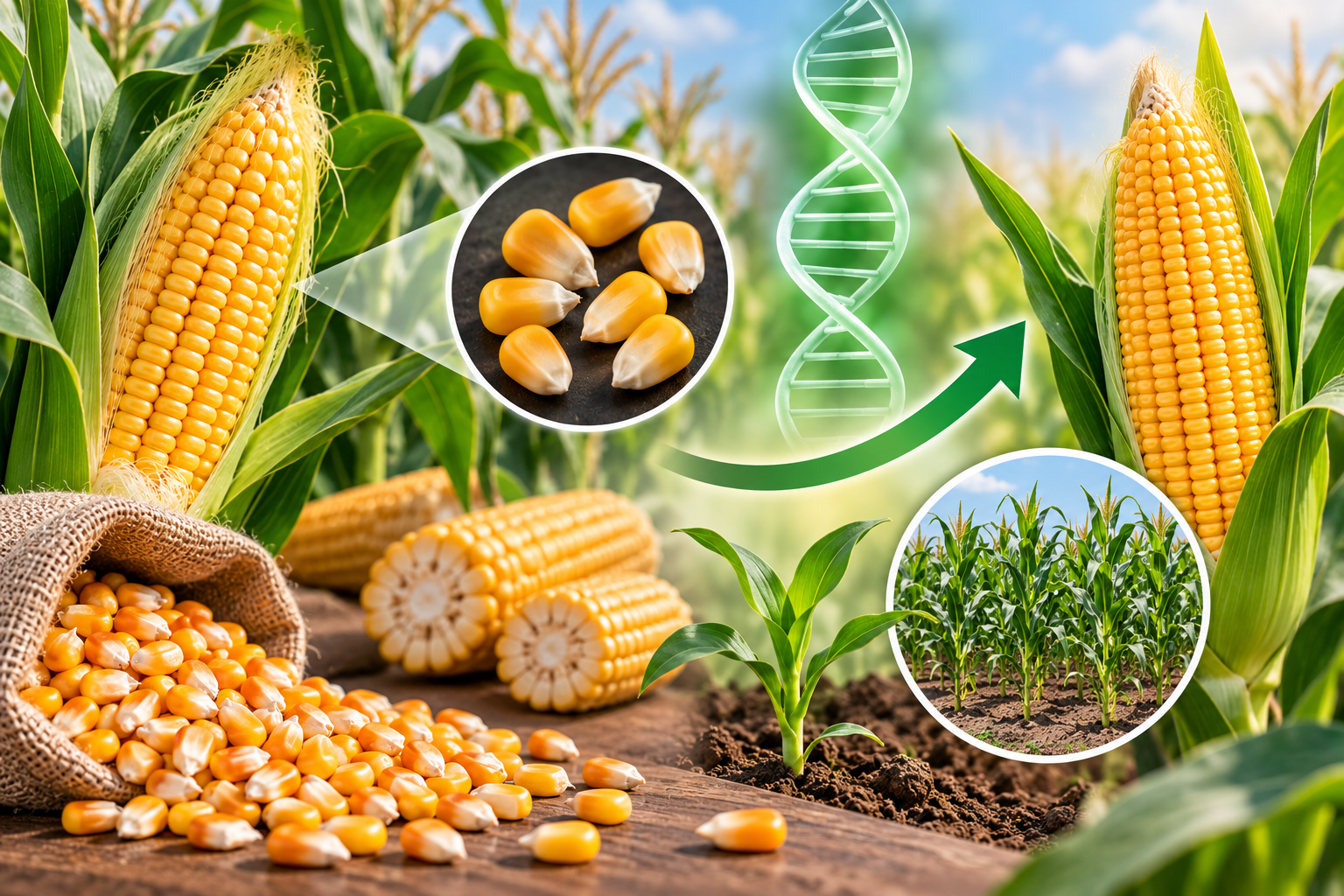
Plant breeding relies heavily on artificial selection for improving grain yield through various yield contributing traits. The selection of complex quantitative traits like maize grain yield is difficult due to less heritability and a greater influence of the environment. The present study was made using 25 maize inbred lines aimed at identifying yield-attributing traits and identifying simultaneous selection models based on discriminant functions. The expected genetic gain for grain yield when all the studied traits were included in simultaneous selection was higher (51.86) than that of selecting grain yield alone (33.96). There were four traits that made up the ideal discriminant function: grain yield, kernels per row, 100-grain weight and cob length which had 49.57 percent relative efficiency and 155.29 percent genetic advance. The relative efficiency of selection considering grain yield alone was at 106.38%, but when five (X1, X2, X3, X5, and X6) and six traits were simultaneously considered the efficiency increased to 160.37 and 162.47%. Based on the ideal discriminant function among the genotypes G17 was selected as the best inbred line with the highest selection score of 66.57 followed by G20 (65.19) and G22 (65.01). Whereas, G23 was the last with 17.05 selection score.
References
[1] O. Erenstein, M. Jaleta, K. Sonder, K. Mottaleb and B. M. Prasanna (2022). Global maize production, consumption and trade: trends and R & D implications. Food Sec., 14: 1295-1319.
[2] Anonymous (2022). Maize vision: a knowledge report. https://ficci.in/spdocument/22966/India-Maize-Summit.
[3] Anonymous (2020). Area, production and productivity of maize in India. https://iimr.icar.gov.in/india-maze-scenario.
[4] Anonymous (2021). Agriculture statistics at a glance-2021, Department of Agriculture and Farmers welfare and Department of Economics and Statistics, Governement of India, https://eands.dacnet.nic.in
[5] S. J. Dao, E. V. S. Traore, V. Gracen and Y. D. Eric (2017) Selection of drought tolerant maize hybrids using path coefficient analysis and selection index. Pakistan J. Biol. Sci., 20: 132-139.
[6] N. M. Htwe, M. Aye and C. N. Thu (2020). Selection index for yield and yield contributing traits in improved rice genotypes. Int. J. Environ. Rural Develop., 11: 86-91.
[7] L. N. Hazel (1943). The genetic basis for constructing selection indexes. Genetics, 28: 476-490.
[8] M. R. Islam, M. O. Kayess, M. Hasanuzzaman, W. M. Rahman, M. J. Uddin and M. R. Zaman (2017). Selection index for genetic improvement of wheat (Triticum aestivum L.). J. Chem. Biol. Phys. Sci., 7: 1-8.
[9] M. F. Anshori, B. S. Purwoko, I. S. Dewi, S. W. Ardie and W. B. Suwarno (2019). Selection index based on multivariate analysis for selecting doubled-haploid rice lines in lowland saline prone area. SABRAO J. Breed. Genet., 51: 161-174.
[10] N. Fadhli, M. Farid, Rafiuddin, R. Effendi, M. Azrai and M. F. Anshori (2020). Multivariate analysis to determine secondary trait in selecting adaptive hybrid maize lines under drought stress. Biodiversitas J. Biol. Divers., 21: 3617-3624.
[11] R. Padjung, M. Farid, Y. Musa, M. F. Anshori, A. Nur and A. Masnenong (2021). Drought-adapted maize line based on morphophysiological selection index. Biodiversitas J. Biol. Divers., 22: 4028-4035.
[12] R. A. Fisher (1936). The use of multiple measurements in taxonomic problems. Ann. Eugen., 7: 179-188.
[13] H. F. Smith (1936). A discriminant function for plant selection. Ann. Eugen., 7: 240- 250.
[14] A. R. Dhabolkar (1999). Elements of biometrical genetics. Concept publishing company, New Delhi, India.
[15] H. F. Robinson, R. E. Comstock and P. H. Harvey (1951). Genotypic and phenotypic correlations in corn and their implications in selection. Agron. J., 43: 282-287.
[16] J. L. Lush (1949). Heritability of quantitiave characters in farm animals. Heriditas, 35(S1): 356-375.
[17] I. Bos and P. D. Caligari (2007). Selection methods in plant breeding (2nd edition). Springer Germany.
[18] R. Venmuhil, D. Sassikumar, C. Vanniarajan and R. Indirani (2020). Selection indices for improving the selection efficiency of rice genotypes using grain quality traits. Electron. J. Plant Breed., 11: 543-549.
[19] A. D. Kalola, D. J. Parmar, G. N. Motka and P. R. Vaishnav (2018). Comparison of selection indices using different weights for biometrical characters in bajra crop. Electron. J. Plant Breed., 9: 124-134.
[20] M. Yousaf (1977). The use of selection indices in maize (Zea mays L.). In A. Muhammed, R. Aksel, R. C. Borstel (Eds) Genetic Diversity in Plants, Springer publication. pp259-367. doi: 10.1007/978-1-4684-2886-5_24.
[21] S. K. Khavari and A. M. Poor (2018). Genetic improvement of grain yield by determination of selection index in single cross hybrids of maize (Zea mays L.). Plant Genet. Res., 5: 1-18.
[22] M. J. Asghar and S. S. Mehdi (2010). Selection indices for yield and quality traits in sweet corn. Pak. J. Bot., 42: 775-789.
[23] D. S. M. Al-Obeydy, J. M. Al-Juboory and A. H. Al-Juboory (2015). Estimating of genetic parameters and construction of selection indices for exotic and endogenous maize genotypes. J. Tikrit Univ. Agri. Sci., 15: 8-17.
[24] D. S. Falconer and T. F. C. Mackay (1996). Introduction to Quantitative Genetics, 4th edition, New York, Longman Inc.
[25] Q. O. Oloyede-Kamiyo (2019). Efficiency of index-based selection methods for stem borer resistance in maize (Zea mays L.). J. Crop Sci. Biotechnol., 22: 205-211.
Downloads
Published
Issue
Section
License
Copyright (c) 2023 Author (s)

This work is licensed under a Creative Commons Attribution-NonCommercial-NoDerivatives 4.0 International License.
Copyright © The Author(s). This is an open access article distributed under the terms of the Creative Commons Attribution-NonCommercial-NoDerivatives 4.0 International License (CC BY-NC-ND 4.0), which permits unrestricted non-commercial use, distribution, and reproduction in any medium, provided the original author(s) and source are properly credited, and the work is not modified or adapted.