Genetic variability and trait association in Jhum Rice of Arunachal Pradesh, India
DOI:
https://doi.org/10.31783/elsr.2023.91135148Keywords:
correlation, genetic variation, heritability, Jhum rice, path coefficientAbstract
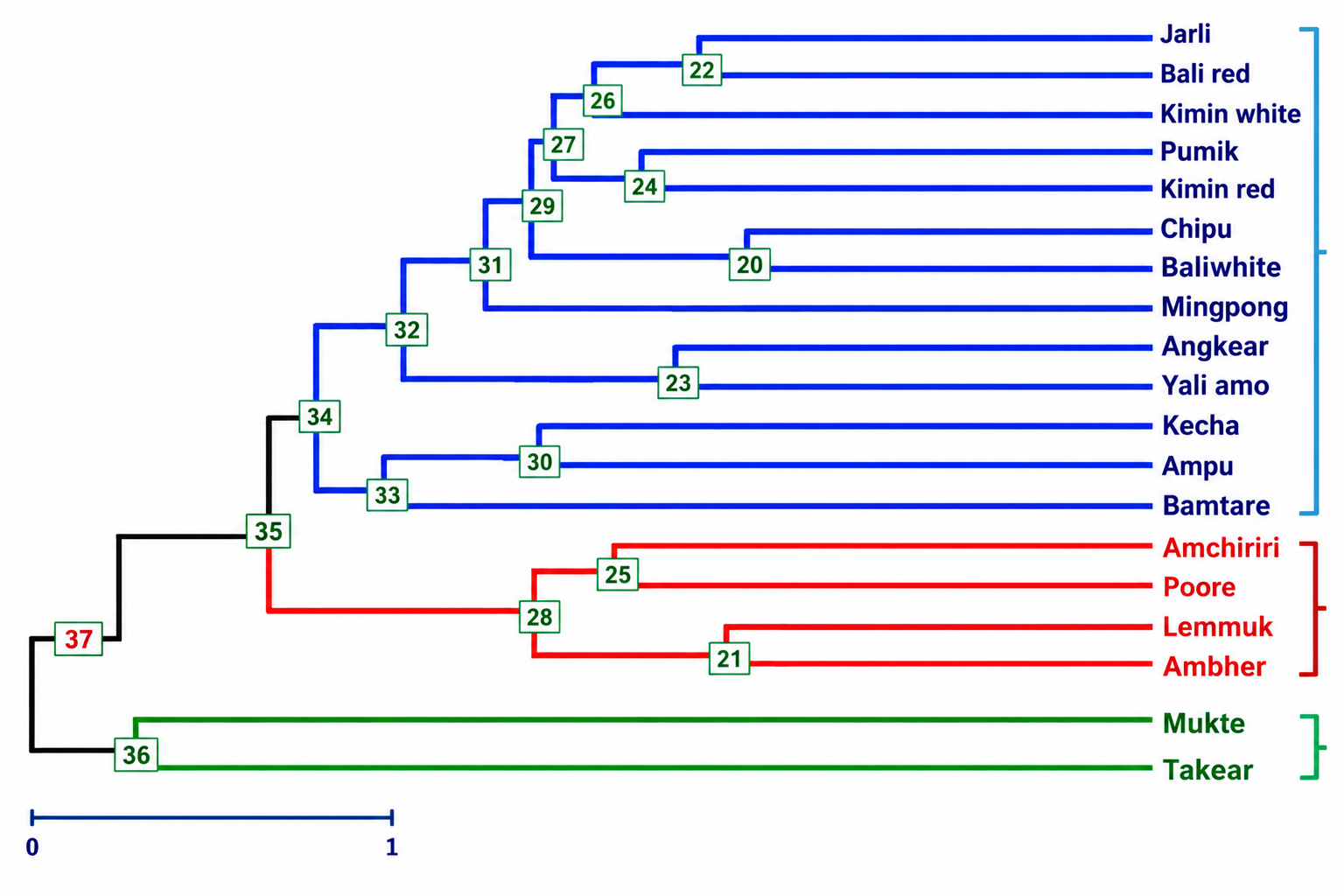
The study comprised of 19 jhum rice landraces from different parts of Arunachal Pradesh. The analysis of variance based on 14 quantitative traits revealed significant traits-wise variations across the genotypes. Based on cluster analysis the landraces were grouped into 3 distinct clusters. Principal component analysis (PCA) extracted 5 principal components (Eigen value >1) with 80.5 % of the total variance. About 60.4% of the cumulative variance was exhibited by the first three principal components. Traits like grain yield (GY), plant height (PH), primary branch per panicle (PBP), filled grain per panicle (FGP), test grain weight (TGW) and grain morphology exhibit heavy positive loadings in these first PCs. The value of the phenotypic coefficient of variation (PCV) was higher than the corresponding genotypic coefficient of variation (GCV) for most of the traits. The traits exhibits moderate to high PCV, GCV, heritability and genetic advance as a percent of the mean (GAM). High heritability couple with high GAM was exhibited by GY, TGW and PH. While moderate heritability with (GAM) was exhibited by panicle length (PnL), FGP and PBP. Except ligule length (LgL) and flag leaf width (FLW), all the traits displayed positive associations with GY. A high positive significant correlation (P≤ 0.01) was exhibited by grain width (0.716) and TGW (0.583). Path coefficient analysis revealed direct positive effects on GY by girth diameter (GD), flag leaf length (FLL), blade leaf width (BLW), filled grain number per panicle (FGP), TGW, and grain length (GL).
References
[1] D. K. Hore (2005). Rice diversity collection, conservation and management in northeastern India. Genet. Resour. Crop. Evol., 52: 1129-1140.
[2] N. Bhuyan, B. K. Bora and R. N. Sarma (2007). Genetic diversity analysis in traditional lowland rice (Oryza sativa L.) of Assam using RAPD and ISSR markers. Curr. Sci., 93: 967-972.
[3] S. Rathi and R. N. Sarma (2012). Microsatellite diversity in indigenous glutinous rice landraces of Assam. Indian J. Biotech., 11: 23-29.
[4] B. Choudhury, M. L. Khan and S. Dayanandan (2013). Genetic structure and diversity of indigenous rice (Oryza sativa) varieties in the Eastern Himalayan region of Northeast India. SpringerPlus. 2: 228. doi: 10.1186/2193-1801-2-228.
[5] T. Longvah and V. S. S. Prasad (2020). Nutritional variability and milling losses of rice landraces from Arunachal Pradesh, Northeast India. Food Chem., 318: 126385. doi: 10.1016/j.foodchem.2020.126385.
[6] S. Roy, A. Banerjee, A. Pattanayak, S. S. Roy, R. S. Rathi, A. K. Misra and S. V. Ngachan et al., (2014a). Chakhao (delicious) rice landraces (Oryza sativa L.) of North-east India: collection, conservation and characterization of genetic diversity. Plant Genetic Resour Characterization Util., 12: 264-272.
[7] S. Roy, B. C. Marndi, B. Mawkhlieng, A. Banerjee, R. M. Yadav, A. K. Misra and K. C. Bansal (2016). Genetic diversity and structure in hill rice (Oryza sativa L.) landraces from the North-Eastern Himalayas of India. BMC Genet., 17: 107. doi:10.1186/s12863-016-0414-1.
[8] M. J. Hasan, M. U. Kulsum, R. R. Majumder and U. Sarker (2020). Genotypic variability for grain quality attributes in restorer lines of hybrid rice. Genetika, 52: 973-89.
[9] S. Sharma, A. W. Schulthess, F. M. Bassi, E. D. Badaeva, K. Neumann, A. Graner and H. Özkan et al., (2021). Introducing beneficial alleles from plant genetic resources into the wheat germplasm. Biology. 10: 982. doi: 10.3390/biology10100982.
[10] S. Fukuoka, T. D. Suu, K. Ebanna, L. N. Trinh, T. Nagamine and K. Okuno (2006). Diversity in phenotypic profiles in landraces populations of Vietnamese rice: A case study of agronomic characters for conserving crop genetic diversity on farm. Genet. Resour. Crop. Evol., 53: 753–761.
[11] R. B. Rana, C. Garforth, B. Sthapit and D. Jarvis (2007). Influence of socio-economic and cultural factors in rice varietal diversity management on-farm in Nepal. Agric. Human Values, 24: 461-472.
[12] H. D. Upadhyaya, S. L. Dwivedi, M. Baum, R. K. Varshney, S. M. Udupa, C. L. Gowda and D. Hoisington et al., (2008). Genetic structure, diversity, and allelic richness in composite collection and reference set in chickpea (Cicer arietinum L.). BMC Plant Biol., 8: 106. doi: 10.1186/1471-2229-8-106.
[13] B. C. Patra and S. R. Dhua (2003). Agro-morphological diversity scenario in upland rice germplasm of Jeypore tract. Genet. Resour. Crop Evol., 50: 825-828.
[14] J. Pandey, D. C. Scheuring, J. W. Koym, J. Coombs, R. G. Novy, A. L. Thompson and D. G. Holm et al., (2021). Genetic diversity and population structure of advanced clones selected over forty years by a potato breeding program in the USA. Sci. Rep., 11: 8344. doi: 10.1038/s41598-021-87284-x.
[15] S. Verma, S. Yashveer, S. Rehman, S. Gyawali, Y. Kumar, S. Chao and A. Sarker (2021). Genetic and agro-morphological diversity in global barley (Hordeum vulgare L.) collection at ICARDA. Genet. Resour. Crop Evol., 68: 1315-1330.
[16] A. K. Yadav, A. Kumar, N. Grover, R. K. Ellur, H. Bollinedi, S. G. Krishnan and P. K. Bhowmick et al., (2021). Genome-wide association study reveals marker–trait associations for early vegetative stage salinity tolerance in rice. Plants. 10: 559. doi: 10.3390/plants10030559.
[17] W. Ketema and N. Geleta (2022). Studies on genetic variability of common bean varieties for yield and yield related traits in western Ethiopia. Int. J. Appl. Agric., 8: 41-49.
[18] U. Sarker and M. A. K. Mian (2003). Genetic variability, character association and path analysis for yield and its components in rice. J. Asiat. Soc. Bangladesh Sci., 29: 47-54.
[19] A. Kumar, A. Pandey, C. Aochen and A. Pattanayak (2015). Evaluation of genetic diversity and interrelationships of agro-morphological characters in soybean (Glycine max) Genotypes. Proc. Natl. Acad. Sci. India Sect. B Biol. Sci., 85: 397-405.
[20] M. D. Asante, K. L. Adjah and E. Annan-Afful (2019). Assessment of genetic diversity for grain yield and yield component traits in some genotypes of rice (Oryza sativa L.). J. Crop. Sci. Biotechnol., 22: 123-130.
[21] R. Beena, V. Veena, M. P. K. Jaslam, N. Nithya and V. S. Adarsh (2021). Germplasm innovation for high-temperature tolerance from traditional rice accessions of Kerala using genetic variability, genetic advance, path coefficient analysis and principal component analysis. J. Crop. Sci. Biotechnol., 24: 555-566.
[22] IRRI (2002). Standard Evaluation System for Rice. Los Banos: IRRI.
[23] SPSS IBM (2011). IBM SPSS Statistics for Windows, Version 20.0. IBM Corp, New York.
[24] X. Perrier and J. P. Jacquemoud-Collet (2006). DARwin software. Available at: https://darwin.cirad.fr/index.php.
[25] G. W. Burton and E. H. Devane (1953). Estimating heritability in tall fescue (Festuca arundanacea) from replicated clonal material. Agron. J., 45: 478-481.
[26] C. H. Hanson, H. F. Robinson and C. E. Comstock (1956). Biometrical studies of yield in segregating populations of Korean laslpedegza. Agron. J., 48: 268-272.
[27] H. W. Johnson, H. F Robinson and R. E. Comstcock (1955). Estimates of genetic and environmental variability in soybean. Agron. J., 47: 314-318.
[28] S. Wright (1923). The theory of path coefficients a reply to Niles's criticism. Genetics, 8: 239-255.
[29] M. T. Khatun, M. M. Hanafi, M. R. Yusop, M. Y. Wong, F. M. Salleh and J. Ferdous (2015). Genetic variation, heritability, and diversity analysis of upland rice (Oryza sativa L.) Genotypes based on quantitative traits. Biomed Res Int., 2015: 290861. doi: 10.1155/2015/290861.
[30] N. Singh and O. P. Verma (2018). Genetic variability, heritability and genetic advance in rice (Oryza sativa L.) under salt stressed soil. J. Pharmacogn. Phytochem., 7: 3114-3117.
[31] S. G. Ram, V. Thiruvengadam and K. K. Vinod (2007). Genetic diversity among cultivars, landraces and wild relatives of rice as revealed by microsatellite markers. J. Appl. Genet., 48: 337-345.
[32] S. Mathure, A. Shaikh, N. Renuka, K. Wakte, N. Jawali, R. Thengane and A. Nadaf (2011). Characterization of aromatic rice (Oryza sativa L.) germplasm and correlation between their agronomic and quality traits. Euphytica. 179: 237-246.
[33] A. Chakravorty, P. D. Ghosh and P. K. Sahu (2013). Multivariate analysis of phenotypic diversity of land races of rice of West Bengal. Am. J. Exp. Agric., 3: 110-123.
[34] S. Roy, R. S. Rathi, A. K. Misra, B. P. Bhatt and D. C. Bhandari (2014b). Phenotypic characterization of indigenous rice (Oryza sativa L.) germplasm collected from the state of Nagaland, India. Plant Genet. Resour. Characterisation Util., 12: 58-66.
[35] A. Kumar, A. Pandey and A. Pattanayak (2013). Evaluation of rice germplasm under Jhum cultivation in North East India and breeding for aluminium tolerance. Indian J. Genet., 73: 153-161.
[36] A. K. Sinha and P. K. Mishra (2013). Morphology based multivariate analysis of phenotypic diversity of landraces of rice (Oryza sativa L.) of Bankura district of West Bengal. J. Crop Weed, 9: 115-121.
[37] M. S. U. Ahmed, M. Khalequzzaman, M. K. Bashar and A. K. M. Shamsuddin (2016). Agro-morphological, physico-chemical, and molecular characterization of rice germplasm with similar names of Bangladesh. Rice Sci., 23: 211-218.
[38] K. A. Sanni, I. Fawole, R. G. Guei, D. K. Ojo, E. A. Somado, S. A. Ogunbayo and I. Sanchez (2008). Geographical patterns of phenotypic diversity in Oryza sativa landraces of Cote d’Ivoire, Euphytica, 160: 389-400.
[39] H. T. Clifford and W. Stephenson (1976). An introduction to numerical classification. Syst. Zool., 25: 92-95.
[40] R. G. Guei, K. A. Sanni, F. J. Abamu and I. Fawole (2005). Genetic diversity of rice (Oryza sativa L.). Agron. Afri., 5: 17-28.
[41] A. K. Sinha and P. K. Mishra (2012). Agronomic evaluation of landraces of rice (Oryza sativa L.) of Bankura district of West Bengal. Columban J. Life Sci., 13: 39-42.
[42] N. Akhtar, M. F. Nazir, A. Rabnawaz, T. Mahmood, M. E. Safdar, M. Asif and A. Rehman (2011). Estimation of heritability, correlation and path coefficient analysis in fine grain rice (Oryza sativa L.). J. Anim. Plant Sci., 21: 660-664.
[43] U. Sarker, M. T. Islam, M. G. Rabbani and S. Oba (2016). Genetic variation and interrelationships among antioxidant, quality, and agronomic traits in vegetable amaranth. Turk. J. Agric. For., 40: 526-535.
[44] I. U. Zaid, N. Zahra, M. Habib, M. K. Naeem, U. Asghar, M. Uzair and A. Latif et al., (2022). Estimation of genetic variances and stability components of yield-related traits of green super rice at multi-environmental conditions in Pakistan. Agronomy, 12: 1157. doi: 10.3390/agronomy12051157.
[45] S. C Roy and P. Shil (2020). Assessment of genetic heritability in rice breeding lines based on morphological traits and caryopsis ultrastructure. Sci. Rep., 10: 7830. doi: 10.1038/s41598-020-63976-8.
[46] H. F. Robinson. R. E. Comstock and V. H. Harvey (1949). Estimates of heritability and degree of dominance in corn. Agron. J., 41: 353-359.
[47] M. Hasan-Ud-Daula and U. Sarker (2020). Variability, heritability, character association, and path coefficient analysis in advanced breeding lines of rice (Oryza sativa L.). Genetika, 52: 711-726.
[48] D. Bhadru, V. T. Rao, Y. C. Mohan and D. Bharathi (2012). Genetic variability and diversity studies in yield and its component traits in rice (Oryza sativa L.). SABRAO J. Breed. Genet., 44: 129-137.
[49] S. R. Saha, L. Hassan, M. A. Haque, M. M. Islam and M. Rasel (2019). Genetic variability, heritability, correlation and path analyses of yield components in traditional rice (Oryza sativa L.) landraces. J. Bangladesh Agric. Univ., 17: 26-32.
[50] A. S. M. Faysal, L. Ali, M. G. Azam, U. Sarker, S. Ercisli, K. S. Golokhvast and R. A. Marc (2022). Genetic variability, character association, and path coefficient analysis in transplant Aman rice genotypes. Plants, 11: 2952. doi: 10.3390/plants11212952.
[51] S. N. Deshmukh, M. S. Basu and P. S. Reddy (1986). Genetic variability, character association and path coefcient analysis of quantitative traits in Viginia bunch varieties of groundnut. Indian J. Agric. Sci., 56: 816-821.
[52] S. Y. Dhurai, P. K. Bhati and S. K. Saroj (2014). Studies on genetic variability for yield and quality characters in rice (Oryza sativa L.) under integrated fertilizer management. Bioscan, 9: 845-848.
[53] P. Satheeshkumar and K. Saravanan (2012). Genetic variability, correlation and path analysis in rice (Oryza sativa L.). Int. J. Curr. Res., 4: 82-85.
[54] M. H. Rahman, U. Sarker and M. A. K. Main (2007). Assessment of variability of floral and yield traits; I restorer lines of rice. Ann. Bangladesh Agric., 11: 87-94.
[55] U. Sarker, M. T. Islam, M. G. Rabbani and S. Oba (2015). Variability, heritability and genetic association in green amaranth (Amaranthus tricolor). Span. J. Agric. Res., 13: 1-8.
[56] U. Sarker, M. T. Islam, M. G. Rabbani and S. Oba (2014). Genotypic variability for nutrient, antioxidant, yield and yield contributing traits in vegetable amaranth. J. Food Agric. Environ., 12: 168-174.
[57] S. Kumar, M. P. Chauhan, A. Tomar and R. K. Kasana (2018). Coefficient of variation (GCV & PCV), heritability and genetic advance analysis for yield contributing characters in rice (Oryza Sativa L .). J. Pharmacogn. Phytochem., 7: 2161-2164.
[58] M. Li, Y. Liu, C. Wang, X. Yang, D Li, X. Zhang and C. Xu et al., (2020). Identification of traits contributing to high and stable yields in different soybean varieties across three Chinese latitudes. Front. Plant Sci., 10: 1642. doi: 10.3389/fpls.2019.01642.
[59] R. K. Ganapati, M. G. Rasul, M. A. K. Mian and U. Sarker (2014). Genetic variability and character association of T-Aman rice (Oryza sativa L.). Int. J. Plant Biol. Res., 2: 1-4.
[60] A. Pratap, P. Bisen, B. Loitongbam and P. K. Singh (2018). Assessment of genetic variability for yield and yield components in rice (Oryza sativa L.) germplasms. Int. J. Bio-Resour. Stress Manag., 9: 87-92.
[61] M. Karine, D. L. Champlain, M. F. M. Noel, T. Zephirin, N. P. Alain, F. Zephyrin and B. Genevieve et al., (2014). Agro-morphological characterization of two rice (Oryza sativa L.) varieties from Japan and four NERICA varieties in an agro-ecological zone of the town of Younde (Cameroon), comparative study of their performance. Int. J. Curr. Res., 6: 9941-9946.
Downloads
Published
Issue
Section
License
Copyright (c) 2023 Author (s)

This work is licensed under a Creative Commons Attribution-NonCommercial-NoDerivatives 4.0 International License.
Copyright © The Author(s). This is an open access article distributed under the terms of the Creative Commons Attribution-NonCommercial-NoDerivatives 4.0 International License (CC BY-NC-ND 4.0), which permits unrestricted non-commercial use, distribution, and reproduction in any medium, provided the original author(s) and source are properly credited, and the work is not modified or adapted.