Fatty acid profiling through GC-MS in oil extracted from thirty varieties of groundnut grown in Gujarat, India
DOI:
https://doi.org/10.31783/elsr.2023.91149158Keywords:
bunch, groundnut, semi spreading, spreadingAbstract
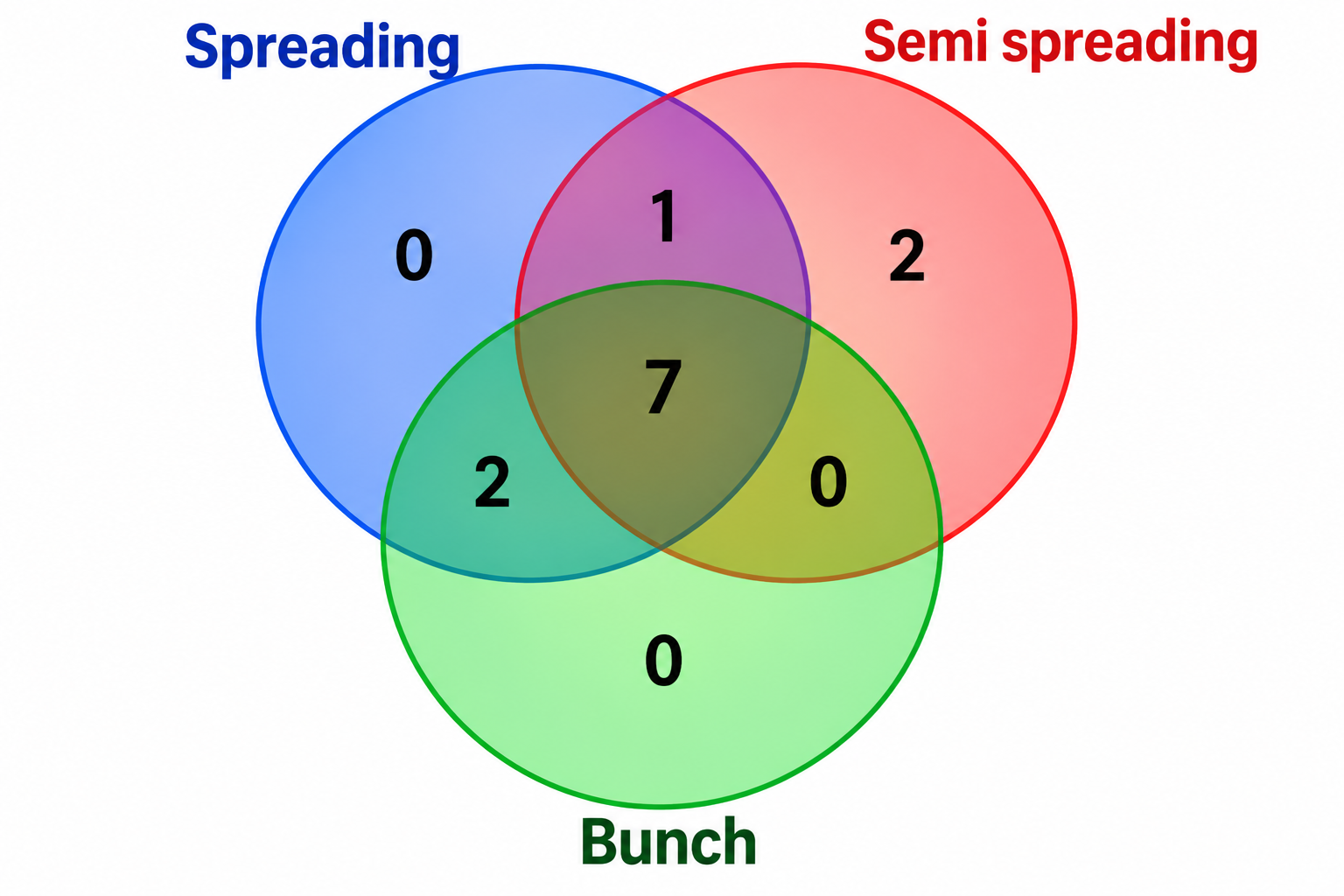
Groundnut is an important crop of Saurashtra region especially for edible oil content. The current information from this experiment focused on profiling of fatty acid, oil content, O/L ratio and MUFA/PUFA ratio. Hexane solvent extracted oil from seeds was used for the fatty acid profile by using Gas chromatography mass spectrometry [GC-MS]. The data showed oil content higher in semi-spreading type varieties with the range of 40.9 to 54.92 % and difference for oil content and fatty acids was found to be statistically significant the unsaturated fatty acids were detected in large amount, whereas saturated were found in small amount in all varieties with irrespective of types. The range of fatty acids varied from 6.83-14.14% of palmitic acid, 2.27-5.25% of stearic acid, 0.97-2.11% of arachidic acid, 1.37-3.54% of behenic acid, 0.45-1.30% of lignoceric acid, 0.03-0.17% of palmitoleic acid, 39.22-82.32% of oleic acid, 0.45-1.79% of gadoleic acid,0.07-0.51% of linolenic acid and 2.26-38.73% of linoleic acid in thirty groundnut varieties comprising 10 each of spreading, semi spreading and bunch type. The oleic to linoleic ratio and MUFA/PUFA ratios found very high in variety GIRNAR-4 and GIRNAR-5 of semi spreading.
References
[1] M. Kratz, P. Cullen, F. Kannenberg, A. Kassner, M. Fobker, P. M. Abuja and G. Assmann et al., (2002). Effects of dietary fatty acids on the composition and oxidizability of low-density lipoprotein. Eur. J. Clin. Nutr., 56: 72-81.
[2] S. K. Bera, J. H. Kamdar, S. V. Kasundra, S. V. Patel, M. D. Jasani, A. K. Maurya and P Dash et al., (2019). Steady expression of high oleic acid in peanut bred by marker-assisted backcrossing for fatty acid desaturase mutant alleles and its effect on seed germination along with other seedling traits. PloS One, 14: e0226252. doi: 10.1371/ journal.pone.0226252.
[3] S. F. O’keefe, V. A. Wiley and D. A. Knauft (1993). Comparison of oxidative stability of high‐and normal‐oleic peanut oils. J. Am. Oil Chem. Soc., 70: 489-492.
[4] S. K. Bera, J. H. Kamdar, S. V. Kasundra, P. Dash, A. K. Maurya, M. D. Jasani and A. B. Chandrashekar et al., (2018). Improving oil quality by altering levels of fatty acids through marker-assisted selection of ahfad2 alleles in peanut (Arachis hypogaea L.). Euphytica. 214: 162. doi: 10.1007/s10681-018-2241-0.
[5] S. Akhtar, N. Khalid, I. Ahmed, A. Shahzad and H. A. R. Suleria (2014). Physicochemical characteristics, functional properties, and nutritional benefits of peanut oil: a review. Crit. Rev. Food Sci. Nutr., 54: 1562-1575.
[6] L. Gulluoglu, H. Bakal, B. Onat, A. El Sabagh and H. Arioglu (2016). Characterization of peanut (Arachis hypogaea L.) seed oil and fatty acids composition under different growing season under mediterranean environment. J. Exp. Biol. Agric. Sci., 4: 564-571.
[7] S. S. Arya, A. R. Salve and S Chauhan (2016). Peanuts as functional food: a review. J. Food Sci. Technol., 53: 31-41.
[8] J. B. Misra and R. S. Mathur (1998). A simple and economical procedure for transmethylation of fatty acids in groundnut oil for analysis by GLC. Int. Arachis Newslett., 18: 40-42.
[9] S. K. Bishi, K. Lokesh, M. K. Mahatma, N. Khatediya, S. M. Chauhan and J. B. Misra (2015). Quality traits of Indian peanut cultivars and their utility as nutritional and functional food. Food Chem., 167: 107-114.
[10] G. S. Mandal, A. Das, D. Dutta, B. Mondal and B. K. Senapati (2017). Genetic variability and character association studies in groundnut (Arachis hypogaea L). Scholars J. Agric. Vet. Sci., 4: 424-433.
[11] S. Sharma, K. S. Brar and S. K. Sandhu (2019). Profiling of groundnut (Arachis hypogaea L.) genotypes for seed quality traits. Indian J. Plant Genet. Resou., 32: 72-79.
[12] F. N. Chaudhary, D. Hossain, M. Hosen and S. Rahman (2015). Comparative study on chemical composition of five varieties of groundnut (Arachis hypogaea L). World J. Agric. Sci., 11: 247-254.
[13] B. Nawade, T. C. Bosamia, R. Thankappan, A. L. Rathnakumar, A. Kumar, J. R. Dobaria and G. P. Mishra (2016). Insights into the Indian peanut genotypes for ahFAD2 gene polymorphism regulating its oleic and linoleic acid fluxes. Front. Plant Sci., 7: 1271. Doi: 10.3389/fpls.2016.01271.
[14] E. C. Shin, R. B. Pegg, R. D. Phillips and R. R. Eitenmiller (2010). Commercial runner peanut cultivars in the USA: Fatty acid composition. Eur. J. Lipid Sci. Technol., 112: 195-207.
[15] J. M. Martínez-Rivas, P. Sperling, W. Lühs and E Heinz (1998). Isolation of three different microsomal oleate desaturase cDNA clones from sunflower. Expression studies in normal type and high-oleic mutant. In: Sánchez J, Cerdá-Olmedo E, Martínez-Force E (eds) Advances in plant lipid research. Secretariado de Publicaciones de la Universidad de Sevilla, Seville, Spain, pp137-139.
[16] K. M. Moore and D. A. Knauft (1989). The inheritance of high oleic acid in peanut. J. Hered., 80: 252-253.
[17] R. S. Jonnala, N. T. Dunford and K. E. Dashiell (2005). New high‐oleic peanut cultivars grown in the Southwestern United States. J. Am. Oil Chem. Soc., 82: 125-128.
[18] P. C. Andersen and D. W. Gorbet (2002). Influence of year and planting date on fatty acid chemistry of high oleic acid and normal peanut genotypes. J. Agric. Food Chem., 50: 1298-1305.
[19] D. F. Brown, C. M. Cater, K. F. Mattil and J. G. Darroch (1975). Effect of variety, growing location and their interaction on the fatty acid composition of peanuts. J. Food Sci., 40: 1055-1060.
[20] Y. Shasidhar, M. K. Vishwakarma, M. K. Pandey, P. Janila, M. T. Variath, S. S. Manohar and S. N. Nigam et al., (2017). Molecular mapping of oil content and fatty acids using dense genetic maps in groundnut (Arachis hypogaea L.). Front. Plant Sci., 8: 794. doi: 10.3389/fpls.2017.00794.
[21] M. Patel, S. Jung, K. Moore, G. Powell, C. Ainsworth and A. Abbott (2004). Higholeate peanut mutants result from a MITE insertion into the FAD2 gene. Theor. Appl. Genet., 108: 1492-1502.
[22] E. G. Hammond, D. Duvick, T. Wang, H. Dodo and R. N. Pittman (1997). Survey of the fatty acid composition of peanut (Arachis hypogaea) germplasm and characterization of their epoxy and eicosanoic acids. J. Am. Oil Chem. Soc., 74: 1235-1239.
Downloads
Published
Issue
Section
License
Copyright (c) 2023 Author (s)

This work is licensed under a Creative Commons Attribution-NonCommercial-NoDerivatives 4.0 International License.
Copyright © The Author(s). Effective from 1 July 2026, articles published in Emergent Life Sciences Research (ELSR) are distributed under the Creative Commons Attribution 4.0 International License (CC BY 4.0), which permits use, sharing, distribution, reproduction, and adaptation in any medium or format, provided that appropriate credit is given to the original author(s) and the source, a link to the license is provided, and any changes made are indicated.
Articles published before 1 July 2026 remain subject to the license applicable at the time of their original publication, including the Creative Commons Attribution-NonCommercial-NoDerivatives 4.0 International License (CC BY-NC-ND 4.0), where applicable.