Nanotechnology in agriculture: Prospect, opportunities and challenges
DOI:
https://doi.org/10.31783/elsr.2023.91164176Keywords:
agriculture, nanoformulation, nanoparticles, nanosensors, nanotechnologyAbstract
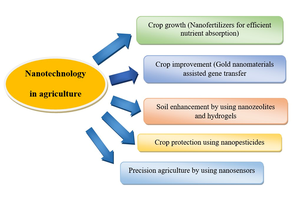
Ensuring food security in emerging nations is extremely difficult due to the low agricultural sector output, depletion of natural resources, significant post-farming losses, lack of value addition, and rapid population expansion. Researchers are working to implement novel breeding technologies to improve the supply and close the gap between food supply and demand. Uses of conventional farming technologies are not so much productive and effective as they are time consuming and labor intensive. This necessitates the use of nanotechnology that has the potency to massively influence the agriculture industry by reducing the negative effects of conventional farming techniques on the surroundings and wellness of humanity, boosting farming capacity, sustainability, and food safety, (as enforced by the anticipated rise of global demography) and fostering communal and economic parity. Nanotechnological meddling in farming has promising futures for enhancing nutrient use efficiency via the use of nanoformulations of fertilizers. Further, it knocks out the farming output hurdles through the blending of biotechnology with nanoscience and targeted and effective vigilance against external pressures. Moreover, it assists scientists in comprehending the molecular-level mechanisms of host-parasite interactions, thereby facilitating the development of new pesticides and carriers that improve efficacy and reduce toxicity. Additionally, nanosensors can be employed to monitor soil quality for agricultural practices. Furthermore, this approach can serve as a milestone in addressing the present challenges faced in the agriculture sector. However, more research is necessary to address the safety and health issues posed by the technology.
References
[1] J. A. Duro, C. Lauk, T. Kastner, K. H. Erb and H. Haberl (2020). Global inequalities in food consumption, cropland demand and land-use efficiency: A decomposition analysis. Glob. Environ. Change, 64: 102124. doi: 10.1016/j.gloenvcha.2020.102124.
[2] R. Prasad, A. Bhattacharyya and Q. D. Nguyen (2017). Nanotechnology in sustainable agriculture: recent developments, challenges, and perspectives. Front. Microbiol., 8: 1014. doi: 10.3389/fmicb.2017.01014.
[3] K. Neme, A. Nafady, S. Uddin and Y. B. Tola (2021). Application of nanotechnology in agriculture, postharvest loss reduction and food processing: Food security implication and challenges. Heliyon, 7: e08539. doi: 10.1016/j.heliyon.2021.e08539.
[4] S. A. Ashraf, A. J. Siddiqui, O. E. Abd Elmoneim, M. I. Khan, M. Patel, M. Alreshidi and M. Adnan et al., (2021). Innovations in nanoscience for the sustainable development of food and agriculture with implications on health and environment. Sci. Total Environ., 768: 144990. doi: 10.1016/j.scitotenv.2021.144990.
[5] V. Bulovic, A. Mandell and A. Perlman (2004). Molecular memory device. US 20050116256 A, 1, 388.
[6] V. Pokropivny, R. Lohmus, I. Hussainova, A. Pokropivny and S. Vlassov (2007). Introduction to nanomaterials and nanotechnology. University of Tartu.
[7] R. Prasad (2014). Synthesis of silver nanoparticles in photosynthetic plants. J. Nanopart., doi: 10.1155/2014/963961 2014.
[8] S. S. Mukhopadhyay (2014). Nanotechnology in agriculture: prospects and constraints. Nanotechnol. Sci. Appl., 7: 63-71. doi:10.2147/NSA.S39409.
[9] N. Joudeh and D. Linke (2022). Nanoparticle classification, physicochemical properties, characterization, and applications: a comprehensive review for biologists. J. Nanobiotechnology, 20: 262. doi: 10.1186/s12951-022-01477-8.
[10] E. J. Cho, H. Holback, K. C. Liu, S. A. Abouelmagd, J. Park and Y. Yeo (2013). Nanoparticle characterization: state of the art, challenges, and emerging technologies. Mol. Pharm., 10: 2093-2110.
[11] S. A. M. Ealia and M. P. Saravanakumar (2017). A review on the classification, characterisation, synthesis of nanoparticles and their application. IOP Conf. Ser. Mater. Sci. Eng., doi: 10.1088/1757-899x/263/3/032019.
[12] S. Machado, J. G. Pacheco, H. P. A. Nouws, J. T. Albergaria and C. Delerue-Matos (2015). Characterization of green zero-valent iron nanoparticles produced with tree leaf extracts. Sci. Total Environ., 533: 76-81.
[13] K. Pan and Q. Zhong (2016). Organic nanoparticles in foods: fabrication, characterization, and utilization. Annu. Rev. Food Sci. Technol., 7: 245-266.
[14] M. Gujrati, A. Malamas, T. Shin, E. Jin, Y. Sun and Z. R. Lu (2014). Multifunctional cationic lipid-based nanoparticles facilitate endosomal escape and reduction-triggered cytosolic siRNA release. Mol. Pharm., 11: 2734-2744.
[15] I. Khan, K. Saeed and I. Khan (2019). Nanoparticles: Properties, applications and toxicities. Arab. J. Chem., 12: 908-931.
[16] K.-Q. Lu, Q. Quan, N. Zhang and Y.-J. Xu (2016). Multifarious roles of carbon quantum dots in heterogeneous photocatalysis. J. Energy Chem., 25: 927-935.
[17] M. Salavati-Niasari, F. Davar and N. Mir (2008). Synthesis and characterization of metallic copper nanoparticles via thermal decomposition. Polyhedron, 27: 3514-3518.
[18] C. Y. Tai, C. T. Tai, M. H. Chang and H. S. Liu (2007). Synthesis of magnesium hydroxide and oxide nanoparticles using a spinning disk reactor. Ind. Eng. Chem. Res., 46: 5536-5541.
[19] S. Gupta and M. Tripathi (2012). An overview of commonly used semiconductor nanoparticles in photocatalysis. High Energy Chem., 46: 1-9.
[20] Y. Wang and Y. Xia (2004). Bottom-up and top-down approaches to the synthesis of monodispersed spherical colloids of low melting-point metals. Nano lett., 4: 2047-2050.
[21] S. Iravani (2011). Green synthesis of metal nanoparticles using plants. Green Chem., 13: 2638-2650.
[22] P. Garrigue, M. H. Delville, C. Labrugère, E. Cloutet, P. J. Kulesza, J. P. Morand and A. Kuhn (2004). Top−down approach for the preparation of colloidal carbon nanoparticles. Chem. Mater., 16: 2984-2986.
[23] S. Mann, S. L. Burkett, S. A. Davis, C. E. Fowler, N. H. Mendelson, S. D. Sims and N. T. Whilton et al., (1997). Sol gel synthesis of organized matter. Chem. Mater., 9: 2300-2310.
[24] H. K. Kammler, L. Mädler and S. E. Pratsinis (2001). Flame synthesis of nanoparticles. Chem. Eng. Technol., 24: 583-596.
[25] P. Kuppusamy, M. M. Yusoff, G. P. Maniam and N. Govindan (2016). Biosynthesis of metallic nanoparticles using plant derivatives and their new avenues in pharmacological applications–An updated report. Saudi Pharma. J., 24: 473-484.
[26] R. Prasad, V. Kumar and K. S. Prasad (2014). Nanotechnology in sustainable agriculture: present concerns and future aspects. Afr. J. Biotechnol., 13: 705-713.
[27] A. C. Ion, I. Ion, A. Culetu and D. Gherase (2010). Carbon-based nanomaterials: Environmental applications. Univ Politehn Bucharest, 38:129-132.
[28] D. Mittal, G. Kaur, P. Singh, K. Yadav and S. A. Ali (2020). Nanoparticle-based sustainable agriculture and food science: Recent advances and future outlook Front. Nanotechnol., 2: 579954. doi: 10.3389/fnano.2020.579954.
[29] R. Raliya, V. Saharan, C. Dimkpa and P. Biswas (2017). Nanofertilizer for precision and sustainable agriculture: current state and future perspectives. J. Agric. Food Chem., 66: 6487-6503.
[30] S. Babu, R. Singh, D. Yadav, S.S. Rathore, R. Raj, R. Avasthe and S.K. Yadav et al., (2022). Nanofertilizers for agricultural and environmental sustainability. Chemosphere, 292: 133451. doi: 10.1016/j.chemosphere.2021.133451.
[31] L. R. Khot, S. Sankaran, J. M. Maja, R. Ehsani and E. W. Schuster (2012). Applications of nanomaterials in agricultural production and crop protection: a review. Crop Prot., 35: 64-70.
[32] D. Wang, N. B. Saleh, A. Byro, R. Zepp, E. Sahle-Demessie, T. P. Luxton and K. T. Ho et al., (2022). Nano-enabled pesticides for sustainable agriculture and global food security. Nature Nanotechnol., 17: 347-360.
[33] A. Bratovcic, W. M. Hikal, H. A. Said-Al Ahl, K. G. Tkachenko, R. S. Baeshen, A. S. Sabra and H. Sany (2021). Nanopesticides and nanofertilizers and agricultural development: Scopes, advances and applications. Open J. Ecol., 11: 301-316.
[34] S. Beegum and S. Das (2022). Nanosensors in agriculture. In: Agricultural Nanobiotechnology. Woodhead Publishing. pp465-478, doi: 10.1016/B978-0-323-91908-1.00012-2.
[35] D. S. Shaw and K. C. Honeychurch (2022). Nanosensor applications in plant science. Biosensors, 12: 675. doi: 10.3390/bios12090675.
[36] A. K. Srivastava, A. Dev and S. Karmakar (2018). Nanosensors and nanobiosensors in food and agriculture. Environ. Chem. Lett., 16: 161-182.
[37] P. Malik, V. Katyal, V. Malik, A. Asatkar, G. Inwati and T. K. Mukherjee (2013). Nanobiosensors: concepts and variations. Int. Scholarly Res. Notices, 327435. doi: 10.1155/2013/327435.
[38] M. S. Johnson, S. Sajeev and R. S. Nair (2021). Role of Nanosensors in agriculture. In Proceedings of the 2021 International Conference on Computational Intelligence and Knowledge Economy (ICCIKE), Dubai, United Arab Emirates, 17–18 March 2021; pp58-63.
[39] The Royal Society (2009). Reaping the benefits: science and the sustainable intensification of global agriculture. The Royal Society, London
[40] M. Kaushal and S. P. Wani (2017). Nanosensors: frontiers in precision agriculture. In: Prasad, R., Kumar, M., Kumar, V. (eds.) Nanotechnology: An Agricultural Paradigm, pp279-291. Springer, Singapore.
[41] L. F. Fraceto, R. Grillo, G. A. de Medeiros, V. Scognamiglio, G. Rea and C. Bartolucci (2016). Nanotechnology in agriculture: which innovation potential does it have? Front. Environ. Sci., 4: doi: 10.3389/fenvs.2016.00020.
[42] E. Mastronardi, P. Tsae, X. Zhang, C. Monreal and M. C. DeRosa (2015). Strategic role of nanotechnology in fertilizers: potential and limitations. In: Rai M, Ribeiro C, Mattoso L, Duran N (eds) Emerging nanotechnologies in agriculture. Verlag, New York, NY, pp25-68.
[43] M. D. Nuruzzaman, M. M. Rahman, Y. Liu and R. Naidu (2016). Nanoencapsulation, nano-guard for pesticides: a new window for safe application. J. Agric. Food Chem., 64: 1447-1483.
[44] Y. Shang, M. K. Hasan, G. J. Ahammed, M. Li, H. Yin and J. Zhou (2019). Applications of nanotechnology in plant growth and crop protection: a review. Molecules, 24: 2558. doi: 10.3390/molecules24142558.
[45] M. Rai and A. Ingle (2012). Role of nanotechnology in agriculture with special reference to management of insect pests. Appl. Microbiol. Biotechnol., 94: 287-293.
[46] A. Servin, W. Elmer, A. Mukherjee, R. De la Torre-Roche, H. Hamdi and J. C. White et al., (2015). A review of the use of engineered nanomaterials to suppress plant disease and enhance crop yield. J. Nanopart. Res., 17: 92. doi: 10.1007/s11051-015-2907-7.
[47] K. Lyons (2010). Nanotechnology: transforming food and the environment. Food first backgrounder, 16: 1-4.
[48] V. Ghormade, M. V. Deshpande and K. M. Paknikar (2011). Perspectives for nano-biotechnology enabled protection and nutrition of plants. Biotechnol. Adv., 29: 792-803.
[49] T. R. Shojaei, M. A. M. Salleh, M. Tabatabaei, H. Mobli, M. Aghbashlo, S. A. Rashid and T. Tan (2019). Applications of nanotechnology and carbon nanoparticles in agriculture. In: S. A. Rashid, R. N. I. R. Othman, M. Z. Hussein (Eds.), Synthesis, technology and applications of carbon nanomaterials. Elsevier, pp247-277. doi: 10.1016/B978-0-12-815757-2.00011-5.
[50] H. N. Cheng, K. T. Klasson, T. Asakura and Q. Wu (2016). Nanotechnology in agriculture. In Nanotechnology: Delivering on the Promise. ACS Symp. Ser., 1224: 233-242.
[51] P. Singh and A. P. Singh (2021). Nanomaterials in Soil Health Management and Crop Production: Potentials and Limitations. In: O. V. Kharissova, L. M. T. Martínez, B. I. Kharisov (eds) Handbook of Nanomaterials and Nanocomposites for Energy and Environmental Applications. Springer, Cham.
[52] A. Dubey and D. R. Mailapalli (2016). Nanofertilisers, nanopesticides, nanosensors of pest and nanotoxicity in agriculture. In: Lichtfouse, E. (eds) Sustainable Agriculture Reviews. Sustainable Agriculture Reviews, Springer, Cham, pp307-330.
[53] J. H. Priester, Y. Ge, R. E. Mielke, A. M. Horst, S. C. Moritz, K. Espinosa and J. Gelb et al., (2012). Soybean susceptibility to manufactured nanomaterials with evidence for food quality and soil fertility interruption. Proc. Natl. Acad. Sci. U S A., 109: 14734-14735.
[54] G. Pandey, S. Tripathi, S. Bajpai and M. Kamboj (2023). Approaches, Challenges, and Prospects of Nanotechnology for Sustainable Agriculture. In: Fernandez-Luqueno, F., Patra, J.K. (eds) Agricultural and Environmental Nanotechnology. Interdisciplinary Biotechnological Advances. Springer, Singapore. pp83-103.
Downloads
Published
Issue
Section
License
Copyright (c) 2023 Author (s)

This work is licensed under a Creative Commons Attribution-NonCommercial-NoDerivatives 4.0 International License.
Copyright © The Author(s). This is an open access article distributed under the terms of the Creative Commons Attribution-NonCommercial-NoDerivatives 4.0 International License (CC BY-NC-ND 4.0), which permits unrestricted non-commercial use, distribution, and reproduction in any medium, provided the original author(s) and source are properly credited, and the work is not modified or adapted.