Variability assessment and trait relationships among confectionery sunflower inbreds Balpreet Kaur, Vineeta Kaila
DOI:
https://doi.org/10.31783/elsr.2023.920112Keywords:
clustering, confectionery, correlation, sunflowerAbstract
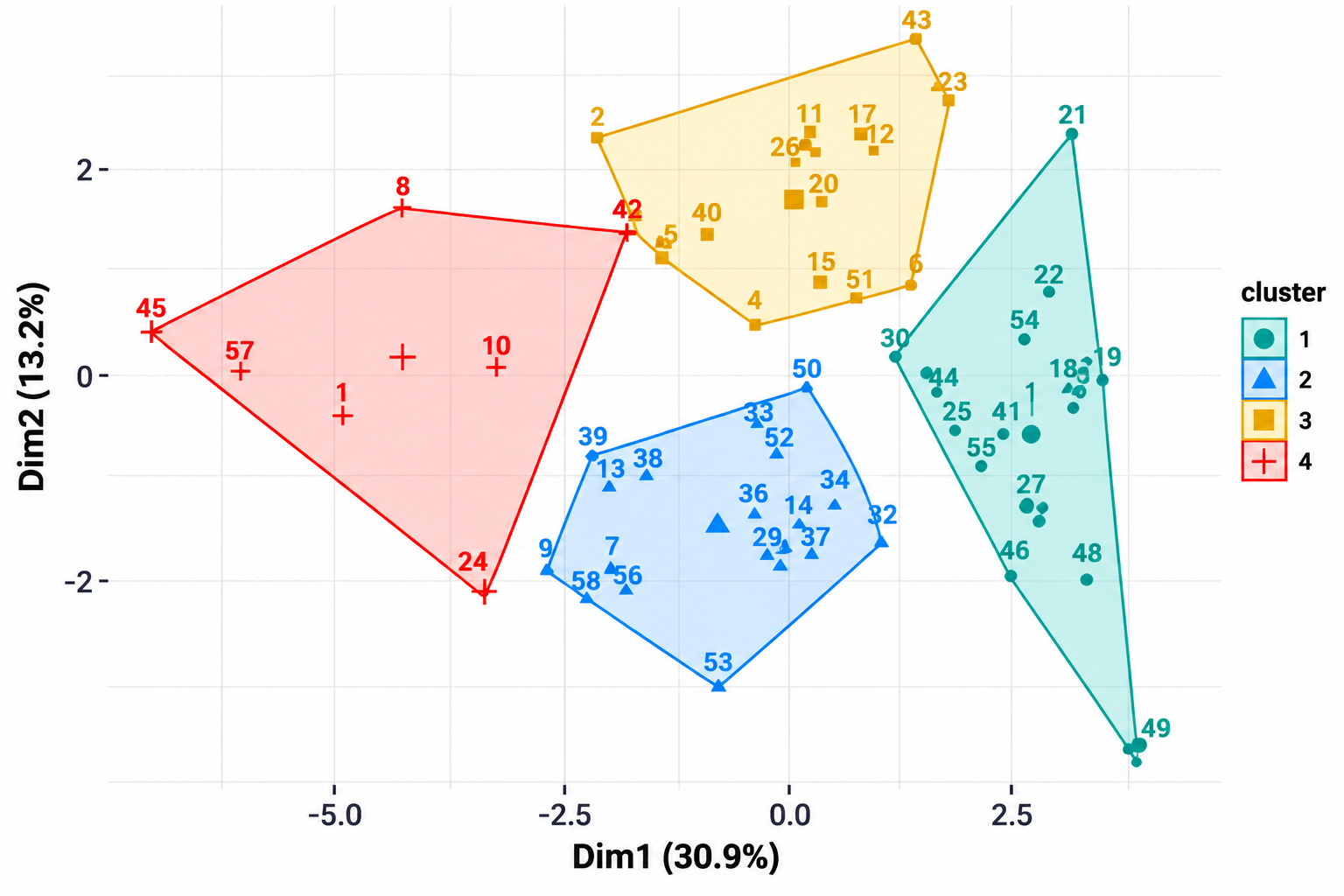
Fifty-eight sunflower inbreds were evaluated for seventeen morphological parameters during spring 2019 and 2020 to understand the relationships among different traits for facilitating the indirect selection of superior confectionery sunflower inbreds. For confectionery inbreds, seed length is an important trait for making selections since seed length exhibited a negative correlation with seed volume weight which is highly correlated with oil content. Thus inbreds having higher seed length had lower oil content which is a desirable trait for confectionery sunflowers. The investigation also helped in the identification of sunflower inbred EC734798 as superior for confectionery purposes based on principal component analysis and EC734792, EC734806, EC734808, EC734831, EC734866, EC734870 and EC734790 were identified as superior inbreds based on cluster analysis. Furthermore, inbreds EC734810, EC734816I, EC734817II, EC734837, and EC734867 can be utilized for improving seed length parameters among confectionery sunflowers.
References
[1] P. T. Basavarajappa (2017). Production and marketing dimensions of sunflower in Gadag district. Int. J. Res. Anal. Rev., 4: 21-30.
[2] A. Fernandez-Cuesta, A. Nabloussi, J. M. Fernandez-Martinez and L. Velasco (2012). Tocopherols and phytosterols in sunflower seeds for the human food market. Grasas y Aceites, 63: 321-327.
[3] N. Hladni, S. Terzic, M. Mutavdzic, M. Zoric (2017). Classification of confectionary sunflower genotypes based on morphological characters. J. Agric. Sci., 155: 1594-1609.
[4] G. Savii and G. Nedelea (2012). Estimation of interrelationships among different yield traits in winter wheat. J. Horti. Fores. Biotechnol., 16: 115-118.
[5] V. T. Rao (2013). Association analysis in sunflower (Helianthus annuus L.). Int. J. Appl. Biol. Pharma. Technol., 4: 1-4.
[6] Z. Z. Ullah, H. A. Sadaqat, M. H. N. Tahir and B. Sadia (2013). Correlation and path coefficient analysis of various traits in sunflower (Helianthus annuus L.). J. Glob. Innov. Agric. Soc. Sci., 1: 5-8.
[7] M. Dominguez, S. Herrera and J. H. González (2021). Assessment of phenotypic variability among EEA INTA Pergamino sunflower lines: Its relationship with the grain yield and oil content. Oilseeds Fat Crops Lip., 28: 33. doi: 10.1051/ocl/2021021.
[8] R. Sasikala, G. R. Christina, P. S. Reddy, P. L. Viswanathan and S. Manonmani (2020). Multivariate analysis in sunflower genotypes for yield associated traits. Electron. J. Plant Breed., 11: 1116-1119.
[9] R. Chandirkala and N.Manivannan (2015). Genetic diversity among sunflower genotypes. Electron. J. Plant Breed., 5: 577-80.
[10] L. F. Camarano, J. C. Lázaro, M. B. Edward and E. Borges (2010). Genotypic divergence among sunflower populations. Pesq. Agropec. Trop., 40: 36-44.
[11] V. K. Baraiya, P. K. Jagtap, D. N. Hadiya and H. R. Patel (2018). Genetic divergence in sunflower (Helianthus annuus L.). Int. J. Chem. Stud., 6: 567-570.
[12] U. P. Narkhede and K. P. Adhiya (2014). Evaluation of modified K-means clustering algorithm in crop prediction. Int. J. Adv. Comput. Res., 4: 799-807.
[13] F. E. Harrell (2019). Package Hmisc. Hmisc Harrell Misc.
[14] S. Kim (2015). ppcor: an R package for a fast calculation to semi-partial correlation coefficients. Commun. Stat. Appl. Methods., 22: 665-674.
[15] A. Kassambara and F. Mundt (2020). Factoextra: extract and visualize the results of multivariate data analyses. https://cran.r-project.org/package=factoextra.
[16] S. Lê, J. Josse and F. Husson (2008). FactoMineR: An R package for multivariate analysis. J. Stat. Software, 25: 1-18. doi: 10.18637/jss.v025.i01.
[17] A. Miji, I. Liovic, Z. Zdunic, S. Maric, A. M. Jeromela and M. Jankulovska (2009). Quantitative analysis of oil yield and its components in sunflower (Helianthus annuus L.). Romanian Agric. Res., 26: 41-46.
[18] S. Neelima, K. A. Kumar, K. Venkataramanamma and Y. Padmalatha (2016). Genetic variability and genetic diversity in sunflower. Electron. J. Plant Breed., 7: 703-707.
[19] M. Ghias, F. Ahmad, H. Sajida, Q. Rizwana and A. Muhammad (2018). Genetic variability studies for economically important traits in sunflower (Helianthus annuus L.). Curr. Inves. Agric. Curr. Res., 2: 135.
[20] H. Razzaq, M. H. N. Tahir and H. A. Sadaqat (2014). Genetic variability in sunflower (Helianthus annuus L.) for achene yield and morphological characters. Int. J. Sci. Nat., 5: 669-676.
[21] M. Kholghi, I. Bernousi, R. Darvishzadeh and A. Pirzad (2011). Correlation and path-coefficient analysis of seed yield and yield related trait in Iranian confectionery sunflower populations. Afr. J. Biotechnol., 10: 13058-13063.
[22] S. Neelima, K. G. Parameshwarappa, Y. Kumar and Praveen (2012). Association and path analysis for seed yield and component characters in sunflower (Helianthus annuus L.). Electron. J. Plant Breed., 3: 716-721.
[23] V. T. Rao (2013). Association analysis in sunflower (Helianthus annuus L.). Int. J. Appl. Biol. Pharma. Technol., 4: 1-4.
[24] H. Chikkadevaiah, H. L. Sujatha, C. Nandini (2002). Correlation and Path analysis in sunflower. Helia, 25: 109-118.
[25] M. Ghaffari (2004). Use of Principal component analysis method for selection of superior three way cross hybrids in sunflower. Seed Plant J., 19: 513-527.
[26] M. Arshad, M. A. Khan, S. A. Jadoon, A. S. Mohmand (2010). Factor analysis in sunflower (Helianthus annuus L.) to investigate desirable hybrids. Pak. J. Bot., 42: 4393-4402.
Downloads
Published
Issue
Section
License
Copyright (c) 2023 Author (s)

This work is licensed under a Creative Commons Attribution-NonCommercial-NoDerivatives 4.0 International License.
Copyright © The Author(s). This is an open access article distributed under the terms of the Creative Commons Attribution-NonCommercial-NoDerivatives 4.0 International License (CC BY-NC-ND 4.0), which permits unrestricted non-commercial use, distribution, and reproduction in any medium, provided the original author(s) and source are properly credited, and the work is not modified or adapted.