
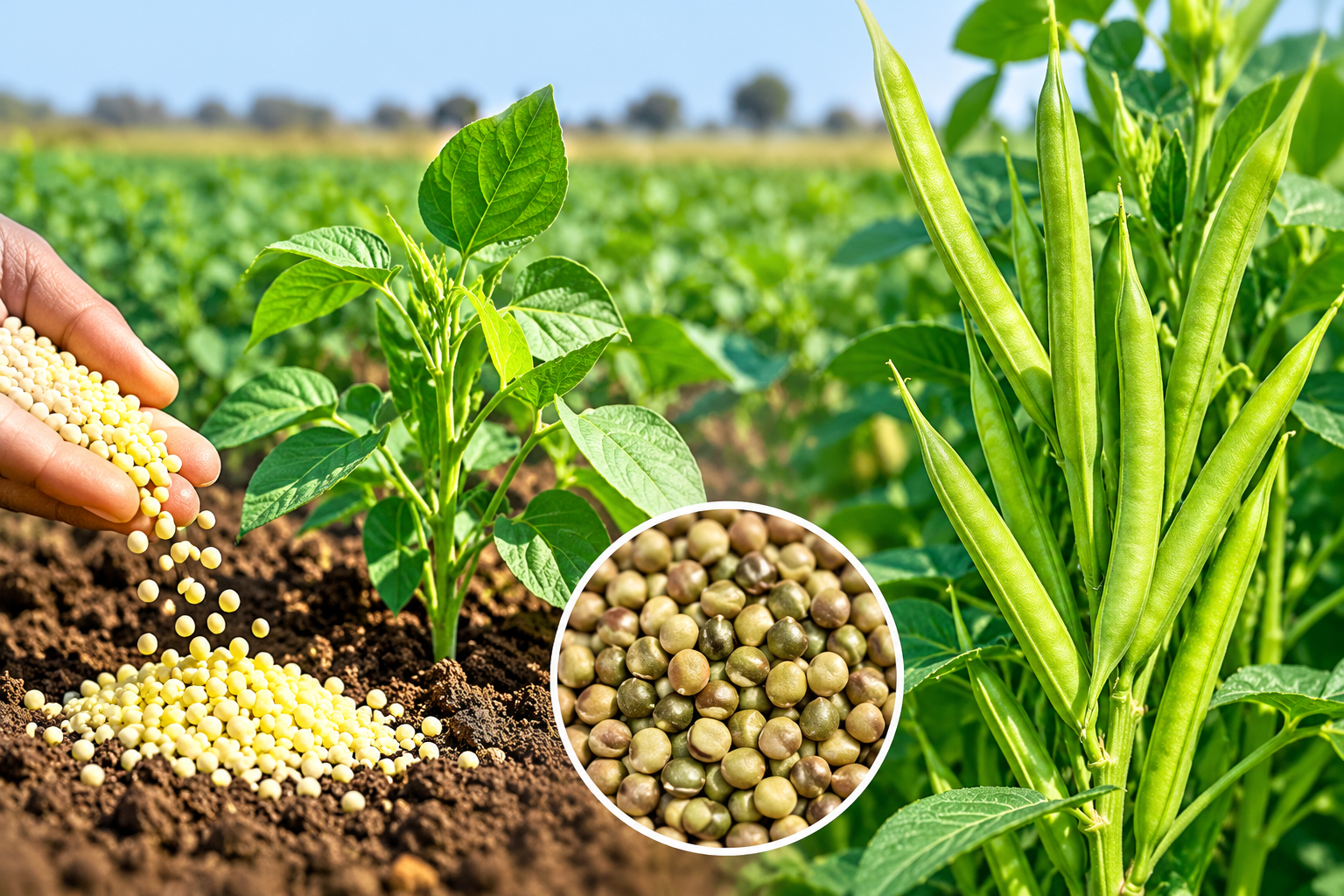
Economically optimum sulphur dose determination under middle Gujarat conditions for summer cluster bean (Cyamopsis tetragonoloba (L.) Taub) production
DOI:
https://doi.org/10.31783/Keywords:
cluster bean, quadratic function, seed yield, sulphur doseAbstract
During the summer of 2020, on farm evaluation was carried out on the College Agronomy Farm of Anand Agricultural University, Gujarat. A significant effect of sulphur fertilizer was observed in raising crop yields of cluster bean. The ideal sulphur dose for maximizing yield and making a profit over fertilizer cost was obtained using a quadratic model of the connection between cluster bean seed yield and the sulphur dose applied. Using information from field trials conducted in 2020, the ideal sulphur dose in cluster bean cultivation under middle Gujarat conditions was determined. For cluster bean, the economically ideal sulphur dose was discovered to be 43.63 kg/ha under middle Gujarat conditions in 2020. When sulphur was over-fertilized for maximum production, the seed yield was nearly identical, even at the physical and economic optimum dose of sulphur, resulting in a 1.55 kg/ha reduction in sulphur use.
References
[1] Anonymous (2008). Area and production, Retrieved from: kvkvellore.org/source/.
[2] A. K. Tiwari and A. K. Shivhare (2016). Pulses in India: Published by Director, Govt. of India, Ministry of Agriculture & Farmers Welfare (DAC&FW), Directorate of Pulses Development, Vindhyachal Bhavan, Bhopal, M.P.- 462004, Publication No.: DPD/Pub.1/Vol. 2/2016.
[3] S. S. Hussain, F. A. Misger, A. Kumar and M. H. Baba (2011). Response of nitrogen and sulphur on biological and economic yield of sunflower (Helianthus annuus L.), Res. J. Agri. Sci., 2: 308-310.
[4] H. W. Scherer (2001). Sulphur in crop production. Eur. J. Agron., 14: 81-111.
[5] H. L. S. Tandon and D. L. Messick (2007). Practical Sulphur Guide (revised). The Sulphur Institute, Washington, D. C.
[6] K. Alivelu, S. A. Rao, S. Sanjay, K. N. Singh, N.S. Raju and P. Madhuri (2006). Prediction of optimal nitrogen application rate of rice based on soil test values, Eur. J. Agron., 25: 71-73.
[7] C. Grant (2006). Enhancing nitrogen use efficiency in dryland cropping systems on the Northern Great Plains.18th World Congress of Soil Science, Philadelphia, USA.
[8] G. Belanger, J. R. Walsh, J. E. Richards, P. H. Milburn and N. Ziadi (2000). Comparison of three statistical models describing potato yield response to nitrogen fertilizer. Agron. J., 92: 902-908.
[9] T. Antoniadou and D. Wallach (2002). Evaluating optimal fertilizer rates using plant measurements, J. Appl. Stat., 29: 1083-1099.
[10] J. Henke, G. Breusted, K. Sieling and H. Kage (2007). Impact of uncertainity on the optimum nitrogen fertilization rate and agronomic, ecological and economic factors in an oilseed rape based crop rotation. J. Agr. Sci., 145: 445-468.
Downloads
Published
Issue
Section
License
Copyright (c) 2023 Author (s)

This work is licensed under a Creative Commons Attribution-NonCommercial-NoDerivatives 4.0 International License.
Copyright © The Author(s). This is an open access article distributed under the terms of the Creative Commons Attribution-NonCommercial-NoDerivatives 4.0 International License (CC BY-NC-ND 4.0), which permits unrestricted non-commercial use, distribution, and reproduction in any medium, provided the original author(s) and source are properly credited, and the work is not modified or adapted.