
In-vitro screening of antagonistic potential of native endophyte strains of banana (Musa spp.) against Fusarium oxysporum f. sp. cubense TR4 causing Fusarium wilt of banana
DOI:
https://doi.org/10.31783/elsr.2023.922735Keywords:
antagonism, banana, endophytes, FocTR4, P. fluorescensAbstract
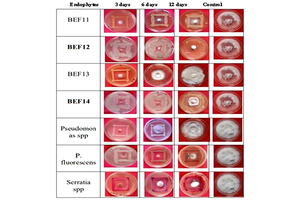
The experiment was done in the Department of Plant Pathology, RPCAU, Pusa, Bihar during 2021-22 to identify the antagonistic potential of native endophytes of bananas against FocTR4. An in-vitro investigation revealed that only four bacterial endophytes, GNBE4, GNBE9, GNBE12, and GNBE14, showed significant antagonistic effects against FocTR4out of 18 screened endophytes (13 bacterial and 5 fungal) of banana. The GNBE4 (Alcaligens sp.) showed maximum mycelial inhibition (75.18%), followed by GNBE9 (Stenotrophomonas maltophilia) (71.90%) and GNBE12 (Staphylococcus warneri) (70.69%), while lowest in GNBE14 (Bacillus subtilis) (61.07%). Among the fungal endophytes, the maximum mycelial growth inhibition was shown in RzFE and LfFE (42.78%) followed by PsdFE (36.11%), while lowest in PtFE1 (26.67%). Apart from that already identified antagonistic PGPR like Pseudomonas fluorescens was obtained from the Department of Microbiology were tested which significantly suppressed the mycelial growth of fungus having a mycelial inhibition of 70.01 %.
References
[1] Anonymous (2021) FAO. FAOSTAT Database Collections. Available online: https://www.fao.org/faostat/en/#data/ (accessed on 27 September 2021).
[2] I. W. Buddenhagen (2009). Understanding strain diversity in Fusarium oxysporum f. sp. Cubense and history of introduction of Tropical Race 4 to better manage banana production. Acta Hort., 828: 193-204.
[3] A. Chakrabarti (2013). Fusarium oxysporum: A “moving” view of pathogenicity. pp157-189, In: Genomics of Soil- and Plant-Associated Fungi, Vol. 36. B. Horwitz, P. Mukherjee, M. Mukherjee, and C. Kubicek, eds. Springer, Berlin, Heideberg, Germany. doi: 10.1007/978-3-642-39339-6_7.
[4] M. A Salacinas, J. Stoorvogel, O. Mendes, C. Schoen, R. Landeweert, A. M. Rebut and G. H. J. Kema (2018). Tracing contamination of Fusarium oxysporum f. sp. Cubense tropical race 4 in soil, water, weeds and field sanitation by burning in The Philippines. (PhD Degree), Wageningen University & Research, Wageningen, The Netherlands.
[5] R. C. Ploetz (2015a). Fusarium Wilt of Banana. Phytopathology., 105: 1512-1521.
[6] A. B. Molina, E. Fabregar, V. G. Sinohin, G. Yi and A. Viljoen (2007). Recent occurrence of Fusarium oxysporum f. sp. cubense tropical race 4 in Asia. Acta Hort., 828: 109-116.
[7] R. C. Ploetz, G. H. Kema and L. J. Ma (2015b). Impact of diseases on export and smallholder production of banana. Annu. Rev. Phytopathol., 53: 269-288.
[8] F. A. Garcia-Bastidas, F. Bakry, B. Irish and G. H. J. Kema (2018). Evidence for wide variation of resistance to Fusarium oxysporum f. sp. cubensetropical race4 and race 1generated by vegetative propagation in banana. (PhD Degree), Wageningen University & Research, Wageningen, The Netherlands.
[9] N. Ordonez, F. García-Bastidas, H. B. Laghari, M. Y. Akkary, E. N. Harfouche, B. N. A. Awar and G. H. J. Kema (2016). First Report of Fusarium oxysporum f. sp. cubense Tropical Race 4 Causing Panama Disease in Cavendish Bananas in Pakistan and Lebanon. Plant Dis. Notes, 100: 209. doi: 10.1094/PDIS-12-14-1356-PDN.
[10] S. Altendorf (2019). Banana Fusarium wilt tropical race 4: A mounting threat to global banana markets? The recent spread and potential future impact of the disease on global banana trade.” In 2019 Food Outlook—Biannual Report on Global Food Markets—November 2019. Rome: Food and Agriculture Organization (FAO). https://www.fao.org/3/ca6911en/ca6911en.pdf.
[11] Anonymous (2022). https://www.iaea.org, 2022.
[12] C. Staver, D. E. Pemsl, L. Scheerer, L. Perez Vicente and M. Dita (2020). Ex ante assessment of returns on research investments to address the impact of Fusarium wilt tropical race 4 on global banana production. Frontiers in Plant Science., 11: 844. doi: 10.3389/fpls.2020.00844.
[13] R. Thangavelu, D. Mostert, M. Gopi, P. G. Devi, B. Padmanaban, A. B. Molina and A. Viljoen (2019). First detection of Fusarium oxysporum f. sp. cubense tropical race 4 (TR4) on Cavendish banana in India. Eur. J. Plant Pathol., 154: 777-786. doi: 10.1007/s10658-019-01701-6.
[14] T. Damodaran, V. K. Mishra, S. K. Jha, R. Gopal, S. Rajan and I. Ahmed (2019). First report of Fusarium wilt in banana caused by Fusarium oxysporum f. sp. cubense tropical race 4 in India. Plant Disease., 103: 1022-1022.
[15] D. N. Shukla and S. K. Singh (2019). An extensive work on roving survey of Panama wilt disease (Fusarium oxysporum f. sp. cubense) of Banana in Bihar. Int. J. Curr. Microbiol. App. Sci., 8: 1809-1817.
[16] M. A. Dita, C. Waalwijk, I. W. Buddenhagen, M. T. Souza Jr and G. H. J. Kema (2010). A molecular diagnostic for tropical race 4 of the banana Fusarium wilt pathogen. Plant Pathol., 59: 348-357.
[17] J. F. Leslie and B. Summerell (2006). Fusarium laboratory workshops-A recent history. Mycotoxin Res., 22: 73-74
[18] A. C. Sekhar and P. Thomas (2015). Isolation and identification of shoot-tip associated endophytic bacteria from banana cv. Grand Naine and testing for antagonistic activity against Fusarium oxysporum f. sp. cubense. Am. J. Plant Sci., 6: 943-954.
[19] T. Jing, D. Zhou, M. Zhang, T. Yun, D. Qi, Y. Wei and Y. Chen, et al., (2020). Newly isolated Streptomyces sp. JBS5-6 as a potential biocontrol agent to control banana Fusarium wilt: genome sequencing and secondary metabolite cluster profiles. Front. Microbiol., 11: 602591. doi: 10.3389/fmicb.2020.602591.
[20] Y. Wei, Y. Zhao, D. Zhou, D. Qi, K. Li, W. Tang and W. Wang et al., (2020). A newly isolated Streptomyces sp. YYS-7 with a broad-spectrum antifungal activity improves the banana plant resistance to Fusarium oxysporum f. sp. cubense tropical race 4. Front. Microbiol., 11: 1712. doi: 10.3389/fmicb.2020.01712.
[21] J. M. Vincent (1947). Distortion of fungal hyphae in the presence of certain inhibitors. Nature, 159: 850. doi: 10.1038/159850b0.
[22] R. Rangaswamy (1995). A Textbook book of agricultural statistics. New Delhi, India, New Age International (P) Ltd. ISBN: 81-224-0758-7.
[23] R. A. Sikora (1992). Management of the antagonistic potential in agricultural ecosystems for the biological control of plant parasitic nematodes. Annu. Rev. Phytopathol., 30: 245-270.
[24] K. Getha, S. Vikineswary, W. H. Wong, T. Seki, A. Ward and M. Goodfellow (2005). Evaluation of Streptomyces sp. strain g10 for suppression of Fusarium wilt and rhizosphere colonization in pot-grown banana plantlets. J. Ind. Microbiol. Biotechnol., 32: 24-32.
[25] D. K. Chaurasiya, S. Sahni, B. D. Prasad and B. Kumar (2023). Biological Management of Lentil (Lens culinaris Medik) Fusarium wilt by using the potential Pseudomonas Isolates. Int. J. Plant Soil Sci., 35: 7-11.
[26] D. Tan, L. Fu, B. Han, X. Sun, P. Zheng and J. Zhang (2015). Identification of an endophytic antifungal bacterial strain isolated from the rubber tree and its application in the biological control of banana Fusarium wilt. PLoS One., 10: e0131974. doi: 10.1371/journal.pone.0131974.
[27] H. Fan, S. Li, L. Zeng, P. He, S. Xu, T. Bai and Y. Huang et al., (2021). Biological control of Fusarium oxysporum f. sp. cubense Tropical Race 4 using natively isolated bacillus spp. YN0904 and YN1419. J. Fungi., 7: 795. doi: 10.3390/jof7100795.
[28] L. Zhang, Z. Liu, Y. Wang, J. Zhang, S. Wan, Y. Huang and T. Yun et al., (2022). Biocontrol potential of endophytic Streptomyces malaysiensis 8ZJF-21 from medicinal plant against banana Fusarium wilt caused by Fusarium oxysporum f. sp. cubense tropical race 4. Front. Plant Sci., 13: 874819. doi: 10.3389/fpls.2022.874819.
[29] L. Zhang, H. Zhang, Y. Huang, J. Peng, J. Xie and W. Wang (2021). Isolation and evaluation of rhizosphere actinomycetes with potential application for biocontrolling Fusarium wilt of banana caused by Fusarium oxysporum f. sp. cubense tropical race 4. Front. Microbiol., 12: 763038. doi: 10.3389/fmicb.2021.763038.
[30] M. C. Martin, L. Leyva, M. A. Suarez, T. Pichardo, I. B. Caraballoso and Y. A. Capo (2021). Antifungal activity of Bacillus amyloliquefaciens against Fusarium oxysporum f. sp. cubense race 1. Agronomia Mesoamericana, 32: 466-478.
[31] N. Shen, S. Li, S. Li, H. Zhang and M. Jiang (2022).The siderophore-producing bacterium, Bacillus siamensis Gxun-6, has an antifungal activity against Fusarium oxysporum and promotes the growth of banana. Egypt. J. Biol. Pest Control, 32: doi: 10.1186/s41938-022-00533-7.
[32] R. Shahzad, A. L. Khan, S. Bilal, S. Asaf, I. J. Lee (2017). Plant growth-promoting endophytic bacteria versus pathogenic infections: an example of Bacillus amyloliquefaciens RWL-1 and Fusarium oxysporum f. sp. lycopersici in tomato. Peer J, 5: e3107.
[33] K. Yadav, T. Damodaran, K. Dutt, A. Singh, M. Muthukumar, S. Rajan and Gopal et al., (2021). Effective biocontrol of banana fusarium wilt tropical race 4 by a bacillus rhizobacteria strain with antagonistic secondary metabolites. Rhizosphere., 18: 100341. doi: 10.1016/j.rhisph.2021.100341.
[34] J. Taribuka, A. Wibowo, S. M. Widyastuti and C. Sumardiyono (2017). Potency of six isolates of biocontrol agents endophytic Trichoderma against fusarium wilt on banana. J. Degrad. Mining Lands Manag., 34: 723-731.
[35] I. M. Sudantha (2021). Characterization and virulence of Fusarium oxysporum f. sp. cubense cause wilt disease in banana plants and its biological control using endophytic fungi Trichoderma spp. at West Nusa Tenggara, Indonesia. In IOP Conference Series: Earth Environ. Sci., 886: 012016. IOP Publishing.
[36] C. G. Puig and C. J. R. Cumagun (2019). Rainforest fungal endophytes for the bio-enhancement of banana toward Fusarium oxysporum f. sp. cubense Tropical Race 4. Archives of Phytopathol. Pflanzenschutz., 52: 776-794.
Downloads
Published
Issue
Section
License
Copyright (c) 2023 Author (s)

This work is licensed under a Creative Commons Attribution-NonCommercial-NoDerivatives 4.0 International License.
Copyright © The Author(s). This is an open access article distributed under the terms of the Creative Commons Attribution-NonCommercial-NoDerivatives 4.0 International License (CC BY-NC-ND 4.0), which permits unrestricted non-commercial use, distribution, and reproduction in any medium, provided the original author(s) and source are properly credited, and the work is not modified or adapted.