
First report of seed weevil, Curculio c-album Fabricius infesting on jamun, Syzygium cuminii (L.) Skeels from Gujarat, India
DOI:
https://doi.org/10.31783/elsr.2023.923642Keywords:
black plum, curculio c-album, jamun, seed weevilAbstract
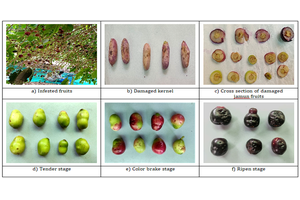
In the Indian subcontinent, largely cultivated evergreen tree is Jamun, Syzygium cuminii (L.) Skeels. The seeds of jamun have a wide variety of pharmacological qualities making them much more valuable. Seed weevil (Curculio c-album Fabricius) and Eulophid wasp (Anselmella kerrichi) both are damaging to seeds. C. c-album caused up to 100 % fruit damage in a few varieties of jamun. Fixed plot surveys were carried out at Horticultural Farm, Anand Agricultural University, Anand during, 2022 and 2023 in jamun orchard to find out the damaging pest of jamun seed. Small, black to brownish color adult beetle with entire body bear golden yellow color scale found during the survey and identified as Curculio c-album. First time in Gujarat this pest was observed to damage on fruits of jamun and cause economic losses. Both adult and grub caused damage to jamun. It causes 48.0 and 62.0% fruit damage at ripening stage of jamun during 2022 and 2023, respectively, and makes it unmarketable.
References
[1] A. C. Zeven and P. M. Zhukovsky (1975). Dictionary of cultivated plants and their centres of diversity excluding ornamentals, forest trees, and lower plants. Centre for Agricultural Publishing and Documentation, Wageningen.
[2] P. K. Warrier, V. P. K. Nambiar and C. Ramankutty (2010). Indian Medicinal Plants, A Compendium of 500 species, vol 4. Univerties Pres. Kottakal, India, pp303-306.
[3] A. K. Singh, A. Bajpai, V. K. Singh, H. Ravishankar and D. K. Tondon (2009). The Jamun (Syzygium cuminii Skeels). Technical Bulletin, Central Institute for Subtropical Horticulture (ICAR), Lucknow, pp20-21.
[4] S. Singh, A. K. Singh, H. P. Singh, B. G. Bagle and T. A. More (2011). Jamun. ICAR Bulletin, pp1-46.
[5] R. Kumar, K. K. Misra and D. S. Mishra (2011). Jamun: A boon for nature. Indian Farmer’s Diges., 43: 38-39.
[6] S. Singh and A. K. Singh (2012). Enjoy new jamun variety. Indian J. Horti., 57: 9-11.
[7] A. C. Dagadkhair, K. N. Pakhare, A. D. Todmal and R. R. Andhale (2017). Jamun (Syzygium cumini) Skeels: A traditional therapeutic tree and its processed food products. Int. J. Pure Appl. Biosci., 5: 1202-1209.
[8] A. Raza, M. U. Ali, T. Nisar, S. A. Qaisrani, R. Hussain and M. N. Sharif (2015). Proximate composition of Jamun (Syzygium cumini) fruit and seed. Am. J. Agric. Environ. Sci., 15: 1221-1223.
[9] S. Rehaman (2021). Therapeutic traits of jamun tree: Syzygium cumini (Linn.) to combat against covid-19, Int. J. Botany Stud., 6: 248-253.
[10] R. Rajeshkumar, V. V. Ramamurthy and G. Sharma (2010). Checklist of insects associated with jamun (Syzygium cuminii Skeels) from India. Biol. Forum, 2: 1-5.
[11] N. Talwar (2014). Trophic relationships: Life cycle strategies and distribution pattern of genus Curculio (Curculioninae: Curculionidae: Coleoptera). Indian J. Forest., 36: 463-466.
[12] Pooja (2019). Studies on pest complex in jamun (Syzygium cuminii (L.) Skeels) varieties. M. Sc. (Hort.) Thesis, Univ. Hort. Sci., Bagalkot, Karnataka, India.
[13] P. D. K. Jayanti, A. Subramoniam, A. Rekha and B. R. J. Mala (2019). Eulophid seed borer, Anselmella Kerrichi (Narayanan et al.; Hymenoptera), an emerging pest of jamun. Curr. Sci., 117: 922-924.
[14] A. Subramoniam, J. P. D. Kamala, M. B. R. Jayanthi and A. Rekha (2019). Differential attraction of jamun seed borer, Anselmella kerrichi (Narayanan, Subba Rao and Patel, 1988) to various colour traps. Pest Manag. Hortic. Ecosyst., 25: 121-122.
[15] A. Hiremath, G. K. P. Ramegowda (2021). Jamun seed and fruit borer complex at University of Horticultural Sciences Campus, GKVK, Bengaluru. Insect Environ., 24: 31-33.
[16] C. F. C. Beeson (1941). The ecology and control of the forest insects of India and the neighbouring countries. Vasant Press, Dehra Dun, India, pp1007.
[17] R. B. Hirekurubar, M. H. Tatagar, G. K. Ramegowda, S. Patil, A. I. Sabarad, M. B. Naika, and A. B. Mastiholi (2023). Survey and surveillance of curculio c-album and Conogethes punctiferalis on Jamun (Syzygium cuminii). Int. J. Bio-resour. Stress Manag., 14: 457-464.
[18] T. B. Fletcher (1917). Jamun. Proceedings on 2nd Entomological Meeting held at Pusa 5th-12th February. pp247.
Downloads
Published
Issue
Section
License
Copyright (c) 2023 Author (s)

This work is licensed under a Creative Commons Attribution-NonCommercial-NoDerivatives 4.0 International License.
Copyright © The Author(s). This is an open access article distributed under the terms of the Creative Commons Attribution-NonCommercial-NoDerivatives 4.0 International License (CC BY-NC-ND 4.0), which permits unrestricted non-commercial use, distribution, and reproduction in any medium, provided the original author(s) and source are properly credited, and the work is not modified or adapted.