Influence of planting time and spacing on quality of Zucchini (Cucurbita pepo) under naturally ventilated polyhouse
DOI:
https://doi.org/10.31783/elsr.2023.924350Keywords:
ash, carotenoid, fiber, polyhouse, zucchiniAbstract
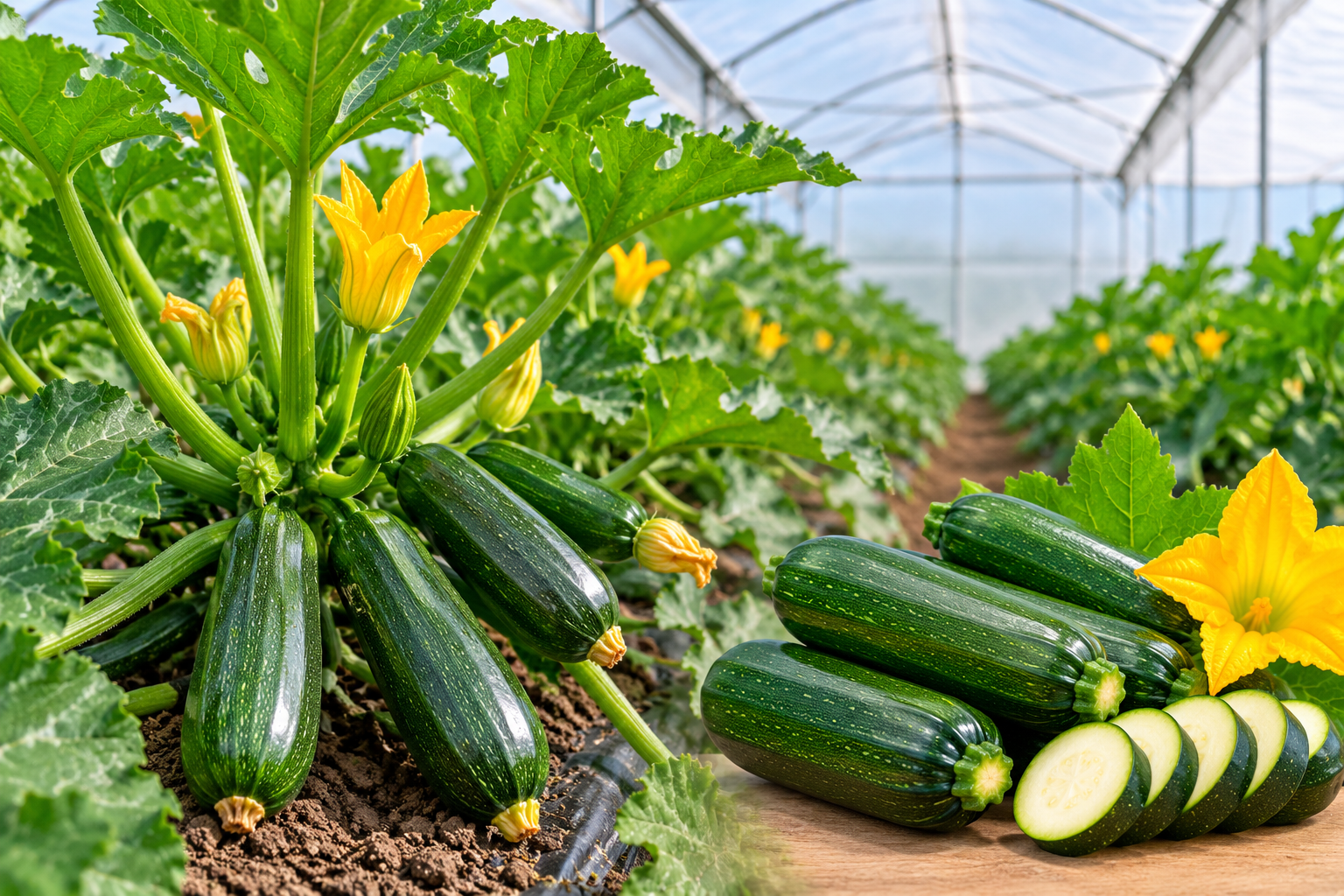
An experiment was carried out during 2021-2022 to examine the influence of planting time and spacing on the growth, yield, and quality of Zucchini (Cucurbita pepo. L) under a naturally ventilated polyhouse in the Experimental Farm, Department of Horticulture, Assam Agricultural University, Jorhat. Factorial Randomized Block Design was used to set up the experiment with 4 different times of planting (10th November 2021, 1st December 2021, 20th December 2021 and 10th January 2022), and 3 spacings (45cm x 60cm, 60cm x 60cm, and 75cm x 60cm) with 3 replications. Moisture content of fruit (96.24% & 95.31%) was highest in P4 and S3 spacing whereas ascorbic acid content (38.46mg/100g & 36.82 mg/100g) was highest in P2 and S3 spacing. The protein content of fruit (6.52 % & 6.42 %), total carotenoid content (8.37 μg/g), fiber content (0.91 %), ash content (0.65 % & 0.59 %) was recorded highest in the P3 planting and S3 spacing. Total soluble solids content (4.15 brix & 3.95 brix) was highest in P3. Fat content (0.66 mg & 0.67 mg) was highest in P4 planting and S3 spacing. Fiber content (0.90 %) in S2 spacing was found to be significantly different from other spacing. The outcome of the study showed that under naturally ventilated polyhouse conditions planting on 20th December along with a moderate planting distance of 60cm x 60cm induces maximum advantage in plant’s quality parameters.
References
[1] D. Bhattacharjee (2022). Zucchini (Cucurbita pepo L.) cultivation in India: A review. Bhartiya Krishi Anusandhan Patr., 37: 88-90. doi: 10.18805/BKAP359.
[2] M. Bannayan, E. E. Revaei and A. Alizadeh (2011). Climatic suitability of growing summer squash (Cucurbita pepo L.) as a medicinal plant in Iran. Not. Sci. Biol., 3: 39-46
[3] M. A. A. Alla, A. A. Mohsen and H. A. El Tanbashawy (2013). Effect of grafting Nubian watermelon on its growth, flowering, yield and fruit quality. Proc. 7th Int. Con. Biol. Sci. (Bot.) pp7-13.
[4] T. K. Bose and M. G. Som (1986). Vegetable crops in India. Naya Prokash, Calcutta, Bib ID: 921234.
[5] F. Welfare (2018). Horticultural statistics at a glance. OUP Catalogue.
[6] S. Maitra, T. Shankar, J.B. Palai, M. Sairam, A. Pal and D.J. Gaikwad (2020). Cultivation of Gerbera in polyhouse, In: Protected Cultivation and Smart Agriculture, New Delhi Publishers, India, pp219-226. doi: 10.30954/NDP-PCSA.2020.23.
[7] D. T. Santosh, and S. Maitra (2021). Estimation of irrigation water requirement of Zucchini squash (Cucurbita pepo L.) Under protected cultivation structures and in open field conditions. Indian J. Nat. Sci., 12: 37380-37385.
[8] P. J. Stoffella and H. H. Bryan (1988). Plant population influences growth and yield of bell pepper. J. Amer. Soc. Horti. Sci., 113: 835-839.
[9] D. Singh, S. Kaur, T. S. Dhillon, P. Singh, J. S. Hundal and G. J. Singh (2004). Protected cultivation of sweet pepper hybrids under net-house in Indian conditions. Acta Hort., 659: 515-521.
[10] S. Ranganna (1986). Handbook of analysis and quality control for fruits and vegetable products. Tata-McGraw Hill Publishing Co. Ltd. New Delhi.
[11] V. G. Panse and P. V. Sukhatme (1995). Randomized design and square and factorial experiment in statistical methods of agricultural workers. (2nd Edn.) ICAR, NewDelhi.
[12] M. Mohanty, M. Kachari, D.B. Phookan, N. Borah and S. Baruah (2023). Quality of zucchini (Cucurbita pepo) influence by planting time and fertilizers. Pharma Innov. J., 12: 3888-3891.
[13] A. Ullah, M. N. Islam, M. I. Hossain, M. D. Sarkar and M. Moniruzzaman (2013). Effect of planting time and spacing on growth and yield of cabbage. Int. J. Bioresour. Stress Manag., 4: 182-186.
[14] A. K. Pandey, A. K. Singh, A. Kumar and S. K. Singh (2013). Effect of Drip irrigation, spacing and nitrogen fertigation on productivity of chilli (Capsicum annuum L.). Environ. Ecol., 31: 139-142.
[15] A. O. Skjelvag (1981). Effects of climatic factors on the growth and development of the field bean (Vicia faba L. var. minor) I. Phenology, Height Growth and Yield in a Phytotrone Experiment. Acta Agric. Scand., 31: 358-371.
[16] J. Lado, E. Alós, M. Manzi, P. J. R. Cronje, A. Gómez-Cadenas, M. J. Rodrigo and L. Zacarías (2019). Light regulation of carotenoid biosynthesis in the peel of mandarin and sweet orange fruits. Front. Plant Sci., 10: 1288. doi: 10.3389/fpls.2019.01288.
[17] S. R. Narke, Y. R. Parulekar, P. C. Haldavanekar, P. M. Haldankar, R. V. Dhopawkar and S. S. Hinge (2015). Effect of spacing and fertilizer levels on growth and yield of zucchini under Konkan agro-climatic conditions. J. Indian Soc. Coastal Agric. Res., 33: 22-27.
[18] H. Lata, R. G. Khandenkar, D. C. Haldavanekar, V. G. Salvi and B. R. Salvi (2017). Effect of spacing and fertilizer levels on growth and yield of zucchini (Cucurbita pepo L.). J. Indian Soc. Coastal Agric. Res., 35: 25-29.
[19] I. D. Bake, B. K. Singh, A. K. Singh,D. P.Moharana and A.K. Maurya (2017). Effect of sowing dates and planting distances on quantitative attributes of okra [Abelmoschus esculentus (L.) Moench] cv. Kashi Pragati. Pharm Innov., 6: 142-148.
[20] V. O. Osadebe, B. C. Echezona and S. O. Bakare (2014). Effect of weed management and cutting frequency on the leaf yield and proximate composition of fluted pumpkin (Telfairia occidentalis Hook F.). Am.-Eurasian J. Agric. Environ. Sci., 14: 664-673.
[21] S. Watanabe, Y. Nakano and K. Okano (2003). Effect of planting density on fruit size, light-interception and photosynthetic activity of vertically trained watermelon (Citrullus lanatus (Thunb.) Matsum. et Nakai) plants. J. Japn. Soc. Hortic. Sci., 72: 497-503.
[22] J. K. Kirimi, F. M. Itulya and V. N. Mwaja (2011). Effects of nitrogen and spacing on fruit yield of tomato. Afr. J. Hort. Sci., 5: 50-60.
[23] S. K. Lee and A. A. Kader (2000). Preharvest and postharvest factors influencing Vitamin C content of horticultural crops. Postharvest Biol. Technol., 20: 207-220.
[24] F. E. Acikgoz (2012). Determination of yield and some plant characteristics with vitamin C, protein and mineral material content in mibuna (Brassica rapa var. Nipposinica) and mizuna (Brassica rapa var. Japonica) grown in fall and spring sowing times. J. Tekirdag Agric. Fac., 9: 64-70.
Downloads
Published
Issue
Section
License
Copyright (c) 2023 Author (s)

This work is licensed under a Creative Commons Attribution-NonCommercial-NoDerivatives 4.0 International License.
Copyright © The Author(s). This is an open access article distributed under the terms of the Creative Commons Attribution-NonCommercial-NoDerivatives 4.0 International License (CC BY-NC-ND 4.0), which permits unrestricted non-commercial use, distribution, and reproduction in any medium, provided the original author(s) and source are properly credited, and the work is not modified or adapted.