Determination of LD50 dose for ethyl methane sulphonate induced mutagenesis in Bhagwa Pomegranate
DOI:
https://doi.org/10.31783/elsr.2023.926167Keywords:
chemical mutagenesis, ethyl methane sulphonate, LD50, mutation breedingAbstract
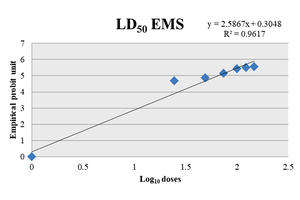
Mutation breeding utilizes both chemical and physical mutagens for inducing variability among existing genotypes. In mutation breeding, the estimation of LD50 is the initial step to finding the optimal dose to determine the best dose to produce a better revival of mutants with little population diminution. Pomegranate is a valued fruit and has immense nutraceutical and pharmaceutical properties. Its hardy nature, low maintenance, wider adaptability, high yield with better keeping quality, and better remuneration make it the choicest fruit to be grown in non-traditional areas in Uttarakhand. Pomegranate cv. Bhagwa is a high yielding variety, soft seeded, and have attractive aril colour. In the current experiment, mutagenesis was performed on hardwood cuttings of ‘Bhagwa’ pomegranate using alkylating agent Ethyl methane sulphonate (EMS). A total of 7 different treatments ranging from 25 mM to 150 mM were tested against control for their efficiency in mutant generation. The results revealed that there is a gradual decrease in the survival percentage of cuttings with increasing doses of mutagenic treatments. Based on the survival percentage of the treated cuttings, the probit curve analysis determined that the LD50 dosage of EMS for hardwood cuttings for Bhagwa pomegranate was 51.82 mM. Furthermore, reduction in chlorophyll content was observed with the application of higher doses of EMS.
References
[1] Z. Yuan, Y. Fang, T. Zhang, Z. Fei, F. Han, C. Liu and M. Liu, et al., (2018). The pomegranate (Punica granatum L.) genome provides insights into fruit quality and ovule developmental biology. Plant Biotechnol. J., 16: 1363-1374.
[2] C. Awachare, N. V. Singh, D. M. Mundewadikar, H. B. Shilpa, R. K. Pal, P. K. Nimbolkar and B. N. S. Murthy (2016). Biochemical profiling in pomegranate (Punica granatum L.) cultivar ‘Bhagawa’. Res. Crops, 17: 310-315.
[3] R. Sangeetha and A. Jayaprakash (2016). Investigation on antimicrobial activity of Punica granatum Linn. acetone peel extract. J. Academia Ind. Res., 5: 77-80.
[4] D. Singh and R. K. Singh (2004). Processed products of pomegranate. Nat. Prod. Radiance., 3: 66-68.
[5] A. Sharma, R. K. Dogra, G. Singh, S. Bodh (2020). Changing paradigms in pomegranate breeding: a review. Int. J. Curr. Microbiol. App. Sci., 9: 1878-1887.
[6] V. P. Singh and K. K. Misra (2010). Variability and character association analysis in bael germplasm. Indian J. Hortic., 67: 70-74.
[7] A. M. Van Harten (1998). Mutation Breeding: Theory and practical applications. Cambridge University Press, UK.
[8] B. J. Till, S. H. Reynolds, C. Weil, N. Springer, C. Burtner, Young and K. Bowers et al., (2004). Discovery of induced point mutations in maize genes by TILLING. BMC Plant Biol. 4: 12. doi: 10.1186/1471-2229-4-12.
[9] A. B. Talebi, A. B. Talebi and B. Shahrokhifar (2012). Ethyl methane sulphonate (EMS) induced mutagenesis in Malaysian rice (cv. MR219) for lethal dose determination. Am. J. Plant Sci., 3: 1661-1665.
[10] R. Beelagi (2020). Effect of mulching and drip irrigation on growth, yield andfruit quality of Pomegranate cv. Bhagwa. MSc Thesis. Pantnagar, Uttarkhand: G. B.Pant University of Agriculture and Technology.
[11] R. Jat, V. P. Singh, S. Ali Abed, N. Al-Ansari, P. K. Singh, D. K. Vishwakarma, A. Choudhary, et al., (2022). Deficit irrigation scheduling with mulching and yield prediction of guava (Psidium guajava L.) in a subtropical humid region. Front. Environ. Sci., 10: 1044886. doi: 10.3389/fenvs.2022.1044886.
[12] T. Hiscox and G. F. Israelstam (1979). A method for extraction of chlorophyll from leaf tissue without maceration. Can. J. Bot., 57: 1332-1334.
[13] D. J. Finney (1978). Statistical Method in Biological Assay. 3rd edn. Charles Griffin: London and High Wycombe, 1978; 362-368.
[14] B. S. Ahloowalia, M. Maluszynski and K. Nichterlein (2004). Global impact of mutation derived varieties. Euphytica, 135: 187-204.
[15] A. Tulmann-Neto, M. Cristofani, B. M. J. Mendes and A. Ando (1994). In vitro mutagenesis in citrus breeding: gamma rays sensitivity of cultivar ‘Pera’ explants. Bragantia., 53: 167-176.
[16] D. L. Gonzaga, R. R. Latado, A. Tullmann-Neto and R. M. Pio (2011). Radiosensitivity of two propagules of citrus. Bragantia, 70: 13-18.
[17] H. Coban (1998). Investigations on the variations caused by gamma rays, originating from 60co, treated to round seedless grape variety in different doses. Ege Uni. Fen Bilimleri Ens. (Ph.D. Thesis). Bornova-Izmir.
[18] S. B. Senthamizh (2005). Studies on Induced mutagenis in amla (Emblica Officinalis Gaertn.) through gamma rays. Ph.D thesis submitted at Tamil Nadu Agricultural University. Coimbatore, Tamil Nadu, India.
[19] I. Sutarto, D. Agisimanto and A. Supriyanto (2009). Development of promising seedless citrus mutants through gamma irradiation. In: Shu, Q.Y. (Ed.), Induced Plant Mutations in the Genomics Era. Food and Agriculture Organization of the United Nations, Rome, pp306-308.
[20] S. Jan, T. Parween, T. O. Siddiqi and Mahmooduzzafar (2012). Effect of gamma radiation on morphological, biochemical, and physiological aspects of plants and plant products. Environ. Rev., 20: 17-39.
[21] R. Roychowdhury and J. Tah (2013). Mutagenesis-A potential approach for crop improvement. In: Crop improvement: new approaches and modern techniques, pp149-187.
[22] G. Gopitha, K. Rajamani, M. Ganga, R. Ravikesavan and R. Gnanam (2022). Resolving the acute gamma irradiation and ethyl methanesulphonate induced lethality for Jasminum sambac L.(Aiton) cv. Ramanathapuram Gundumalli. Electron. J. Plant Breed., 13: 341-349.
[23] S. Ghosh, M. Ganga and A. Joel (2018). Assessment of mutagenic sensitivity in jasmine (Jasminum spp.) to chemical mutagen. Electron. J. Plant Breed., 9: 1002-1011.
[24] S. Ghosh and M. Ganga (2019). Determination of lethal dose for ethyl methane sulphonate induced mutagenesis in jasmine. Chem. Sci. Rev. Lett., 8: 6-10.
[25] M. M. Spencer-Lopes, B. P. Forster and L. Jankuloski (2018). Manual on mutation breeding ( 3rd ed.). Food and agriculture Organization of the United Nations (FAO).
[26] D. Bind and V. K. Dwivedi (2014). Effects mutagenesis on germination, plant survival and pollen sterility in M1 generation of cowpea (Vigna unguiculata L. Walp). Indian J. Agric. Res., 48: 398-401.
[27] M. Mallick, O. P. Awasthi, S. K. Singh and A. K. Dubey (2016). Physiological and biochemical changes in pre-bearing mutants of kinnow mandarin (C. nobilis Lour× C. deliciosa Tenora). Sci. Hortic., 199: 178-185.
[28] C. J. Hearn (1984). Development of seedless orange and grapefruit cultivars through seed irradiation. J. Am. Soc. Hortic. Sci., 109: 270-273.
[29] V. Y. Murthy, H. L. Ramesh and M. Munirajappa (2011). Ethyl Methane Sulphonate induced morphological variations in mulberry (Morus) variety M5. J. Appl. Nat. Sci., 3: 114-118.
[30] K. Anitha, R. Surendranath, M. Jawaharlal and M. Ganga (2017). Mutagenic effectiveness and efficiency of gamma (γ) rays and ethyl methane sulphonate on Bougainvillea spectabilis Willd. (cv. Lalbagh). Int. J. Bio-resour. Stress Manag., 8: 247-256.
[31] K. M. Prabhukumar, V. P. Thomas, M. Sabu, A. V. Prasanth and K. V. Mohanan (2015). Induced mutation in ornamental gingers (Zingiberaceae) using chemical mutagens viz. colchicine, acridine and ethyl methane sulphonate. J. Hortic. Biotechnol., 19: 18-27.
[32] T. C. Moore (2012). Biocemistry and Physiology of Plant Hormones. Springer, New York
[33] S. S. Bidabadi, M. Mahmood, S. Meon, Z. Wahab and C. Ghobadi (2011). Evaluation of in vitro water stress tolerance among EMS-induced variants of banana (Musa spp., AAA), using morphological, physiological and molecular traits. J. Crop Sci. Biotechnol., 14: 255-263.
[34] S. Kumar, O. P. Awasthi, R. M. Sharma and S. Pradhan (2021). Physiological and biochemical responses of Kinnow mandarin (Citrus nobilis × Citrus deliciosa) to EMS induced mutagenesis. Indian J. Agric. Sci., 91: 1015-1019.
[35] G. Kumar and A. Pandey (2019). Ethyl methane sulphonate induced changes in cyto-morphological and biochemical aspects of Coriandrum sativum L. J. Saudi Soc. Agric., 18: 469-475.
Downloads
Published
Issue
Section
License
Copyright (c) 2023 Author (s)

This work is licensed under a Creative Commons Attribution-NonCommercial-NoDerivatives 4.0 International License.
Copyright © The Author(s). This is an open access article distributed under the terms of the Creative Commons Attribution-NonCommercial-NoDerivatives 4.0 International License (CC BY-NC-ND 4.0), which permits unrestricted non-commercial use, distribution, and reproduction in any medium, provided the original author(s) and source are properly credited, and the work is not modified or adapted.