Insect pollinator diversity and their foraging behaviour in Radish, Raphanus sativus L.
DOI:
https://doi.org/10.31783/elsr.2023.926876Keywords:
foraging behavior, honeybees, pollinator diversity, radishAbstract
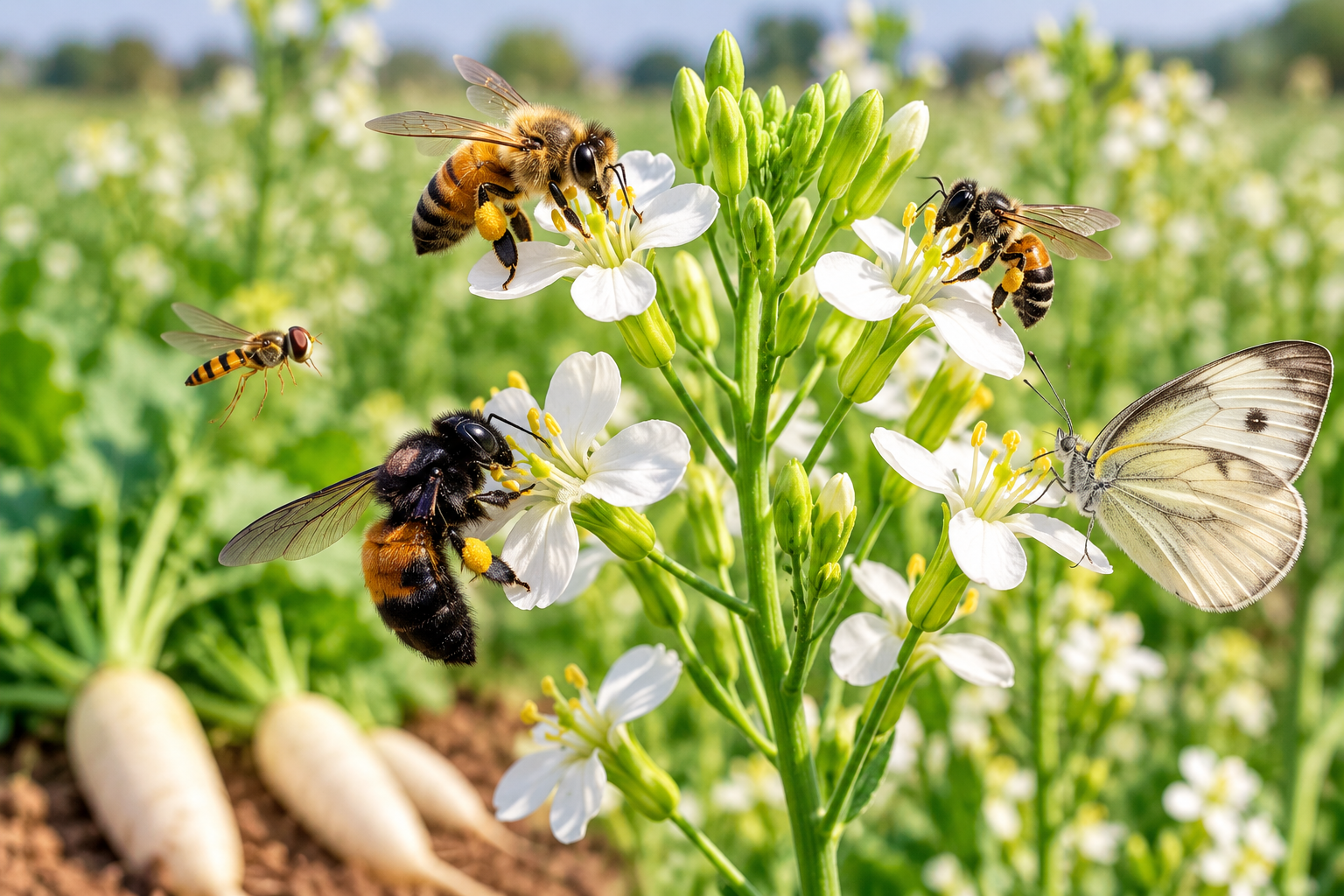
Radish is a cross-pollinated crop and honey bees are essential for its pollination. In the present investigation, the diversity and abundance of insect pollinators and additionally their visitation rate and frequency were also studied during 2019 and 2020. The foraging observations were noted at 08:00–10:00 hours (early morning foraging activity), 10:00-12:00 hours (late morning foraging activity), 12:00-14:00 hours (noon foraging activity), and 14:00-16:00 hours (afternoon foraging activity). The results revealed that nine species of bees, five flies, three butterflies, and three wasps species visited the flowers of radish during the study period. Apis florea, Apis mellifera, and Apis dorsata were the dominant pollinator species with 132-201, 110-130, and 90-115 individuals, respectively during the study duration. The maximum foraging activity of the dominant pollinators was observed at 14:00 hrs followed by 12:00 hrs whereas the minimum foraging activity was recorded in the early morning hours at 08:00. The frequency of floral visitors varied greatly, with A. florea (14.50-15.80 visits/flower/5 min) being the most frequent, followed by A. mellifera (9.80-11.00 visits/flower/5 min) and A. dorsata (8.30–9.40 visits/flower/5 min) in both seasons. Similarly, A. florea had statistically higher visitation rate (26.93–27.40 flowers visited/min) followed by A. mellifera (15.93–16.00 flowers visited/min) and A. dorsata (12.62-15.13 flowers visited/min). The findings suggested that A. florea, A. mellifera, and A. dorsata may be efficient radish pollinators. Therefore, on a commercial scale, these three species can be effectively used to increase crop yields.
References
[1] C. A. Kearns, D. W. Inouye and N. M. Waser (1998). Endangered mutualisms: The conservation of plant-pollinator interactions. Annu. Rev. Ecol. Syst., 29: 83-112.
[2] A. M. Klein, B. E. Vaissière, J. H. Cane, I. Steffan-Dewenter, S. A. Cunningham, C. Kremen and T. Tscharntke (2007). Importance of pollinators in changing landscapes for world crops. Proc. Biol. Sci., 274: 303-313. doi: 10.1098/rspb.2006.3721.
[3] S. Kercher and J. K. Conner (1996). Patterns of genetic variability within and among populations of wild radish, Raphanus raphanistrum (Brassicaceae). Am. J. Bot., 83: 1416-1421.
[4] R. Radchenko (1966). Role of honey bees as pollinators in increasing the seed crop from cabbage and radish. Bdzhil’nitstvo (In Ukrainian) 2: 72-75.
[5] U. Partap and L. R .Verma (1994). Pollination of radish by Apis cerana. J. Apic. Res., 33: 237-241.
[6] S. U. Zameer, M. Bilal, M. I. Fazal and A. Sajjad (2017). Foraging behavior of pollinators leads to effective pollination in radish Raphanus sativus L. Asian J. Agric. Biol., 5: 221-227.
[7] A. Dukare, S. Paul, P. H. Mhatre and P. A. Divekar (2021). Biological Disease Control Agents in Organic Crop Production System. In Pesticide Contamination in Freshwater and Soil Environs: Impacts, Threats, and Sustainable Remediation, ed. by M. A. Mehmood, K. R. Hakeem, R. A. Bhat and G. H. Dar. Apple Academic Press, USA. doi: 10.1201/9781003104957-10.
[8] P. A. Divekar, S. Narayana, B. A. Divekar, R. Kumar, B. G. Gadratagi, A. Ray and A. K. Singh et al., (2022a). Plant secondary metabolites as defense tools against herbivores for sustainable crop protection. Int. J. Mol. Sci., 23: 2690. doi: 10.3390/ijms23052690.
[9] P. A. Divekar, V. Rani, S. Majumder, S. G. Karkute, K. A. Molla, K. K. Pandey and T. K. Behera et al., (2022b). Protease inhibitors: an induced plant defense mechanism against herbivores. J. Plant Growth Regul. doi: 10.1007/s00344-022-10767-2.
[10] P. A, Divekar, S. Nebapure, S. Majumder and C. K. Verma (2021). Honeybee and Crop Pollination: concepts, challenges and applications. https://vikaspedia.in/agriculture/best-practices/sustainable agriculture/biodiversity/honeybee-and-crop-pollination. Accessed on 24th April, 2023.
[11] J. Ollerton and L. Cranmer (2002). Latitudinal trends in plant-pollinator interactions: are tropical plants more specialised? Oikos, 98: 340-350. doi: 10.1034/ j.1600-0706.2002.980215.x.
[12] R. J. Mitchell, R. J. Flanagan, B. J. Brown, N. M. Waser and J. D. Karron (2009). New frontiers in competition for pollination. Ann. Bot., 103: 1403-1413. doi: 10.1093/aob/mcp062.
[13] R. C. Mishra, Priti, and R. C. Sihag (2001). Role of insect pollination in seed production of radish (Raphanus sativus L.). Seed Res., 29: 231-234.
[14] E. C. Pielou (1975). Ecological Diversity, John Wiley & Sons, New York, NY, USA.
[15] E. H. Simpson (1949). Measurement of diversity. Nature, 163: 688. doi: 10.1038/163688a0.
[16] P. A. Henderson (2003). Practical Methods in Ecology. Blackwell Science Ltd., Oxford, UK.
[17] A. Dalal and S. Gupta (2016). A comparative study of the aquatic insect diversity of two ponds located in Cachar District, Assam, India. Turk. J. Zool, 40: 392-401.
[18] J. A. Tidke and S. B. Thorat (2011). Observations on reproductive biology of Madhuca longifolia (Koen) Maccbr. Int. J. Repro. Biol., 3: 1-8.
[19] S. Saeed, S. A. Malik, K. Dad, A. Sajjad and M. Ali (2012). In search of the best native pollinators for bitter gourd (Momordica charantia L.) pollination in Multan, Pakistan. Pak. J. Zool., 44: 1633-1641.
[20] C. D. Michener (2000). The Bees of the World. John Hopkins University Press, Baltimore.
[21] R. J. Vockeroth (1996). A revision of genera of Syrphini (Diptera: Syrphidae). Mem. Entomol. Soc. Can., 101: 1-176.
[22] S. D. Divija, P. K. Jayanthi, Y. B. Varun, P. S. Kumar, G. Krishnarao and G. S. Nisarga (2022). Diversity, abundance and foraging behaviour of insect pollinators in Radish (Raphanus raphanistrum subsp. Sativus L.). J. Asia-Pac Entomol., 25: 101909. doi: 10.1016/j.aspen.2022.101909.
[23] V. Karuppaiah, P. S. Soumia and P. D. Wagh (2018). Diversity and foraging behavior of insect pollinators in onion. Indian J. Entomol., 80: 1366-1369.
[24] D. K. Chaudhary, B. Singh and P. P. Singh (2002). Population dynamics of honey bees foraging on litchi flowers. J. Entomol. Res., 26: 71-75.
[25] C. Kremen (2018). The value of pollinator species diversity. Science, 359: 741-742. doi: 10.1126/science.aar7.
[26] S. N. Sinha and A. K. Chakrabarti (1980). Bee pollination and its impact on cauliflower seed production. Proceedings of the Second International Conference on Apiculture In Tropical Climates, New Delhi, pp513-527.
[27] J. Kumar, K. V. K. Rao, P. R. Gupta and G. S. Dogra (1989). Temporal distribution of bees (Hymenoptera: Apoidea) on spring flowering crops in mid-hills of Himachal Pradesh. Indian Bee J., 51: 55-58.
[28] S. K. Giri, U. Chandra, G. Singh., M. P. Gautam and R. Jaiswal (2018). Study the abundance of insect pollinators/visitors in rapeseed-mustard (Brassica juncea L.). J. Entomol. Zool. Stud., 6: 2563-2567.
[29] R. Das and S. Jha (2018). Record of insect pollinators and their abundance on Indian mustard (Brassica juncea L.) in new alluvial zone of West Bengal. Int. J. Pure Appl. Biosci., 6: 848-853.
[30] M. P. Bajiya and D. P. Abrol (2017). Flower-visiting insect pollinators of mustard (Brassica napus) in Jammu Region. J. Pharmacogn. Phytochem., 6: 2380-2386.
[31] P. Selvakumar, S. N. Sinha and V. K. Pandita (2006). Abundance and diurnal rhythm of honeybees visiting hybrid seed production plots of cauliflower (Brassica oleracea var. botrytis L.). J. Apic. Res., 45: 7-15. doi: 10.1080/00218839.2006.11101318.
[32] D. C. Murrell and W. T. Nash (1981). Nectar secretion by toria (Brassica campestris cv toria) and foraging behaviour of three Apis species on toria in Bangladesh. J. Apic. Res., 20: 34-38.
[33] S. Verma (1983). Foraging behaviour of Apis cerana indica F in Jeolikote (Nainital India). Indian Bee J., 45: 5-7.
[34] J. B. Free (1970). Insect Pollination of Crops. Academic Press, London, 544.
[35] N. A. Mohr and S. C. Jay (1988). Nectar and pollen collecting behaviour of honey bees on canola (Brassica campestris L and Brassica napus). J. Apic. Res., 27: 131-136.
[36] V. K. Rana, D. Raj and R. Kaushik (1997). Comparative foraging activity of Apis mellifera L and A cerana F on rapeseed bloom. J. Entomol. Res., 21: 59-64.
[37] P. Sharma, M. Singh, S. K. Bhardwaj and R. Gupta (2019). Impact of weather parameters on pollinator activity in cauliflower (Brassica oleracea var botrytis L) seed crop in mid-hills of Himachal Pradesh. Int. J. Farm Sci., 9: 22-25.
[38] A. Latif, S. A. Malik, S. Saeed, N. Iqbal, Q. Saeed, K. A. Khan and C. Ting et al., (2019). Diversity of pollinators and their role in the pollination biology of chickpea, Cicer arietinum L. (Fabaceae). J. Asia Pac. Entomol., 22: 597-601.
[39] T. Akhtar, M. A. Aziz, M. Naeem, M. S. Ahmed and I. Bodlah (2018). Diversity and relative abundance of pollinator fauna of canola (Brassica napus L. Var Chakwal Sarsoon) with managed Apis mellifera L. in Pothwar region, Gujar khan, Pakistan. Pak. J. Zool., 50: 567-573.
[40] N. Kumar and R. Singh (2005). Relative abundance of honeybees on toria bloom Brassica campestris var. toria, in Pusa, India. Shashpa, 12: 26-30.
[41] M. Ali, S. Saeed, A. Sajjad and A. Whittington (2011). In search of the best pollinators for canola (Brassica napus L.) production in Pakistan. Appl. Entomol. Zool., 46: 353-361.
[42] J. Singh, O. P. Agrawal and R. C. Mishra (2006). Foraging rates of different Apis species visiting parental lines of Brassica napus L. Zoos' print J., 21: 2226-2227.
[43] S. S. Dhurve (2008). Impact of honey bee pollination on seed production of niger. M.Sc.(Ag.) Thesis, University of Agricultural Sciences, Dharwad, Karnataka, India.
Downloads
Published
Issue
Section
License
Copyright (c) 2023 Author (s)

This work is licensed under a Creative Commons Attribution-NonCommercial-NoDerivatives 4.0 International License.
Copyright © The Author(s). This is an open access article distributed under the terms of the Creative Commons Attribution-NonCommercial-NoDerivatives 4.0 International License (CC BY-NC-ND 4.0), which permits unrestricted non-commercial use, distribution, and reproduction in any medium, provided the original author(s) and source are properly credited, and the work is not modified or adapted.