
Morphological characterization of different primary genotypes of mango (Mangifera indica L.) in Bihar
DOI:
https://doi.org/10.31783/elsr.2023.927782Keywords:
canopy volume, floral attributes, genotypes, mango, plant heightAbstract
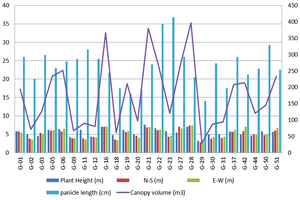
The morphological characterization of mango genotypes plays a significant role to understand their diversity, identifying distinct traits, and providing valuable insights into their classification and breeding. Hence, the experiment was conducted on 25 primary mango genotypes at Bihar Agricultural University, Sabour, Bihar during the years 2020–2021. The results showed that the genotypes G-06 and G-42 had the earliest bud break (4th February). While genotype G-23 had the maximum panicle length (36.75 cm). The genotype G-28 had the maximum canopy volume of 397.42 m3 with the maximum plant spread in both directions (7.35m in north-south and 7.35 m in east-west direction). Based on the above findings, it can be concluded that genotypes G-11, G-12, G-30, G-23, G-28, and G-29 performed better in respect of floral attributes and more canopy volume, which are important factors for maximization of yield.
References
[1] A. Latheef, L. Pugalendhi, A. Rani, P. Jeyakumar, M. Kumarand and M. Devi (2022). Genetic analysis of mango (Mangifera indica L) genotypes for year-round flowering and yield characters. Madras Agric. J., 109: 1-3.
[2] M. A. Anjum, G. A. Chattha, M. Sultan and S. Abbas (1999). Studies on flowering behavior, fruit setting and extent of floral malformation in different cultivars of mango (Mangifera indica L.). Int. J. Agri. Biol., 3: 88-90.
[3] IPGRI (2006). Descriptors for mango (Mangifera indica L). International Plant Genetic Resources Institute, Rome, Italy.
[4] H. N. Samaddar and U. Chakrabarti (1988). Effect of different rootstocks on Himsagar and Langra. Acta Hortic., 231: 220-224.
[5] T.K. Bose and S.K. Mitra (1990). In Fruits: Tropical and Subtropical, Naya Prakash, Calcutta; Vedams eBooks: New Delhi, India, pp565-591.
[6] R. Joshi, M. Kundu and C. P. Singh (2013). Morphological characters: efficient tool for identification on different mango cultivars. Environ. Ecol.., 31: 385-388.
[7] M. S. Islam, M. J. Bhuyan, M. Biswas, M. N. Islam and A. K. Hossain (1995). Studies on the growth, flowering and fruit characteristics of eight mango cultivars. Bangladesh Hort., 23: 59-65.
[8] C. E. Thormann, M. E. Ferreira, L. E. A. Camargo, J. G. Tivang and T. C. Osborn (1994). Comparison of RFLP and RAPD markers to estimating genetic relationships within and among cruciferous species. Theor. Appl. Genet., 88: 973-980.
[9] V. J. Kulkarni (2004). The tri-factor hypothesis for flowering in mango. Acta Hortic., 70: 61-70.
[10] H. Barua, M. M. A. Patwary and M. H. Rahman (2013). Performance of BARI mango (Mangifera indica L.) varieties in Chittagong region. Bangladesh J. Agric. Res., 38: 203-209.
[11] S. K. Mitra, S. Mitra, B. Ghosh, and P. K. Pathak, (2010). Mango cultivars and hybrids grown in West Bengal, India. In IX International Mango Symposium., 992, pp325-330.
[12] D. N. Majumder, L. Hassan, M. A, Rahim and M. M. Kabir (2012). Genotypic and phenotypic variability in mango (Mangifera indica L.). Bangladesh J. Agric. Res., 37: 683-690.
[13] R. Prasad, S. K. Yadav, P. Kumar and R. P. Yadav (2016). Performance of mango cultivars in eroded soils of Shiwalik foot hills. Indian J. Soil Conser., 44: 67-72.
[14] P. Bakshi, R. Kumar, A. Jasrotia and V. K. Vali (2012). Growth and yield performance of mango variety under rainfed area of Jammu. Indian J. Agric. Sci., 46: 281-285.
[15] S. G. Barhate, S. Balasubramanyan and R. Bhalero (2012). Genetic diversity in mango (Mangifera indica L.) genotypic and phenotypic characterization. Int. J. Plant Sci. (Muzaffarnagar), 7: 85-89.
[16] A. R. Desai and D. G. Dhandar (2000). Variation in Physico-chemical and morphogenetic characters of some mango varieties of Goa. Acta Hortic., 509: 243-252.
[17] D. B. Singh, T. V. Sharma, B. L. Attri and M. A. Suryanarayana (2000). Genetic diversity in mango. Progressive Hortic., 4: 35-36.
[18] L. B. Singh (1968). The Mango: Botany, Cultivation and Utilization. Interscience Publishers, INC, New York.
[19] R. W. Hodgson (1967). Horticultural varieties of citrus. The Citrus Industry (W. Reuther, H. J. Webber, and L. D. Batchelor. eds.). University of California Press, Berkely., 1, pp431-591.
[20] W. S. Dhillon, R. C. Sharma and G. S Kahlon (2004). Evaluation of some mango varieties under Punjab conditions. Haryana J. Hortic. Sci., 33: 157-159.
[21] D. N. Majumder, L. Hassan, M. A. Rahim and M. A. Kabir (2011). Studies on physio-morphology, floral biology and fruit characteristics of mango. J. Bangladesh Agric. Uni., 9: 187-199.
[22] S. S. Shrivastava, K. P. Asati, M. P. Patel, B. L. Tiwari and U. P. S. Bhadauria (1987). Evaluation of mango varieties in M.P. Indian J. Hortic., 44: 97-201.
[23] G. S. R. Murti and K. K. Upreti (2004). An analysis of possible causes for poor flowering in mango under Bangalore conditions. Indian J. Hortic., 61: 289-291.
[24] S. N. Singh, S. Sengupta, M. Kundu, S. Sahay, D. Kumar (2021). Phonological characterization of different mango genotype under Sabour condition. Pharma Innov. J., 10: 2152-2156.
Downloads
Published
Issue
Section
License
Copyright (c) 2023 Author (s)

This work is licensed under a Creative Commons Attribution-NonCommercial-NoDerivatives 4.0 International License.
Copyright © The Author(s). This is an open access article distributed under the terms of the Creative Commons Attribution-NonCommercial-NoDerivatives 4.0 International License (CC BY-NC-ND 4.0), which permits unrestricted non-commercial use, distribution, and reproduction in any medium, provided the original author(s) and source are properly credited, and the work is not modified or adapted.