
Bioefficacy of different insecticides against pomegranate insect pests and their impact on natural enemies
DOI:
https://doi.org/10.31783/elsr.2023.92111119Keywords:
aphids, insecticides, predators, thripsAbstract
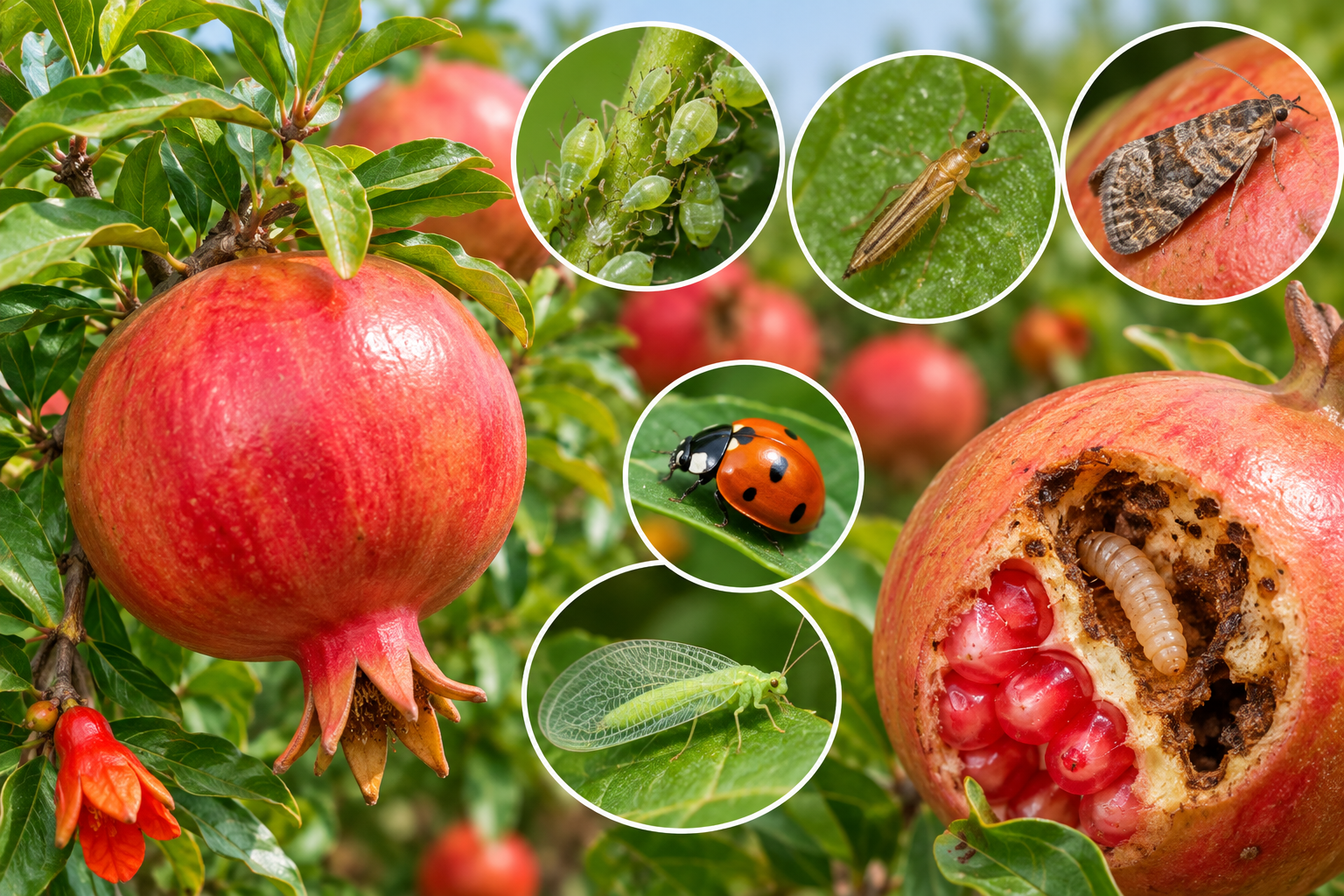
A field experiment was conducted during rabi 2021-22 and 2022-23 at Horticulture Research and Extension Centre, Vijayapur, Karnataka, India, to evaluate the bioefficacy of different insecticides against pomegranate insect pests and their impact on natural enemies. During 2021-22, Cyantraniliprole 10.26% OD @ 70 g.a.i/ha recorded significantly lowest population of aphids (10.42 and 1.91 per 5cm twig), and thrips (6.33 and 1.22 per 5cm twig) at 7 days after imposition of treatment during first and second spray, respectively. Further, Cyantraniliprole 10.26% OD @ 70g.a.i/ha recorded the lowest fruit damage (6.67%) by pomegranate fruit borer and the highest damage reduction over control (84.53%) on fruits. Imidacloprid 17.8 % SL @ 71.8 g.a.i/ha was next best with higher population reduction over control in different pests viz., aphids (91.89%), thrips (91.24%). However, Emamectin benzoate 5% SG @ 220g.a.i/ha recorded lower fruit damage (7.11%) and higher reduction over control (83.51%). Cyantraniliprole 10.26% OD @ 70 g.a.i/ha was also found to be safer for natural enemies. At harvest, Cyantraniliprole 10.26% OD @ 70 g.a.i/ha recorded the highest yield (13.21 t/ha), followed by, Imidacloprid 17.8 % SL @ 71.8 g.a.i/ha (12.97 t/ha). A similar trend was observed during 2022-23 for pest control and the impact of different insecticides on natural enemies.
References
[1] V. Vucic, M. Grabez, A. Trchounian and A. Arsic (2019). Composition and potential health benefits of pomegranate: a review. Curr. Pharm. Des., 25: 1817-1827.
[2] A. Kumar, A. K. Sharma, R. K, Yadav, S. Meitei, N. Arora and K. Gaur (2022). All India area and production of horticulture crops. Agricultural Statistics at a Glance 2022, Government of India, Ministry of Agriculture and Farmers Welfare, Department of Agriculture and Farmers Welfare, Economics and Statistics Division. pp92. Available online: https://desagri.gov.in/document-report/agricultural-statistics-at-a-glance-2022/.
[3] R. A. Balikai, Y. K. Kotikal and P. M. Prasanna (2011). Status of pomegranate pests and their management strategies in India. Acta. Hortic (ISHS), 890: 569-583.
[4] K. Sreedevi and A. Verghese (2009). Effect of aphid, Aphis punicae (Hemiptera: Aphididae) infestation on pomegranate fruits and flowers. In: 2nd International Conference on Pomegranate and Minor Including Mediterranean Fruits, 23-27 June 2009, University of Agricultural Sciences, Dharwad-Karnataka, India. pp150.
[5] S. Kumar and D. Gupta (2018). Management of pomegranate fruit borer, Deudorix epijarbas (moore) using new group of insecticides and some biopesticides. J. Entomol. Zool. Stud., 6: 1060-1063.
[6] Anonymous (2016). Horticulture-POP-UHS,Bagalkot. University of Horticultural Sciences, Bagalkot, Karnataka, India. pp34-40. Available online: https://kvkvijayapura.org/new/package-of-practicepop/.
[7] R. D. Solankar, A. R. Walunj, G. B. Kabre and P. E. More (2021). Bioefficacy and compatibility of new insecticide molecules against sucking pests of pomegranate. Pharma Innov. J., 10 (Special Issue): 669-672.
[8] A. A. Abd Ella (2015). Effect of several insecticides on pomegranate aphid, Aphis punicae (Passerini) (Homoptera: Aphididae) and its predators under field conditions. OEPP/EPPO Bull., 45: 90-98.
[9] D. Kumar, R. S. Kamal and S. V. S. Raju (2019). Field Efficacy of insecticidal combinations against Chilli thrips, Scirtothrips dorsalis (Hood) and Aphis gossypii (Glover). Ann. Plant Protec. Sci., 27: 324-328.
[10] G. Chandrakar, Renuka, M. S. Bisen and H. K. Chandrakar (2020). Bio-efficacy of Emamectin Benzoate 3.5% + lambda cyhalothrin 5% WP against sucking insect pests of chilli during Rabi season 2017-18 and 2018-19. Int. J. Chemical Stud., 8: 2306-2313.
[11] S. B. Jagginavar, L. K. Naik and S. S. Karabantanal (2018). Bioefficacy and Phytotoxicity of Alanto 240 SC (Thiacloprid 240 SC) against Thrips and Natural Enemies in Pomegranate. Int. J. Curr. Microbiol. App. Sci., 7: 1598-1602.
[12] N. Chauhan and D. Gupta (2023). Evaluation of Ipm modules against pomegranate fruit Borer Deudorix epijarbas (Moore). Indian J. Entomol., doi: 10.55446/IJE.2023.815.
[13] D. B. Sattelle, D. Cordova and T. R. Cheek (2008). Insect ryanodine receptors: molecular targets for novel control chemicals. Invertebr. Neurosci., 8: 107-119.
[14] T. P. Selby, G. P. Lahm, T. M. Stevenson, K. A. Hughes, D. Cordova, I. B. Annan and J. D. Barry et al., (2013). Discovery of cyantraniliprole a potent and selective anthranilic diamide ryanodine receptor activator with cross-spectrum insecticidal activity. Bioorg. Med. Chem. Lett., 23: 6341-6345.
[15] S. Mantzoukas, G. Kosmidou, A. Gekas, F. Kitsiou, P. A. Eliopoulos and G. Patakioutas (2022). A Preliminary analysis on the insecticidal effect of Cyantraniliprole against stored-product pests. Appl. Sci., 12: 1297. doi: 10.3390/app12031297.
[16] A. Gonzales-Coloma, C. Gutierrez, H. Hubner, H. Achenbach, D. Terrero and B. M. Fraga (1999). Selective insect anti-feedant and toxic action of ryanodine diterpenes. J. Agric. Food Chem., 47: 4419-4424.
[17] V. K. Bojan (2021). Bioefficay, phytotoxicity, safety to natural enemies and residues of Cyantraniliprole 10 OD on potato (Solanum tuberosum L.) under open field condition. Crop Prot., 142: 105505. doi: 10.1016/j.cropro.2020.105505
Downloads
Published
Issue
Section
License
Copyright (c) 2023 Author (s)

This work is licensed under a Creative Commons Attribution-NonCommercial-NoDerivatives 4.0 International License.
Copyright © The Author(s). This is an open access article distributed under the terms of the Creative Commons Attribution-NonCommercial-NoDerivatives 4.0 International License (CC BY-NC-ND 4.0), which permits unrestricted non-commercial use, distribution, and reproduction in any medium, provided the original author(s) and source are properly credited, and the work is not modified or adapted.