Micronutrients enriched organic manure and biofertilizer as influenced on multi-cut fodder oat [Avena sativa (L.)]
DOI:
https://doi.org/10.31783/elsr.2023.92120130Keywords:
enriched organic manure, green fodder, micronutrients, oat, vermicompostAbstract
Micronutrients enriched organic manure and biofertilizer as influenced on multi-cut fodder oat” conducted during rabi 2021-22 at MFRS, AAU, Anand 388110 (Gujarat) with ten different treatments i.e T1 RDF (80-40-0 NPK/ha), T2 (RDF + NPK consortia), T3 (RDF + Micronutrients Enriched FYM 0.5 t/ha), T4 (RDF + Micronutrients Enriched FYM 1 t/ha), T5 (RDF + Micronutrients Enriched VC 0.5 t/ha), T6 (RDF + Micronutrients Enriched VC 1 t/ha), T7 (RDF + Micronutrients Enriched FYM 0.5 t/ha + NPK consortia), T8 (RDF + Micronutrients Enriched FYM 1 t/ha + NPK consortia), T9 (RDF + Micronutrients Enriched VC 0.5 t/ha + NPK consortia) and T10 (RDF + Micronutrients Enriched VC 1 t/ha + NPK consortia) and an experiment data analysis done with randomized block statistical design having three replications.
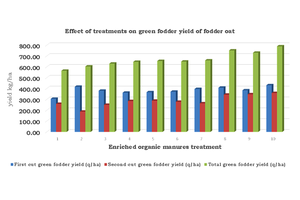
Plant population, plant height at 20 and 40 DAS, DM% gave non-significant differences due to different treatments. An application of RDF + Micronutrients Enriched VC 1 t/ha + NPK consortia (T10) gave significantly higher plant height at 1st cut (103.32 cm), 30 days after 1st cut (21.37 cm) and at 2nd cut (37.86 cm) and LSR (2.35 and 0.93 both cuts, respectively). Economical yield at 1st and 2nd cut (430.56 & 358.13 q/ha, respectively) and TGFY yield (788.69 q/ha) was observed higher in treatment T10 (RDF + Micronutrients Enriched VC 1 t/ha + NPK consortia).
References
[1] S. Biswas and R. Das (2022). Role of integrated nutrient management on oat: A review. Int. J. Environ. Clim. Chang., 12: 66-79.
[2] D. Kumar, M. Singh, M. R. Yadav, G. Makarana, M. Kushwaha, S. Dutta and S. Bhattacharjee et al., (2022). Growth and yield performance of fodder oat (Avena sativa) grown under different nutrient management practices. Indian J. Agric. Sci., 92: 267-272.
[3] A. K. Roy, R. K. Agrawal, N. R. Bhardwaj, A. K. Mishra and S. K. Mahanta (2019). Revisiting national forage demand and availability scenario. In: Indian fodder scenario: Redefining state wise status. ICAR-AICRP on Forage Crops and Utilization, Jhansi, India, pp1-21.
[4] M. Pandey (2018). Effect of integrated nutrient management on yield, quality and uptake of nutrients in oat (Avena sativa) in alluvial soil. Ann. Plant Soil Res., 20: 1-6.
[5] J. Jena, N. C. Sarkar, C. Sen, J. B. Palai (2018). Effect of integrated nutrient management on crude protein content in grain and straw of oat (Avena sativa) in red and lateritic soil of West Bengal. Int. J. Chem. Stud., 6: 1659-1661.
[6] R. D. Graham and R. M. Welch (1996). Breeding for staple food crops with high micronutrients density. Working papers on Agricultural Strategies for Micronutrients No.3 International Food Policy Research Institute, Washington, D.C.
[7] D. D. Rathod, M. C. Meena and K. P. Patel (2012). Effect of different Zn enriched organics on yields and micronutrients uptake under wheat-maize (Fodder) cropping sequence in semi-arid region of Gujarat. Indian J. dryland Agric. Res. Dev., 27: 37-42.
[8] S. R. Mousavi, M. Galavi and M. Rezaei (2013). Zinc (Zn) importance for crop production- a review. Int. J. Agron. Plant Prod., 4: 64-68.
[9] M. C. Meena, K. P. Patel and D. D. Rathod (2006). Effect of Zn and Fe enriched FYM on mustard yield and micronutrients availability in loamy sand soil (Type Haplustepts) of Anand. J. Indian Soc. Soil Sci., 54: 495-499.
[10] D. D. Rathod, M. C. Meena and K. P. Patel (2012). Evaluation of different zinc enriched organics as source of zinc under wheat-maize (Fodder) cropping sequence on zinc deficient typic Haplustepts. J. Indian Soc. Soil Sci., 60: 50-55.
[11] W. G. Cochran and G. M. Cox (1967). Experimental designs. Jhon willy and sons Inc., New York, 53: 43-50.
[12] M. L. Jackson (1973). Soil Chemical Analysis. Prentice Hall of India Pvt. Ltd. New Delhi, pp38-336.
[13] H. K. Goering and P. J. Vansoest (1970). Forage fibre analysis, ARS US Dept. Agric. Handbook, No. 379.
[14] S. Bokde (1968). Effect of different levels of nitrogen application and cutting intervals on growth, yield and quality of two varieties of oat. 2. Oat grown for grain. Indian J. Agric. Sci., 38: 910-930.
[15] J. P. Singh, A. Kumar, L. L. Relwani and A. K. Singh (1973). Effect of stage of cutting and levels of N on the yield and quality of oats of fodder. Annual Report National Dairy Research Institute, Karnal.
[16] S. K. Sharma and S. R. Bhunia (2001). Response of oat (Avena sativa L.) to cutting management, method of sowing and nitrogen. Indian J. Agron., 46: 563-567.
[17] R. S. Rana, S. S. Rana, N. Kumar and R. Prasad (2002). Influence of nitrogen application and cutting management on the productivity of oats. Himachal J. Agric. Res., 28: 1-5.
[18] P. Amonge, K. Thakuria and J. K. Saikia (2013). Intercropping of oilseed crops with oat fodder in rice fallows under rainfed condition. Forage Res., 39: 99-101.
[19] S. Bhagat, M. Gupta, M. Banotra, A. Sharma, S. Kumar and A. Sharma (2017). Production potential and economics of fodder maize (Zea mays) varieties sown under varying intercropping systems with cowpea (Vigna unguiculata). Int. J. Curr. Microbiol. Appl. Sci., 6: 4082-4087.
[20] V. C. Ganvit, S. H. Vaishali, S. F. F. M. A. Sharma and J. B. Ganvit (2018). Forage production potential of oat (Avena sativa) -lucerne (Medicago sativa L.) intercropping under sole and intercropping systems. Curr. Adv. Agric. Sci., 10: 132-134.
[21] K. A. Singh, G. S. Rawat, S. Gupta, D. Patil and N. Prajapati (2017). Production and profitability assessment of clusterbean (Cyamopsis tetragonoloba L. Taub.) based intercropping systems under different row arrangement. Legume Res., 40: 916-919.
[22] S. Chandra (2007). Effect of integrated nutrient management on yield and nutrient use efficiency in mustard (Brassica juncea L.). SAARC J. Agric., 5: 93-100.
[23] S. B. Agarwal, S. S. Tomar, A. K. S. Bhadauria and M. L. Kewat (2002). Response of fodder oat (Avena sativa L.) to methods of Azotobacter inoculation under various levels of nitrogen. Ann. Agric. Res., 23: 692-696.
[24] U. Devi, K. P. Singh, S. Kumar and M. Sewhag (2014). Effect of nitrogen levels, organic manures and Azotobacter inoculation on yield and economics of multi-cut oats. Forage Res., 40: 36-43.
[25] V. Shiyal, H. K. Patel, C. H. Raval, M. K. Rathwa, P. S. Patel and H. K. Patel (2020). Fodder yield and economics as influenced by integrated nutrient management on fodder dual purpose oat (Avena sativa). Int. J. Curr. Micobiol. App. Sci., 9: 3752-3758.
[26] O. Singh (2019). Effect of bio-manures on green forage yield of oat in irrigated conditions. Int. Arch. App. Sci. Technol., 10: 119-121.
[27] R. L. Bhilare and Y. P. Joshi (2007). Productivity and quality of oat (Avena sativa L.) in relation to cutting management and nitrogen levels. Indian J. Agron., 52: 247-250.
[28] L. R. Meena, J. S. Mann and R. Chand (2011). Effect of intercropping, row ratios and organic manures on productivity and quality of forage under semi-arid regions of Rajasthan. Ann. Arid Zone, 50: 41-45.
[29] S. M. Deore, M. R. Patel, P. M. Patel H. K. Patel and U. J. Patel (2013). Production potential of forage maize (Zea mays L.) cowpea (Vigna unguiculata L.) intercropping system as influenced by row ratios. Adv. Res. J. Crop Improv., 4: 110-112.
[30] A. K. Verma and K. L. Jeengar (2015). Impact of balanced fertilization and legume mixture on fodder oat (Avena sativa L.). Int. J. Scientific Res. Pub., 5: 1-5.
[31]A. Iqbal, M. A. Iqbal, F. Nabeel, H. Z. Khan, N. Akbar and R. N. Abbas (2014). Economic and sustainable forage oat (Avena sativa L.) production as influenced by different sowing techniques and sources of nitrogen. Am-Euras. J. Agric. Environ. Sci., 14: 1035-1040.
[32] A. S. Godara, U. S. Gupta and R. Singh (2012). Effect of integrated nutrient management on herbage, dry fodder yield and quality of oat (Avena sativa L.). Forage Res., 38: 59-61.
Downloads
Published
Issue
Section
License
Copyright (c) 2023 Author (s)

This work is licensed under a Creative Commons Attribution-NonCommercial-NoDerivatives 4.0 International License.
Copyright © The Author(s). This is an open access article distributed under the terms of the Creative Commons Attribution-NonCommercial-NoDerivatives 4.0 International License (CC BY-NC-ND 4.0), which permits unrestricted non-commercial use, distribution, and reproduction in any medium, provided the original author(s) and source are properly credited, and the work is not modified or adapted.