Effect of pre-harvest spray of PGRs, calcium and cow urine on yield and quality of aonla fruit (Emblica officinalis Gaertn.)
DOI:
https://doi.org/10.31783/elsr.2023.92131136Keywords:
aonla, benzyl adenine, calcium nitrate, cow urine, mulch, salicylic acidAbstract
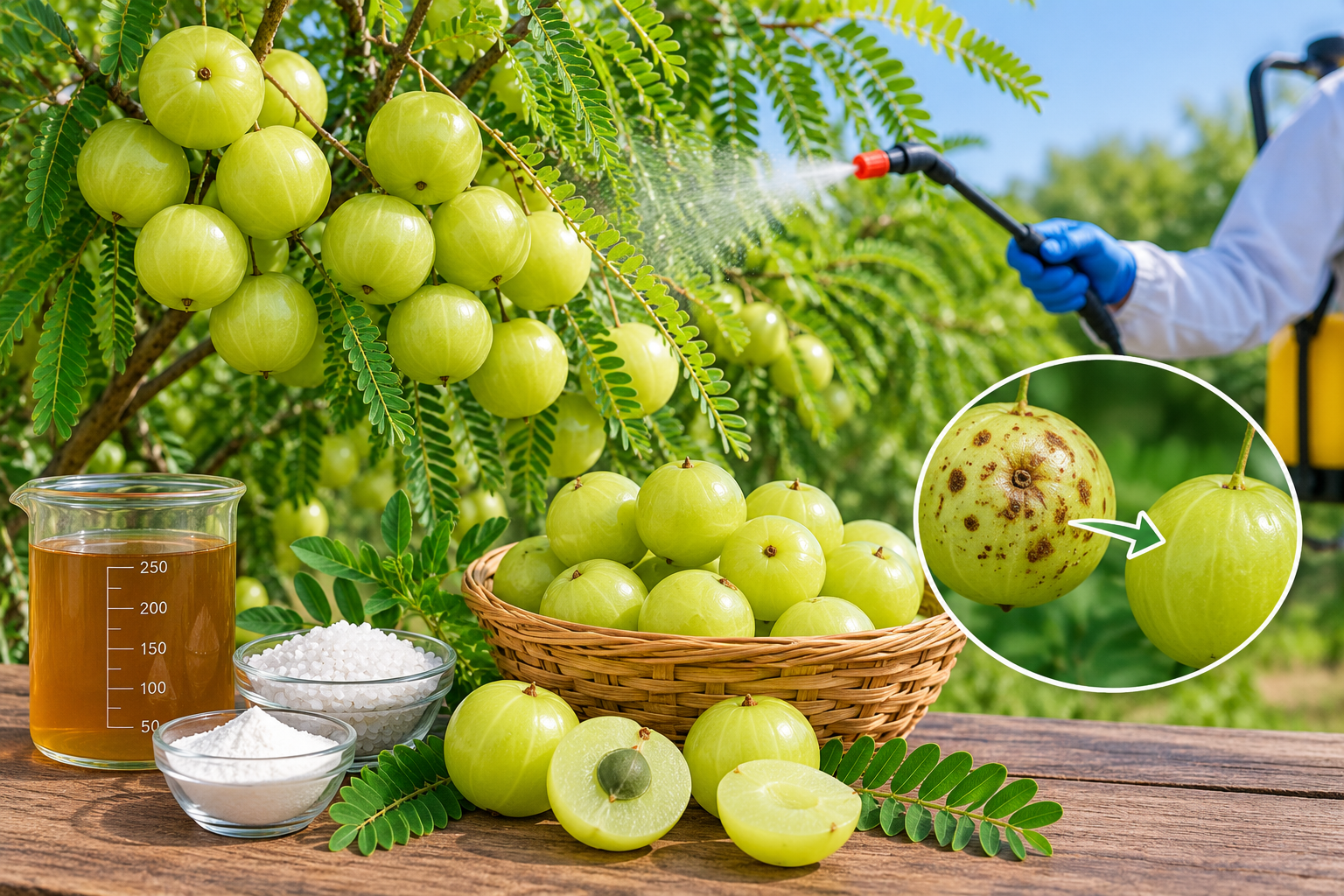
Aonla or Indian gooseberry is an indigenous fruit to Indian subcontinents, which is regarded as amritphal. It is cultivated in India in 95000 ha area out of which more than 70% area is covered by cultivar NA-7. In north India, 30-80 percent of fruits are affected by brown spots. Such type of affected fruits has poor marketability and is not very suitable for processing purposes. Therefore, an investigation was carried out on the effect of the pre-harvest spray of PGRs, calcium, and cow urine. The experiment was laid out in a randomized block design (RBD) with three replications and nine treatments i.e., T1- control, T2- Salicylic Acid @ 2 mmol + Mulch, T3- Calcium Nitrate (CN) @1℅ + Mulch, T4- Benzyl Adenine (BA) @75 ppm+ Mulch, T5- Salicylic acid @2 mmol + BA (Benzyl Adenine) @75ppm + Mulch, T6- Salicylic acid @2 mmol + Calcium nitrate @1℅ + Mulch, T7- Calcium nitrate @1℅ + BA (Benzyl Adenine) @75ppm + Mulch, T8- Cow Urine @35℅ + Mulch, T9- Mulch on aonla fruit at the Main Horticulture Experiment Station, A.N.D.U.A and T, Kumarganj, Ayodhya during the year 2021-22. These treatments were sprayed twice on the aonla tree, in order to standardize the best pre-harvest treatment for improving the yield and quality of aonla fruits.
References
[1] N. N. Barthakar and N. P. Arnold (1991). Chemical analysis of the aonla (Phyllanthus emblica L.) and its potential as a food source. Sci. Hortic., 47: 99-105.
[2] A. K. Singh, S. Singh, P. L. Saroj, D. S. Mishra, P. P. Singh and R. K. Singh (2019). Aonla (Emblica officinalis) in India: a review of its improvement, production and diversified uses. Indian J. Agric. Sci., 89: 1773-1781.
[3] R. K.Pathak (2003). Status Report on Genetic Resources of Indian Gooseberry-Aonla (Emblica officinalis Gaertn.) in South and Southeast Asia. IPGRI Office for South Asia National Agriculture Science Centre (NASC) DPS Marg, Pusa Campus, New Delhi, India, pp1-96.
[4] R. K. Goyal, A. R. P. Kingsly, P. Kumar and H. Walia (2007). Physical and mechanical properties of Aonla fruits. J. Food Eng., 82: 595-599.
[5] K. Ghorai and V. Sethi (1996). Varietal suitability of Amla (‘Desi’ and ‘Banarasi’) fruits for storage and preservation. Indian Food Packer 50: 11-18.
[6] S. K. Jain and D. S. Khurdiya (2004). Vitamin C enrichment of fruit juice based Ready-to-serve beverage through blending of Indian gooseberry (Emblica officinalis Gaertn.) juice. Plant Foods Hum. Nutr., 59: 63-66.
[7] Z. V. P. Murthy and D. Joshi (2007). Fluidized bed drying of Aonla (Emblica officinalis). Drying Technol., 25: 883-889.
[8] M. S. Baliga and J. J. Dsouza (2011). Amla (Emblica officinalis Garten), a wonder berry in the treatment and prevention of cancer. Eur. J. Cancer Prev., 20: 225-239.
[9] S. Rangana (1977). Manual for analysis of fruit and vegetable products. Tata McGraw Hill, New Delhi.
[10] M. Somogyi (1945). A new reagent for the determination of sugars. J. Biol. Chem., 160: 61-68.
[11] F. Yates and K. Mather (1963). Ronald Aylmer Fisher Biographical memoirs of fellows of the Royal Society of London 9: 91–120.
[12] G. K. Randhawa and R. Sharma (2015). Chemotherapeutic potential of cow urine: A review. J. Intercult. Ethnopharmacol., 4: 180-186.
[13] M. Devasena and V. Sangeetha (2022). Cow urine: Potential resource for sustainable agriculture. In: Emerging Issues in Climate Smart Livestock Production, (pp247-262). Academic Press.
[14] M. A. Kader, A. Singha, M. A. Begum, A. Jewel, F. H. Khan and N. I. Khan (2019). Mulching as water-saving technique in dryland agriculture. Bulletin of the National Research Centre, 43: 1-6.
[15] S. Jandaik, P. Thakur and V. Kumar (2015). Efficacy of cow urine as plant growth enhancer and antifungal agent. Adv. Agric., Article ID 620368, doi: 10.1155/2015/620368.
[16] M. Goutam, H. S. Dhaliwal and B. V. C. Mahajan (2010). Effect of preharvest calcium sprays on post-harvest life of winter guava (Psidium guajava L.). J. Food Sci. Technol., 47: 501-506.
[17] M. Kazemi, M. Aran and S. Zamani (2011). Effect of salicylic acid treatments on quality characteristics of apple fruits during storage. Am. J. Plant Physiol., 6: 113-119.
[18] V. Rabiei, E. Shirzadeh, Y. Sharafi and N. Mortazavi (2011). Effects of postharvest applications of calcium nitrate and acetate on quality and shelf-life improvement of Jonagold apple fruit. J. of Med. Plants Res., 5: 4912-4917.
[19] H. Zeraatgar, G. H. Davarynejad, F. Moradinezhad and B. Abedi (2018). Effect of salicylic acid and calcium nitrate spraying on qualitative properties and storability of fresh jujube fruit (Ziziphus jujube Mill.). Not. Bot. Horti. Agrobot. Cluj Napoca., 46: 138-147.
[20] D. Erogul and I. Özsoydan (2020). Effect of pre-harvest salicylic acid treatments on the quality and shelf life of the ‘Cresthaven’ peach cultivar. Folia. Hortic., 32: 221-227.
[21] I. Ali, X. Wang, M. J. Tareen, F. M. Wattoo, A. Qayyum, M. U. Hassan, and M. Shafique et al., (2021). Foliar application of salicylic acid at different phenological stages of peach fruit CV. ‘Flordaking’ improves harvest quality and reduces chilling injury during low temperature storage. Plants, 10: 1981. doi: 10.3390/plants10101981.
[22] Liao L., Dong T., Qiu X., Rong Y., Wang Z., Zhu J. (2019). Nitrogen nutrition is a key modulator of the sugar and organic acid content in citrus fruit. PloS One, 14: e0223356. doi: 10.1371/journal.pone.0223356.
[23] A. Spironella, J. A. Quaggio, T. L. A. Junqueira, J. M. M. Sigrist (2004). Pineapple yield and fruit quality affected by NPK fertilization in a tropical soil. Rev. Bras. Frutic., 26:155-159
[24] R. K. Goyal, A. R. P. Kingsly, P. Kumar and H. Walia (2007). Physical and mechanical properties of aonla fruits. J. Food Eng., 82: 595-599.
Downloads
Published
Issue
Section
License
Copyright (c) 2023 Author (s)

This work is licensed under a Creative Commons Attribution-NonCommercial-NoDerivatives 4.0 International License.
Copyright © The Author(s). This is an open access article distributed under the terms of the Creative Commons Attribution-NonCommercial-NoDerivatives 4.0 International License (CC BY-NC-ND 4.0), which permits unrestricted non-commercial use, distribution, and reproduction in any medium, provided the original author(s) and source are properly credited, and the work is not modified or adapted.