Evaluation of various substrates for mass production and shelf life of Trichoderma asperellum
DOI:
https://doi.org/10.31783/elsr.2023.92137146Keywords:
formulation, fungal bio-agent, mass production, shelf lifeAbstract
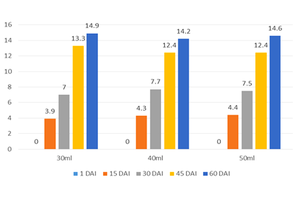
Trichoderma species, which belong to the genus Trichoderma and the order Hypocreales within the Ascomycota phylum, are highly promising bio-control agents. They are commonly present in natural soil, decaying organic plant matter, and wood, demonstrating remarkable efficacy in combating various plant diseases, including those caused by parasitic nematodes. Being imperfect fungi, the formulation and shelf-life of Trichoderma species play vital roles in ensuring their successful utilization in commercial applications. The present study aimed to assess different substrates for mass production and shelf-life of two Trichoderma asperellum isolates, FbMi4 and FbMi6. The initial spore count of T. asperellum FbMi4 at three concentrations (30, 40, and 50 ml/100 g carrier) on the first day were 226×106, 255×106, and 291×106 spores/ml, respectively. Over a storage period of 60 days, the spore populations gradually decreased to 149×106, 169×106, and 192×106 spores/ml, with reductions in viability of 14.9%, 14.2%, and 14.6% for the respective concentrations. The study also found similar trends in T. asperellum FbMi6 and sorghum grains talc-based formulations. Neem cake, an organic amendment, outperformed potato dextrose broth in producing spores, even after 45 days of storage. Remarkably, the formulated solutions maintained a substantial number of viable spores for up to 60 days, indicating their potential for extended shelf-life and storage. These findings emphasize the significance of selecting appropriate substrates to achieve mass production and long-term viability of Trichoderma as an effective bio-control agent against various plant diseases, including those caused by parasitic nematodes.
References
[1] G. H. Panahian, K. Rahnama and M. Jafari (2012). Mass production of Trichoderma spp. and application. Int. Res. J. Appl. Basic Sci., 3: 292-298.
[2] L. V. Kolombet, S. K. Zhigletsova, N. I. Kosareva, E. V. Bystrova, V. V. Derbyshev, S. P. Krasnova and D. Schisler (2008). Development of an extended shelf-life, liquid formulation of the biofungicide Trichoderma asperellum. World J. Microbiol. Biotechnol., 24: 123-131.
[3] K. Perveen and N. A. Bokhari (2012). Antagonistic activity of Trichoderma harzianum and Trichoderma viride isolated from soil of date palm field against Fusarium oxysporum. Afr. J. Microbiol. Res., 6: 3348-3353.
[4] A. Reena, M. Anitha, O. S. Aysha, S. Valli, P. Nirmala and P. Vinothkumar (2013). Antagonistic activity of Trichoderma viride isolate on Soil borne plant pathogenic fungi. Int. J. Bioassays., 2: 294-297.
[5] P. Chaudhary, S. Singh, A. Chaudhary, A. Sharma and G. Kumar (2022). Overview of biofertilizers in crop production and stress management for sustainable agriculture. Front. Plant Sci., 13: 930340. doi: 10.3389/fpls.2022.930340.
[6] D. Rai and A. K. Tewari (2016). Shelf life studies of different formulations based on Trichoderma harzianum (Th14). J. Biol. Sci., 7: 1-5.
[7] K. N. Babu and P. N. Pallavi (2013). Isolation, identification and mass multiplication of Trichoderma- an important bio-control agent. Int. J. Pharm. Life Sci., 4: 2320-2323.
[8] S. R. Niranjana, S. Lalitha and P. Hariprasad (2009). Mass multiplication and formulations of bio-control agents for use against fusarium wilt of pigeon pea through seed treatment. Int. J. Pest Manage., 55: 317-324.
[9] Y. Yan, Q. Mao, Y. Wang, J. Zhao, F. Yalun, Z. Yang and X. Peng et al., (2021). Trichoderma harzianum induces resistance to root-knot nematodes by increasing secondary metabolite synthesis and defense-related enzyme activity in Solanum lycopersicum L. Biol. Control., 158: 104609. doi: 10.1016/j.biocontrol.2021.104609.
[10] N. W. Zaidi and U. S. Singh (2004). Use of farmyard manure for mass multiplication and delivery of biocontrol agents, Trichoderma harzianum and Pseudomonas fluorescens. Asian Agrihist., 8(4): 297-304.
[11] S. Kumar, M. Thakur and A. Rani (2014). Trichoderma: Mass production, formulation, quality control, delivery and its scope in commercialization in India for the management of plant diseases. Afr. J. Agric. Res., 9: 3838-3852.
[12] S. Kannangara, R. M. G. C. S. Dharmarathna and D. L. Jayarathna (2017). Isolation, identification and characterization of Trichoderma species as a potential bio-control agent against Ceratocystis paradoxa. J. Agric. Sci., 12: 51-62.
[13] J. A. Lewis, G. C. Papawizas (1984). Chlamydospore formation by Trichoderma spp.in natural substrates. Can. J. Microbiol., 30: 1-7.
[14] B. R. Kerry (2000). Rhizosphere interactions and the exploitation of microbial agents for the biological control of plant-parasitic nematodes. Annu. Rev. Phytopathol., 38: 423-441.
[15] A. Q. Rajput, M. A. Khanzada and S. Shahzad (2014). Effect of different substrates and carbon and nitrogen sources on growth and shelf life of Trichoderma pseudokoningii. Int J Agric Biol., 16: 893-898.
[16] S. Kumar, P. D. Roy, M. Lal, G. Chand and V. Singh (2014). Mass multiplication and shelf-life of Trichoderma species nature to survive. The Bioscan., 9: 1143-1145.
[17] N. Hewavitharana, S. D. P Kannangara and S. P. Senanayake (2018). Isolation, identification and mass production of five Trichoderma spp. on solid and liquid carrier media for commercialization. Int. J. appl. Sci. Biotechnol., 6: 285-293.
[18] K. C. Kumhar, A. Babu, M. Bordoloi and A. Ali (2014). Evaluation of culture media for biomass production of Trichoderma viride (KBN 24) and their production economics. Am. J. Agric. Forestr., 2: 317-320.
[19] A. S. Alwadai, K. Perveen and M. Alwahaibi (2022). The isolation and characterization of antagonist Trichoderma spp. from the soil of Abha, Saudi Arabia. Molecules., 27: 2525. doi: 10.3390/molecules27082525.
[20] K. Sorathiya, K. Sorathiya, S. Kalariya and L. Patel (2023). Development and evaluation of a liquid formulation of Trichoderma viride as a Bio-pesticide for pest management. Int. J. Appl. Sci. Biotechnol., 11: 60-65.
[21] A. Singh, S. Srivastava and H. B. Singh (2007). Effect of subtracts on growth and shelf life of Trichoderma harzianum and its use in biocontrol of diseases. Bioresour. Technol., 98: 470-473.
[22] R. B. Gaur, R. N. Sharma and R. R. Sharma (2005). Shelf life of talc based formulation of Trichoderna and soil application for biological control of dry root rot of chickpea. J. Mycol. Plant Pathol., 35: 380-384.
[23] S. Khan, N. B. Bagwan, M. A. Iqbal and R. R. Tamboli (2011). Mass multiplication and shelf life of liquid fermented final product of Trichoderma viride in different formulations. Adv. Biores., 2: 178-182.
[24] C. R. Rini and K. K. Sulochana (2007). Substrate evaluation for multiplication of Trichoderma spp. J. Trop. Agric., 45: 58-60.
[25] S. Dawar and A. Ghaffar (2003). Screening of substrates for mass production of biocontrol agents, Pak. J. Bot., 35: 409-414.
[26] K. K. Pandey (2009). Evaluation of different agricultural based substrate for mass multiplication of Trichoderma viride using various agro-products. Indian Phytopathol., 62: 530-532.
[27] L. Tewari and C. Bhanu (2004). Evaluation of agro- industrial wastes for conidia based inoculum production of bio-control agent: Trichoderma harzianum. J. Sci. Ind. Res., 63: 807-812.
[28] K. A. Saju, M. Anandaraj and Y. R. Sama (2002). On-farm production of Trichoderma harzianum using organic matter. Indian Phytopathol., 55: 277-281.
[29] A. Mustafa, M. A. Khan, M. Inam-ul-Haq, S. H. Khan and M. A. Pervez (2009). Mass multiplication of Trichoderma species on organic substrates and their effect in management of seed borne fungi. Pak. J. Phytopathol., 21: 108-114.
[30] F. A. Mohiddin, I. Bashir, A. P. Shahid and H. Burhan (2017). Evaluation of different substrates for mass multiplication of Trichoderma species. J. Pharmacogn. Phytochem., 6: 563-56.
[31] R. Saharan (2021). Isolation, identification and evaluation of indigenous fungal bio-agents against Meloidogyne incognita in okra. Thesis Nematology, CCSHAU, Hisar.
Downloads
Published
Issue
Section
License
Copyright (c) 2023 Author (s)

This work is licensed under a Creative Commons Attribution-NonCommercial-NoDerivatives 4.0 International License.
Copyright © The Author(s). This is an open access article distributed under the terms of the Creative Commons Attribution-NonCommercial-NoDerivatives 4.0 International License (CC BY-NC-ND 4.0), which permits unrestricted non-commercial use, distribution, and reproduction in any medium, provided the original author(s) and source are properly credited, and the work is not modified or adapted.