
Host extracts, sugars and amino acids concentrations enhanced growth of Macrophomina phaseolina
DOI:
https://doi.org/10.31783/elsr.2023.92147158Keywords:
amino acid sources, carbon, Macrophomina phaseolina, oilseed cropsAbstract
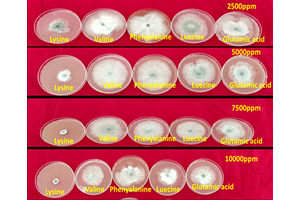
Macrophomina phaseolina is a soil inhabitant and it is pathogenic to a wide range of host crops. In the present investigation, M. phaseolina was grown in an enriched medium using semi mature stage of plant parts i.e. capsule/pod/head, leaf, stem, root Viz., castor, safflower, mustard, sunflower, groundnut, soybean, sesame crop parts were used at different concentrations. Furthermore, various carbon and amino acid sources were assessed at different concentrations to investigate their impact on the fungus growth under controlled in-vitro conditions. Results showed oil seed crop extracts significantly enhanced mycelial growth was recorded at all concentrations except castor stem extract which recorded the lowest mycelial growth over control, therefore carbon sources @ 250 ppm and 500 ppm of galactose, mannose, inositol, glucose, fructose, dextrose, and mannitol significantly influenced mycelial growth of M. phaseolina. All eight carbon sources have shown almost similar trends of mycelial development and amino acid sources @ 2500 ppm, 5000 ppm, 7500, and 10000 ppm showed maximum mycelial growth was recorded at 2500 ppm, 5000 ppm, 7500 ppm as increasing concentration reduced growth of mycelium however L-Lysine monohydrate recorded lowest mycelial growth at all concentrations.
References
[1] M. A. El-Hamid and S. A. El-Bramawy (2010). Genetic analysis of yield component and disease resistance in sesame (Sesame indicum L.) using two progenies of diallel crosses. Res. J. Agron., 4: 44-56
[2] E. A. Weiss (1971). Castor, sesame and safflower. Cambridge University Press, London.
[3] Y. S. Shyu and L. S. Hwang (2002). Antioxidative activity of the crude extract of lignan glycosides from unroasted Burma black sesame meal. Food. Res. Int., 35: 357-365.
[4] J. D. Mihali, and S. J. Taylor (1995). Interpreting variability among isolates of Macrophomina phaseolina in pathogenicity, pycnidium production and chlorate utilization. Can. J. Bot., 73: 1596-1603
[5] B. Sutton (1980). The Coelomycetes: fungi imperfecti with pycnidia acervuli and stromata. Commonwealth Mycological Institute, Kew, pp1-696.
[6] H. K. Abbas, N. Bellaloui, C. Accinelli, J. R. Smith and W. T. Shier (2019).Toxin production in soybean (Glycine max L.) plants with charcoal rot disease and by Macrophomina phaseolina, the fungus that causes the disease. Toxins, 11: 645. doi: 10.3390/toxins11110645.
[7] V. H. Khambhati, H. K. Abbas, M. Sulyok, M. Tomaso-Peterson and W. T. Shier (2020). First report of the production of mycotoxins and other secondary metabolites by Macrophomina phaseolina (Tassi) Goid. Isolates from soybeans (Glycine max L.) symptomatic with charcoal rot disease. J. Fungi, 6: 332. doi: 10.3390/jof6040332.
[8] S. Lodha and R. Mawar (2020). Population dynamics of Macrophomina phaseolina in relation to disease management: A review. J. Phytopathol., 168: 1-17.
[9] T. K. Dhar, K. A. Siddiqui and E. Ali (1982). Structure of phaseolinone, a novel phytotoxin from Macrophomina phaseolina. Tetrahedron Lett., 23: 5459-5462.
[10] S. B. Mahato, K. A. Siddiqui, G. Bhattacharya, T. Ghosal, K. Miyahara, M. Sholichin and T. Kawasaki (1987). Structure and stereochemistry of phaseolinic acid: A new acid from Macrophomina phaseolina. J. Nat. Prod., 50: 245-247.
[11] D. Bhattacharya, K. A. Siddiqui and E. Ali (1992). Phytotoxic metabolites of Macrophomina phaseolina. Indian J. Mycol. Plant Pathol., 22: 54-57.
[12] M. Ramezani, W. T. Shier, H. K. Abbas, J. L. Tonos, R. E. Baird and G. L. Sciumbato (2007). Soybean charcoal rot disease fungus Macrophomina phaseolina in Mississippi produces the phytotoxin (–)–botryodiplodin but no detectable phaseolinone. J. Nat. Prod., 70: 128-129.
[13] S. Lodha and R. Mawar (2020). Population dynamics of Macrophomina phaseolina in relation to disease management: A review. J. Phytopathol., 168: 1-17.
[14] O. D. Dhingra and J. B. Sinclair (1973). Variation among isolates of Macrophomina phaseoli (Rhizoctonia bataticola) from different regions. Phytopathol Z., 76: 200-204.
[15] F. Petrak (1923). Kykologische Notizen VI. Ann. Mycol., 21: 195-196.
[16] W. Mc Rae (1932). Report of the imperial mycologist. Scientific Report of Imperial Agricultural Research Institute for 1931, pp73-86. Pusa, India.
[17] A. Singh, T. P Bhowmik and A. Singh (1991). Prevalence and severity of root rot of sesamum caused by Macrophomina phaseolina. Indian Phytopath., 44: 235-238
[18] S. Sundararaman (1931). Administration report of the mycologist for the year. 1929-1930. Dept. Agric. Madras.
[19] T. Acharya and J. Hare (2022). Sabouraud agar and other fungal growth media. In: V. K. Gupta, M. Tuohy (eds) Laboratory protocols in fungal biology. Fungal Biology. Springer, Cham. doi: 10.1007/978-3-030-83749-5_2.
[20] R. B. Pandhare, R. W. Deshmukh and A. P. Suryawanshi (2015). Management of sorghum charcoal rot caused by Macrophomina phaseolina with amendments. National symposium on Prospects in diversity, diagnosis and management of the diseases of horticultural and field crops. COA, Badnapur., pp54-55.
[21] S. I. Sayyad, T. R. Mogle and M. M. Sonkamble (2015). Cultural characterstics of Macrophomina phaseolina. Ann. Plant Prot. Sci., 23: 412-413.
[22] A. P. Suryawanshi, V.P. Mule, K. T. Apet, U. Dey, D. P. Kuldhar (2015). Integrated Managing Macrophomina phaseolina causing charcoal rot of sunflower (Helianthus annus) by soil amendment. Indian Phytopatholo., 68: 196-200.
[23] Z. A. Osman, S. M. Elsanousi and E. A. E. Elsheikh (2012). Plant materials as probable growth promoters for certain fungi. Eur. J. Exp. Biol., 2: 1785-1791.
[24] C. Channakeshava and N. S. Pankaja (2018). Effect of media, temperature, light, ph and nutrient source on growth and development of Bipolaris oryzae causing brown leaf spot of paddy. Int. J. Curr. Microbiol. App. Sci., 7: 1713-1722.
[25] P. A. Gaikwad, D. N. Dhutraj and C. V. Ambadkar (2020). Effect of organic and inorganic sources of carbon and nitrogen on growth and sclerotial production of Rhizoctonia bataticola causing dry root rot of chickpea. Int. J. Chem. Stud., 8: 1708-1711
[26] M. H. Mostafa and M. H. Mohamed (2018). Influence of different nitrogen sources on growth and pathogenic capability of Rhizoctonia solani causing root rot of Faba bean. Int. J. Phytopathol., 7: 19-29.
[27] S. Upamanyu and S. K. Gupta (2009). Physiological variation among French bean isolates of Rhizoctonia solani. J. Plant Dise. Sci., 4: 160-163.
Downloads
Published
Issue
Section
License
Copyright (c) 2023 Author (s)

This work is licensed under a Creative Commons Attribution-NonCommercial-NoDerivatives 4.0 International License.
Copyright © The Author(s). This is an open access article distributed under the terms of the Creative Commons Attribution-NonCommercial-NoDerivatives 4.0 International License (CC BY-NC-ND 4.0), which permits unrestricted non-commercial use, distribution, and reproduction in any medium, provided the original author(s) and source are properly credited, and the work is not modified or adapted.