
An analytical approach integrating GGE-Biplot and AMMI techniques for assessing genotype-environment interactions and yield stability in rice (Oryza sativa L.) genotypes
DOI:
https://doi.org/10.31783/elsr.2023.92168176Keywords:
AMMI, GGE biplot, G x E interaction, rice, stabilityAbstract
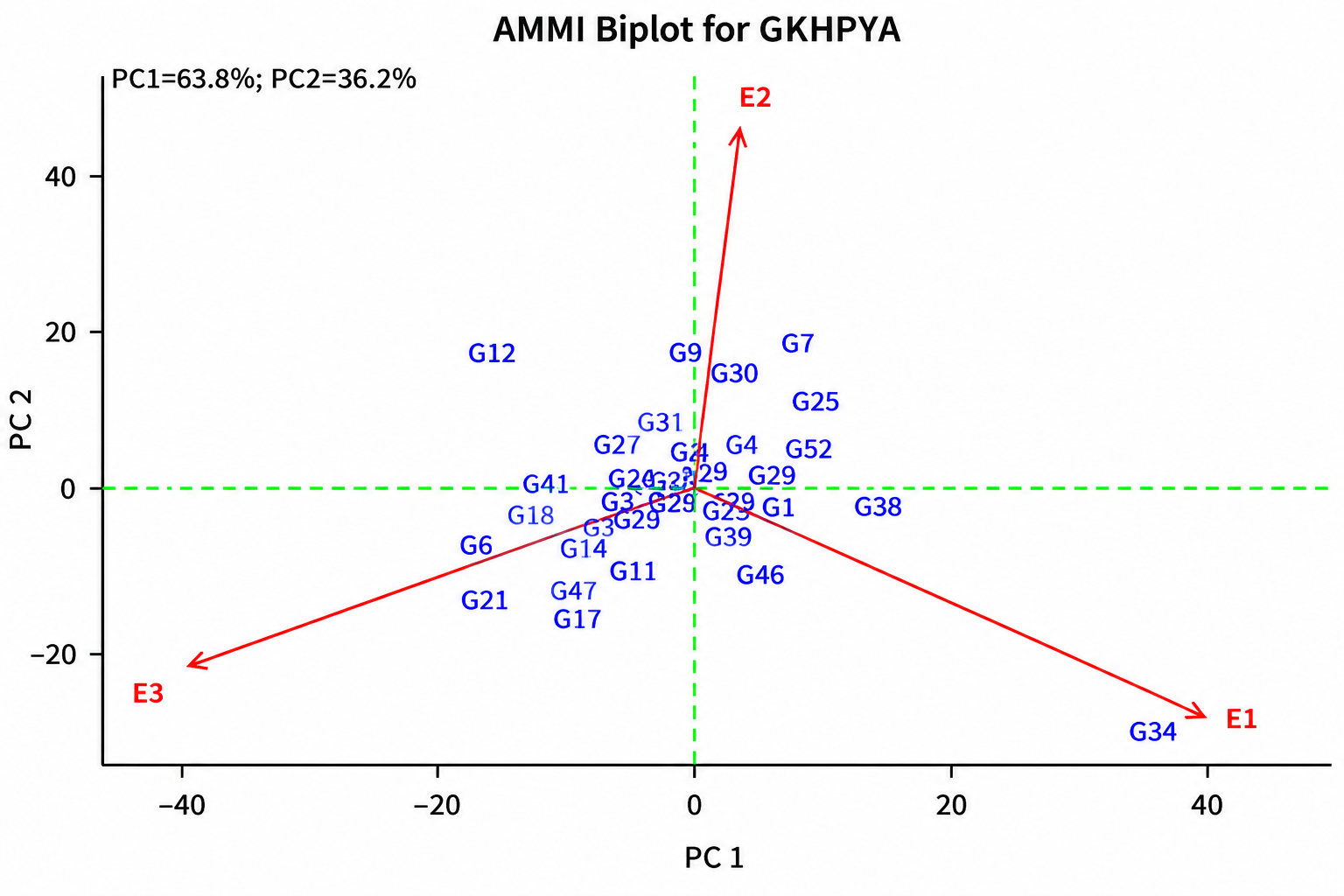
A study was conducted during the Kharif 2020 season in Eastern Uttar Pradesh, India, to investigate the interaction between genotype and environment (GxE) for 55 rice genotypes grown at three different locations. The analysis employed GGE Biplot and AMMI tools to evaluate and graphically visualize these locations for grain yield response to their interrelationships, discrimination ability, and representativeness. AMMI ANOVA revealed significant genotype-environment interactions. A lower value of ASV led to the most stable genotypes HL19WS-33B-369, HL19WS-33A-16, and HL19WS-33B-128, which produced the higher grain yield of all genotypes. The combined use of AMMI and GGE biplot approaches helped identify stable genotypes viz., BRRI Dhan 64, HL19WS-33B-171, HL19WS-33B-317, Samba Mahsuri, and HL19WS-33B-77, which can be proposed in the national testing programs to release new varieties. GGE biplots analysis depicted that all three locations fall under one mega environment. The genotypes, HL19WS-33B-359 and HL19WS-33A-51 exhibited the best yields in the mega-environment. In terms of genotype selection, E1 and E3 demonstrated effective genotypes with general adaptability and specific adaptability for yield, respectively. The mean v/s stability view shows genotype HL19WS-33B-359 to be ideal and most desirable among all other screened genotypes.
References
[1] S. Peng, R. C. Laza, R. M. Visperas, G. S. Khush and P. Virk (2005). Progress in breeding the new plant type for yield improvement: a physiological view. In: Toriyama K, Heong KL, Hardy B (eds) Rice is life: scientific perspectives for the 21st century. Proceedings of the World Rice Research Conference held in Tokyo and Tsukuba, Japan, 4–7 November 2004. pp130-132.
[2] Anonymous (2021). Pocket book of agriculture statistics. Govt. of India, Ministry of Agriculture and farmers welfare, Directorate of Economics and Statistics. 22-32.
[3] L. K. Bose, N. N. Jambhulkar and O. N. Singh (2014). Additive main effects and multiplicative interaction (AMMI) analysis of grain yield stability in early duration rice. J. Anim. Plant Sci., 24: 1885-1897.
[4] A. K. Dewi, M. A. Chozin, H. Triwidodo and H. Aswidinnoor (2014). Genotype× environment interaction, and stability analysis in lowland rice promising genotypes. Int. J. Agron. Agric. Res., 5: 74-84.
[5] A. Akter, J. M. Hassan, M. U. Kulsum, M. R. Islam, K. Hossain and M. M. Rahman (2014). AMMI biplot analysis for stability of grain yield in hybrid rice (Oryza sativa L.). J. Rice Res., 2: 126. doi: 10.4172/jrr.1000126.
[6] R. W. Zobel, M. J. Wright and H. G. Gauch (1988). Statistical analysis of a yield trial. Agron. J., 80: 388-393.
[7] H. G. Gauch and R. W. Zobel (1996). AMMI analysis of yield trails. In: M.S. Kang and H.G. Gauch (ed.) Genotype-by-environment interaction. CRC Press, Boca Raton, FL., pp85-122.
[8] L. C. I. D. Silveira, V. Kist, T. O. M. D. Paula, M. H. P. Barbosa, L. A. Peternelli and E. Daros (2013). AMMI analysis to evaluate the adaptability and phenotypic stability of sugarcane genotypes. Sci. Agric., 70: 27-32.
[9] J Crossa, H. G. Gauch and R. W. Zobel (1990). Additive main effects and multiplicative interaction analysis of two international maize cultivar trials. Crop Sci., 30: 493-500.
[10] M. Umadevi, and S. Manonmani (2018). AMMI analysis of grain yield in rice genotypes across environments. Electron. J. Plant Breed., 9: 135-145.
[11] N. Lingaiah, B. S. Chandra, V. Venkanna, K. R. Devi and Y. Hari (2020). AMMI Biplot analysis for genotype x environment interaction on yield in rice (Oryza sativa L.) genotypes. J. Pharmacogn. Phytochem., 9: 1384-1388.
[12] W. Yan (2002). Singular-value partition for biplot analysis of multi-environment trial data. Agronomy J., 94: 990-996.
[13] W. Yan and M. S Kang (2003). GGE Biplot Analysis: A graphical tool for breeders, geneticists, and agronomists. Boca Raton, FL, USA: CRC Press.
[14] W. Yan and N. A. Tinker (2006). Biplot analysis of multi-environment trial data: Principles and applications. Can. J. Plant Sci., 86: 623-645.
[15] M. N. Rad, M. A. Kadir, M. Y. Rafii, H. Z. Jaafar, M. R. Naghavi and F. Ahmadi (2013). Genotype x environment interaction by AMMI and GGE biplot analysis in three consecutive generations of wheat (Triticum aestivum) under normal and drought stress conditions. Aus. J. Crop Sci., 7: 956-961.
[16] Z. Haider, M. Akhter, A. Mahmood and R. A. R. Khan (2017). Comparison of GGE biplot and AMMI analysis of multi-environment trial (MET) data to assess adaptability and stability of rice genotypes. Afr. J. Agric. Res., 12: 3542-3548.
[17] H. Kesh, R. Kharb, K. Ram, R. Munjal, P. Kaushik and D. Kumar (2021). Adaptability and AMMI biplot analysis for yield and agronomical traits in scented rice genotypes under diverse production environments. Indian J. Tradit. Knowl., 20: 550-562.
[18] J. Rubio, J. I. Cubero, L. M. Martin, M. J Suso and F. Flores (2004). Biplot analysis of trait relations of white lupin in Spain. Euphytica, 135: 217-224.
[19] S. Chandrashekhar, R. Babu, P. Jeyaprakash, R. Umarani, K. Bhuvaneshwari and S. Manonmani (2020). Yield stability analysis in multi-environment trials of hybrid rice (Oryza sativa L.) in Northern India using GGE Biplot Analysis. Electron. J. Plant Breed., 11: 665-673.
[20] J. L. Purchase, H. Hatting and C. S. Van Deventer (2000). Genotype× environment interaction of winter wheat (Triticum aestivum L.) in South Africa: II. Stability analysis of yield performance. S. Afr. J. Plant Soil, 17: 101-107.
[21] R. Mohammadi and A. Amri (2008). Comparison of parametric and non-parametric methods for selecting stable and adapted durum wheat genotypes in variable environments. Euphytica, 159: 419-432.
[22] W. Yan, M. S. Kang, B. Ma, S. Woods and P. L. Cornelius (2007). GGE biplot vs. AMMI analysis of genotype‐by‐environment data. Crop Sci., 47: 643-653.
[23] M. Hasan, M. Kulsum, M. Mofazzel Hossain, Z. Akond and M. Rahman (2015). Identification of stable and adaptable hybrid Rice genotypes. SAARC J. Agri., 12: 1-15.
[24] G. L. Ashwini, M. P. Rajanna, C. A. Deepak, B. S. Chethana, D. Shobha, T. H. Gouda and B. M. Dushyanthkumar et al., (2019). Stability analysis for grain yield and quality traits in selected traditional and improved varieties of rice over different Zones of Karnataka. Oryza-An Int. J. Rice, 56: 193-203.
[25] V. Reddy, K. Mahantashivayogayya, J. R. Diwan, B. V. Tembhurne and D. Pramesh (2022). Assessment of genetic stability of medium slender rice genotypes for yield traits using AMMI model and gge biplot methodology over different locations of Karnataka. Int. J. Environ. Clim. Chang., 12: 67-75,
[26] A. Dwivedi, D. Basandrai and A. K. Sarial (2020). AMMI biplot analysis for grain yield of basmati lines (Oryza sativa L.) in North Western Himalayan Hill regions. Indian J. Genet. Plant Breed., 80: 140-146.
[27] A. Akter, M. J. Hasan, M. U. Kulsum, M. H. Rahman, A. K. Paul, L. F. Lipi and S. Akter (2015). Genotype× environment interaction and yield stability analysis in hybrid rice (Oryza sativa L.) by AMMI biplot. Bangladesh Rice J., 19: 83-90.
[28] C. K. Das, D. Bastia, B. S. Naik, B. Kabat, M. R. Mohanty and S. S. Mahapatra (2018). GGE biplot and AMMI analysis of grain yield stability and adaptability behaviour of paddy (Oryza sativa L.) genotypes under different agroecological zones of Odisha. Oryza-An Int. J. Rice, 55: 528-542.
[29] S. Jadhav, D. Balakrishnan, G. Shankar, K. Beerelli, G. Chandu and Neelamraju (2019). Genotype by environment (G×E) interaction study on yield traits in different maturity groups of rice. J. Crop Sci. Biotechnol., 22: 425–449.
[30] N. Hashim, M. Y. Rafii, Y. Oladosu, M. R. Ismail, A. Ramli, F. Arolu and S. Chukwu (2021). Integrating multivariate and univariate statistical models to investigate genotype–environment interaction of advanced fragrant rice genotypes under rainfed condition. Sustainability, 13: 4555. doi: 10.3390/su13084555.
[31] Y. C. Mohan, L. Krishna, B. Srinivas, K. Rukmini, S. Sreedhar, K. S. Prasad and N. S. Kishore et al., (2023). Stability analysis of short duration rice genotypes in Telangana using AMMI and GGE Bi-plot models. Environ. Conserv. J., 24: 243-252.
Downloads
Published
Issue
Section
License
Copyright (c) 2023 Author (s)

This work is licensed under a Creative Commons Attribution-NonCommercial-NoDerivatives 4.0 International License.
Copyright © The Author(s). This is an open access article distributed under the terms of the Creative Commons Attribution-NonCommercial-NoDerivatives 4.0 International License (CC BY-NC-ND 4.0), which permits unrestricted non-commercial use, distribution, and reproduction in any medium, provided the original author(s) and source are properly credited, and the work is not modified or adapted.