Optimization of intense plant to plant spacing of soybean [Glycine Max (L.) Merrill] for better productivity and quality seeds in the Western Himalayas
DOI:
https://doi.org/10.31783/elsr.2023.92177185Keywords:
oil content, protein content, soybean, spacing, varietyAbstract
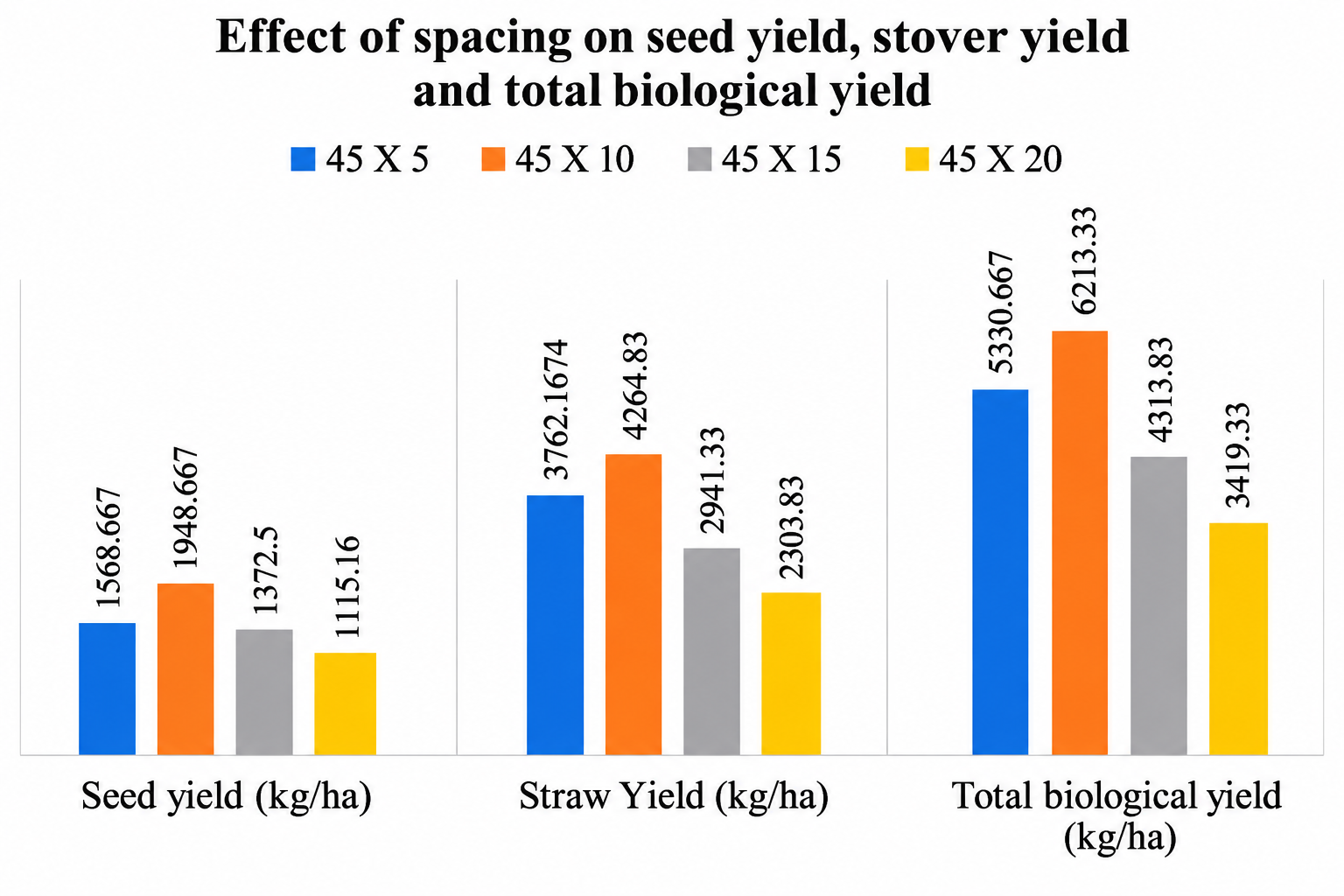
At the Pantnagar's Crop Research Centre, a field experiment was conducted during the 2019 Kharif season with the objective to establish the best plant-to-plant spacing for the PS 1092 and SL 958 soybean cultivars, which were developed especially for the western Himalayan region. The goal of the study was to determine how variable plant-to-plant spacing affected a variety of factors, including soybean production attributes, yield parameters, and quality metrics, particularly when ridge and furrow planting schemes were taken into consideration. The field experiment was laid out in a split-plot design, with four plant-to-plant spacing intervals (5 cm, 10 cm, 15 cm, and 20 cm) and two cultivars (PS 1092 and SL 958). Intense spacing treatments exhibited a discernible influence on soybean seed yield, stover yield, and total biological yield. The configuration of 45 cm × 10 cm spacing resulted in heightened productivity, showcasing maximal seed yield, stover yield, and total biological yield in comparison to alternative treatments. Furthermore, the stringent spacing regimens significantly impacted the quality parameters of soybeans. The protein content and oil content reached their zenith within plots featuring a plant-to-plant spacing of 10 cm. Intriguingly, no noteworthy differences surfaced in terms of productivity and quality parameters between the two soybean varieties. In summation, this study deduces that for achieving heightened productivity and superior quality of soybean varieties, PS 1092 and SL 958, in the Tarai conditions of the Western Himalayas, the recommended spacing of 45 cm × 10 cm holds promise.
References
[1] T. Hymowitz, F. I. Collins, J. Panczner and W. M. Walker (1972). Relationship between the content of oil, protein, and sugar in soybean seed. Agron. J., 64: 613-616.
[2] S. D. Billore and S. K. Srivastava (2014). Effect of seed rate and row spacing on productivity of soybean varieties under different agro-climatic zones of India. Soybean Research., 2: 83-89.
[3] O. S. Daramola, O. R. Adeyemi, J. A. Adigun and C. O. Adejuyigbe (2019). Row spacing and weed management methods influence growth and yield of soybean (Glycine max (L.) Merr.). Agric. Trop. Subtrop. 52: 59-71.
[4] G. Rasool, G. Mahajan, R. Yadav, Z. Hanif and B. S. Chauhan (2017). Row spacing is more important than the seeding rate for increasing Rhodes grass (Chloris gayana) control and grain yield in soybean (Glycine max). Crop Pasture Sci., 68: 620-624.
[5] R. H. Walker (1982). Crop manipulation in integrated weed management systems. Weed Sci., 30: 17-24.
[6] J. A. Liebert and M. R. Ryan (2017). High planting rates improve weed suppression, yield, and profitability in organically-managed, no-till–planted soybean. Weed Technol., 31: 536-549.
[7] W. J. Cox and J. H. Cherney (2011). Growth and yield responses of soybean to row spacing and seeding rate. Agron. J., 103: 123-128.
[8] O. Sobko, J. Hartung, S. Zikeli, W. Claupein and S. Gruber (2019). Effect of sowing density on grain yield, protein and oil content and plant morphology of soybean (Glycine max L. Merrill). Plant Soil Environ., 65: 594-601.
[9]C. S. Kahlon, B. Li, J. Board, M. Dia, P. Sharma and P. Jat (2018). Cluster and principle component analysis of soybean grown at various row spacings, planting dates and plant populations. Open Agric., 3: 110-121.
[10] D. L. Holshouser and J. P. Whittaker (2002). Plant population and row spacing effects on early soybean production systems in the Mid Atlantic USA. Agron. J., 94: 603-611.
[11] N. M. Thompson, J. A. Larson, D. M. Lambert, R. K. Roberts, A. Mengistu, N. Bellaloui and E. R. Walker (2015). Mid‐South soybean yield and net return as affected by plant population and row spacing. Agron. J., 107: 979-989.
[12] R. K. Singh, S. R. K. Singh, T. K. Singh, U. S. Gautam and A. K. Dixit (2013). Yield performance of soybean in Vindhyan plateau of Madhya Pradesh. Soybean Res., 11: 66-73.
[13] A. Negi (2017). Performance of soybean varieties under different land configurations in mollisols of himalayan tarai (thesis). G. B. Pant University of Agriculture and Technology, Pantnagar, Uttarakhand, India
[14] K. A. Gomez and A. A. Gomez (1984). Statistical procedures for agricultural research. (2nd edn), John Wiley and Sons.
[15] Y. Abeje, T. Tadesse and Y. Ousman (2020). Effects of inter and intra row spacing on yield and yield components of soybean (Glycine max L.) under rain fed condition in North Western Ethiopia. J. Biol. Agric. Healthcare, 10: 38-44.
[16] H. Deribe, T. Kufa and A. Nebiyu (2018). Response of soybean (Glycine max (L) Merrill) to plant population and NP fertilizer in Kersa Woreda of Jimma Zone, South Western Ethiopia. Int. J. Curr. Res. Aca. Rev., 6: 50-71.
[17] L. Gulluoglu, H. Bakal, A. El-Sabagh and H. Arioglu (2017). Soybean managing for maximize production: plant population density effects on seed yield and some agronomical traits in main cropped soybean production. J. Exp. Biol. Agric., 5: 31-37.
[18] B. Zaimoglu, H. H. Arioglu and M. Aslan (2004). Effects of seed quality on plant population and seed yield of double cropped soybean in the Mediterranean region of Turkey. Asian J. Plant Sci., 3: 574-577.
[19] K. Saitoh (2011). Effect of row-spacing and planting density on podding and yield performance of early soybean cultivar “Enrei” with reference to raceme order. In: El-Shemy H (Ed.). Agricultural and Biological Sciences .Soybean Physiology and Biochemistry. pp275-288.
[20] I. Nater, O. L. Osabuohein, U. M. Sesugh, E. G. Chibuike and O. Peter (2021). Effects of inter-row spacing on growth, seed yield and yield components of Soybean (Glycine max) in Makurdi, Benue State-Nigeria. Int. J. Agric. Sci. Vet. Med., 9: 18-24.
[21] M. Worku, T. Astatkie (2011). Row and plant spacing effects on yield and yield components of soya bean varieties under hot humid tropical environment of Ethiopia. J. Agron. Crop Sci., 197: 67-74.
[22] T. Ohyama, R. Minagawa, S. Ishikawa, M. Yamamoto, N. V. P. Hung, N. Ohtake and K. Sueyoshi et al., (2013). Soybean seed production and nitrogen nutrition. In: A Comprehensive Survey of International Soybean Research-Genetics, Physiology, Agronomy and Nitrogen Relationships (E.B. James, ed), pp115-157. Rijeka: InTech.
[23] R. A. Ball, R. W. McNew, E. D. Vories, T. C. Keisling and L. C. Purcell (2001). Path analyses of population density effects on short-season soybean yield. Agron. J., 93: 187-195.
[24] M. Aslam, N. A. Khan, M. S. Mirza, and Naeemullah (1993). Effect of different row and plant spacings on soybean yield and its components. Pakistan J. Agric. Res., 14: 143- 148.
[25] A. S. M. G. Akond, R. Bobby, R. Bazzelle, W. Clark, S. K. Kantartzi, K. Meksem and A. Kassem (2013). Effect of two row spaces on several agronomic traits in soybean [Glycine max (L.) Merr.]. Atlas J. Plant Biol., 1: 18-23.
[26] M. Joshi (2012). Effect of seed rate, spacing and its economics of newly released soybean [Glycine Max (L.) Merr.] Varieties in Uttarakhand (Thesis). G. B. Pant University of Agriculture and Technology, Pantnagar, Uttarakhand, India.
[27] S. Gurmu (2023). Plant Population Density Effects on Yield and yield components of Soybean (Glycine max. L.) Varieties in Ethiopia-A Review. Glob. J. Multidiscip. Stud., 2: 26-30
[28] P. K. Schmitz, J. D. Stanley, and H. Kandel (2020). Row spacing and seeding rate effect on soybean seed yield in North Dakota. Crop. Forage Turfgrass Manag., 6: e20010. doi: 10.1002/cft2.20010.
[29] J. L. De Bruin and P. Pedersen (2008). Effect of row spacing and seeding rate on soybean yield. Agron. J., 100: 704-710.
[30] E. Kumagai (2021). Agronomic responses of soybean cultivars to narrow intra-row spacing in a cool region of northern Japan. Plant Prod. Sci., 24: 29-40.
[31] M. Schutt and T. Nleya (2019). Row spacing and seeding rate effects on soybean seed yield. In: M. Kasai (Ed.), Soybean-Biomass, yield and productivity. IntechOpen. doi:10.5772/intechopen.80748.
[32] Y. Hilena (2023). Effects of fertilizer rate and row spacing on forage soybean [Glycine max (L) merrill] biomass yield and nutritional quality under irrigation at koga site, west gojam zone, amhara region (Thesis). Bahirdar University, Ethiopia.
[33] B. S. Chauhan and J. L. Opena (2013). Effect of plant spacing on growth and grain yield of soybean. Am. J. Plant Sci., 4: 2011-2014.
[34] V. Popovic, M. Vidic, D. Jockovic, J. Ikanovic, S. Jaksic and G. Cvijanoviv (2012). Variability and correlations between yield compo¬nents of soybean (Glycine max (L.) Merr.). Genetika, 44: 33-45.
[35]M. Flajsman, I. Santavec, A. Kolmanic and D. K. Acko (2019). Bacterial seed inoculation and row spacing affect the nutritional composition and agronomic performance of soybean. Int. J. Plant Prod., 13: 183-192.
Downloads
Published
Issue
Section
License
Copyright (c) 2023 Author (s)

This work is licensed under a Creative Commons Attribution-NonCommercial-NoDerivatives 4.0 International License.
Copyright © The Author(s). This is an open access article distributed under the terms of the Creative Commons Attribution-NonCommercial-NoDerivatives 4.0 International License (CC BY-NC-ND 4.0), which permits unrestricted non-commercial use, distribution, and reproduction in any medium, provided the original author(s) and source are properly credited, and the work is not modified or adapted.