
Impact of site specific nutrient omission technique on growth, yield and quality of QPM
DOI:
https://doi.org/10.31783/elsr.2023.92186195Keywords:
crop growth rate, leaf area index, nutrient omission, quality protein maize, seed indexAbstract
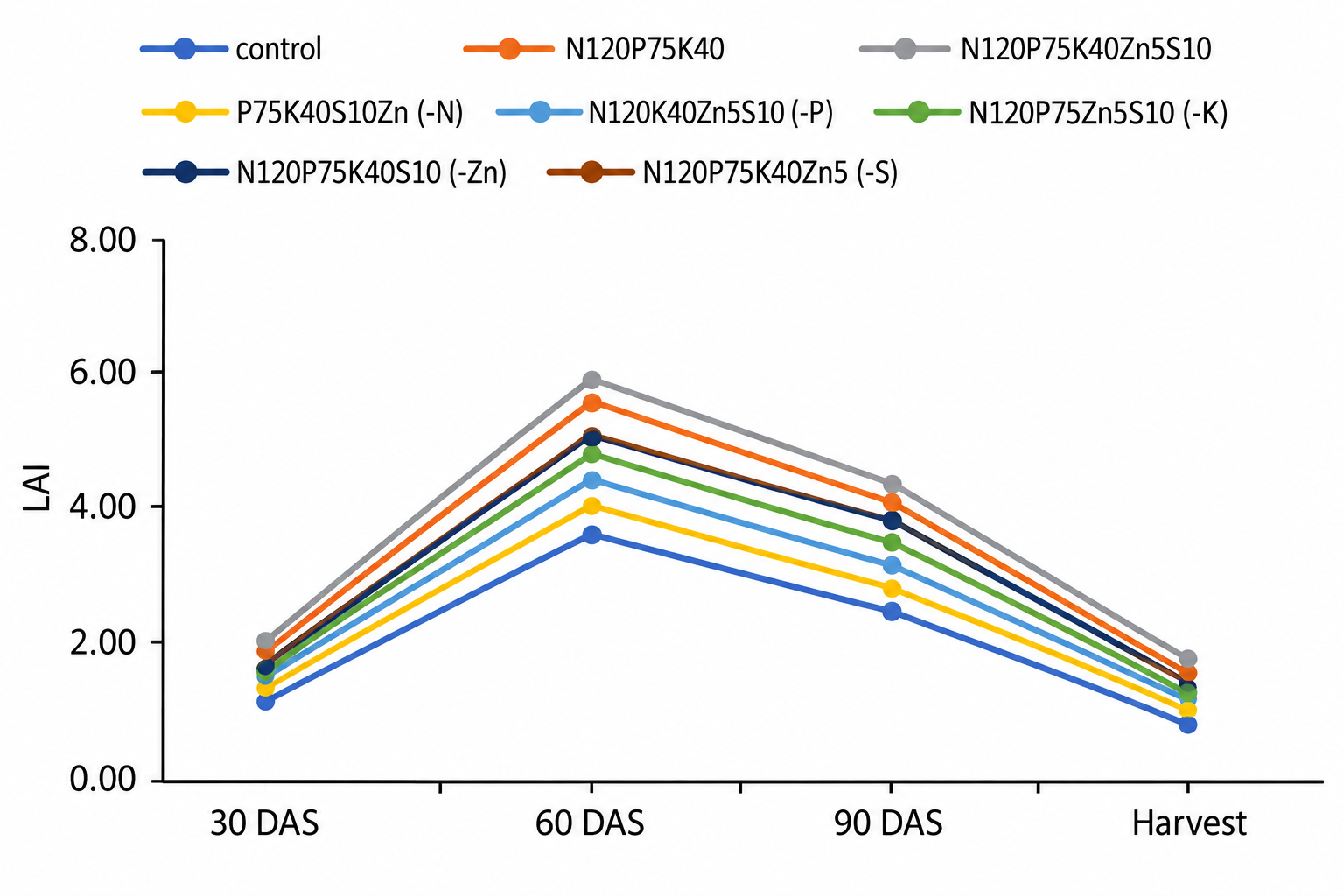
Maize holds immense importance as the most widely cultivated crop on a global scale. It exhibits remarkable responsiveness to the external application of fertilizers and the optimal doses of nutrients are essential to augment the growth as well as yield characteristics of maize. Therefore, to investigate the nutrient omission impact on crop growth and yield of quality protein maize (LQMH-1 hybrid) under SSNM application of nutrients, a study was performed at an Agricultural Research Farm, FoA, Wadura, SKUAST Kashmir, India, during Kharif season 2021. The experiment comprised of eight treatments viz., absolute control (T1), NPK (T2), NPKZnS (T3), PKZnS (-N) (T4), NKZnS (-P) (T5), NPZnS (-K) (T6), NPKS (-Zn) (T7) and NPKZn5 (-S) (T8) in RCBD experimental design with three replications. The application of NPKZnS led to a substantial increase in yield metrics, including cob length, cob diameter, ear height, grain rows per cob, and seed index. The treatment (T3) attained a significantly higher leaf area index of 5.82 at 60 DAS with CGR of 2.78g m-2 day-1 at 60-90 DAS and RGR of 52.74 mg g-1 day-1 between 30-60 DAS and also recorded maximum protein content (9.5%). Among the omission of nutrients, nitrogen was found to be the most limiting nutrient that drastically reduced LAI, CGR, RGR, yield characters, and protein content of maize which was trailed by P omission and K omission. However, the omission of Zn and S had the least significant impact on the performance of the QPM hybrid.
References
[1] DES (2020). Agriculture statistics at glance, published by Directorate of Economics and Statistics. New Delhi.
[2] B. M. Prasanna, S. K. Vasal, B. Kassahum and N. N. Singh (2001). Quality protein maize. Curr. Sci., 81: 1308-1319.
[3] P. K. Kataki and S. C. Babu (2002). Food systems for improved human nutrition: Linking agriculture, nutrition and productivity. 394. Binghamton: Food Products Press.
[4] G. W. Xu, G. L. Tan, Z. Q. Wang, L. J. Liu and J. C. Yang (2009). Effects of wheat residue application and site-specific nitrogen management on growth and development in direct seeded rice. Acta Agron. Sin., 35: 685-694.
[5] C. B. Chisanga, E. Phiri and V. R. N. Chinese (2017). Assessing crop growth indices and yield parameters for maize (Zea mays L.) under irrigated condition in a subtropical environment of Zambia. Int. J. Multidisciplinary Res. Rev., Paper-ID : CFP/394/2017.
[6] K. B. Amanullah, Marwat, P. Shah, N. Maula and S. Arifullah (2009). Nitrogen levels and its time of application influence leaf area, height and biomass of maize planted at low and high density. Pak. J. Bot., 41: 761-768.
[7] M. S. Zeidan, A. Amany and M. F. Bahr El-Kramany (2006). Effect of N fertilizer and plant density on yield and quality of maize in sandy soil. Res. J. Agric. Biol. Sci., 2: 156-161.
[8] S. A. Valadabadi and H. A. Farahani (2010). Effects of planting density and pattern on physiological growth indices in maize (Zea mays L.) under nitrogenous fertilizer application. J. Agric. Ext. Rural Dev., 2: 40-47.
[9] W. A. Hoffmann and H. Poorter (2002). Avoiding bias in calculations of relative growth rate. Ann. Bot., 90: 37-42.
[10] S. Hokmalipour and M. H. Darbandi (2011). Physiological growth indices in corn (Zea mays L.) cultivars as affected by nitrogen fertilizer levels. World Appl. Sci. J., 15: 1800-1805.
[11] R. S. Sharifi, Y. Raei and W. Weisany (2014). Study of physiological growth indices in maize (Zea mays L.) hybrids under different plant densities. Int. J. Biosci., 5: 100-109.
[12] J. C. L. Lukeba, R. K. Vumilia, K. C. K. Nkongolo, M. L. Mwabila and M. Tsumbu (2013). Growth and leaf area index simulation in maize (Zea mays L.) under small-scale farm conditions in a Sub-Saharan African region. Am. J. Plant Sci., 4: 575–583.
[13] J. T. Edwards, L. C. Purcell and E. D. Vories (2005). Light interception and yield potential of short-season maize (Zea mays L.) hybrids in the Midsouth. Agron. J., 97: 225-234.
[14] G. J. Bouyoucos (1962). Hydrometer method improved for making particle size analyses of soils. Agron. J., 54: 464-465.
[15] A. J. Walkley and I. A. Black (1934). Estimation of soil organic carbon by the chromic acid titration method. Soil Sci., 37: 29-38.
[16] M. L. Jackson (1962). Soil chemical analysis. Prentice Hall of India private limited, New Delhi, pp498.
[17] P. Redford (1967). Growth Analysis formulae-their use and abuse. Crop Sci., 7: 171-175.
[18] D. J. Watson (1952).The physiological basis of variation in yield. Adv. Agron., 4: 101-145.
[19] G. O. Kolawole, O. Eniola and Y. B. Oyeyiola (2018). Effects of nutrients omission on maize growth and nutrient uptake in three dominant soil types of southwestern Nigeria. J. Plant Nutr., 41: 1903-1915.
[20] M. A. A. Kumar, S. K. Gali and N. S. Hebsur (2007). Effect of different levels of NPK on growth and yield parameters of sweet corn. Karnataka J. Agric. Sci., 20: 41-43.
[21] V. Kumar, A. K. Singh, S. L. Jat, C. M. Parihar, V. Pooniya, S. Sharma and B. Singh (2014). Influence of site-specific nutrient management on growth and yield of maize (Zea mays) under conservation tillage. Indian J. Agron., 59: 657-660.
[22] D. Jinger, S. Dhar, A. Dass, V. K. Sharma, L. Shukla, V. Paramesh and M. Parihar et al., (2021). Growth indices, yield, nutrient uptake and soil enzyme activity of wheat as affected by residual effect of phosphorus and silicon. doi: 10.21203/rs.3.rs-930544/v1.
[23] M. R. Broadley, A. J. Escobar-Gutierrez, A. Burns and I. G. Burns (2000). What are the effects of nitrogen deficiency on growth components of lettuce? New Phytol., 14: 519-526.
[24] V. Sobhana, A. Kumar, L. K. Idnani, I. Singh and Shivadhar (2012). Plant population and nutrient requirement for baby corn hybrids (Zea mays). Indian J. Agron., 57: 294-296.
[25] E. Kolo, F. O. Takim and O. Fadayomi (2012). Influence of planting date and weed management practices on weed emergence, growth and yield of maize (Zea mays L.) in Southern Guinea Savanna of Nigeria. J. Agr. Biodiv. Res., 1: 33-42.
[26] R. K. Shivran, R. Kumar and A. Kumari (2013). Influence of sulphur, phosphorus and farm yard manure on yield attributes and productivity of maize (Zea mays L.) in humid south eastern plains of Rajasthan. Agric. Sci. Digest., 33: 9-14.
[27] R. R. Meena, H. S. Purohit, M. L. Khatik and H. K. Sumeriya (2013). Effect of site specific nutrient management on growth, productivity and macro nutrients in maize (Zea mays L.) under southern Rajasthan conditions. Annals Biol., 29: 364-369.
[28] A. Asghar, A. Ali, W. H. Syed, M. Asif, T. Khaliq and A. A. Abid (2010). Growth and yield of maize (Zea mays L.) cultivars affected by NPK application in different proportion. Pak. J. Sci., 62: 211-216.
[29] C. Muthaura, M. Mucheru-Muna, S. Zingore, J. Kihara and J. Muthamia (2017). Effect of application of different nutrients on growth and yield parameters of maize (Zea mays), case of Kandara Murang’a County. ARPN J. Agric. Biol. Sci., 12: 19-33.
[30] H. M. O. Otieno, G. N. Chemining’wa and S. Zingore (2018). Effect of farmyard manure, lime and inorganic fertilizer applications on soil pH, nutrients uptake, growth and nodulation of soybean in acid soils of western Kenya. J. Agric. Sci., 10: 199-208.
[31] M. Lashkari, H. Madani, M. R. Ardakani, F. Golarardi and K. Zargari (2011). Effect of plant density on yield and yield components of different corn (Zea mays L.) hybrids. American-Eurasian J. Agric. Environ. Sci., 10: 450-457.
[32] M. R. Umesh, N. Manjunatha, M. A. Shankar, and N. Jagadeesha (2014). Influence of nutrient supply levels on yield, nutrient uptake, grain quality and economics of corn (Zea mays L.) in Alfisols of Karnataka. Indian J. Dryland Agric. Res. Dev., 29: 73-78.
[33] B. Jamsheed, T. A. Bhat, A. A. Saad, A. Nazir, S. Fayaz,S. M. Eldin and B. Jan et al., (2023). Estimation of yield, phenology and agro-meteorological indices of quality protein maize (Zea mays L.) under different nutrient omissions in temperate ecology of Kashmir. J. King Saud Univ.–Sci., 35: 102808. doi: 10.1016/j.jksus.2023.102808.
[34] A. Rehman, M. F. Saleem, M. E. Safdar, S. Hussain and N. Akhtar (2011). Grain quality, nutrient use efficiency, and bioeconomics of maize under different sowing methods and NPK levels. Chil. J. Agric. Res., 71: 586-593.
Downloads
Published
Issue
Section
License
Copyright (c) 2023 Author (s)

This work is licensed under a Creative Commons Attribution-NonCommercial-NoDerivatives 4.0 International License.
Copyright © The Author(s). This is an open access article distributed under the terms of the Creative Commons Attribution-NonCommercial-NoDerivatives 4.0 International License (CC BY-NC-ND 4.0), which permits unrestricted non-commercial use, distribution, and reproduction in any medium, provided the original author(s) and source are properly credited, and the work is not modified or adapted.