Variability in diamondback moth larval abundance: A seasonal and geographic perspective
DOI:
https://doi.org/10.31783/elsr.2023.92201207Keywords:
crucifers, diamondback moth, infestation, weather parametersAbstract
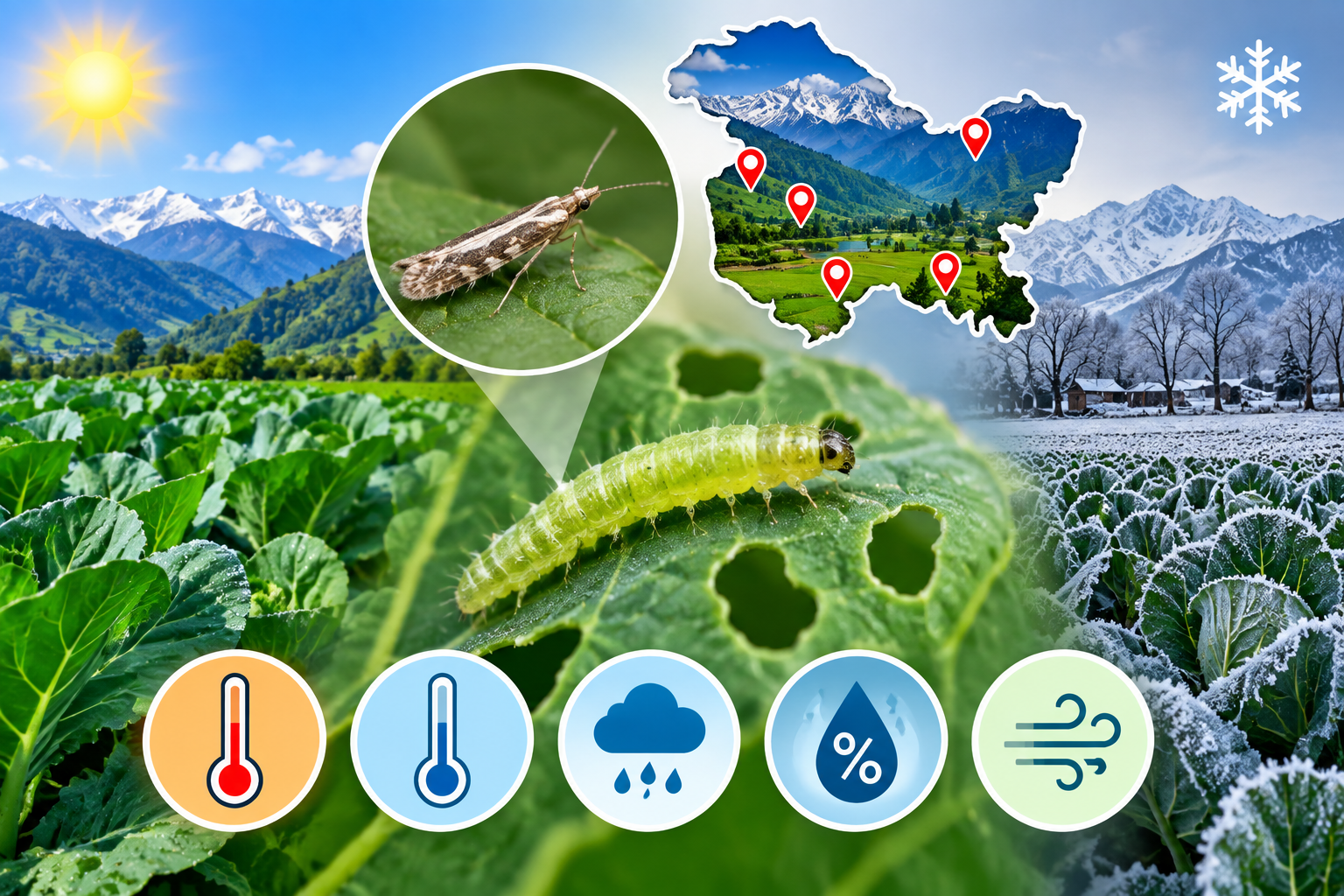
Jammu and Kashmir supports a flourishing vegetable cultivation sector, with cruciferous vegetables playing a vital role in the regional economy and dietary habits. In the year 2022, an experiment was conducted to monitor the population dynamics of diamondback moth larvae at different locations in the region during the Kharifand Rabi seasons. Our findings revealed that during the Kharifseason, the larval population commenced its rise from mid-May and peaked towards the end of June to early July. In contrast, during the Rabi season, larval activity began in September, with the maximum population observed in early to mid-October. Furthermore, correlation studies revealed intriguing relationships between weather parameters and larval population dynamics. In the Kharifseason, maximum temperature exhibited a positive and non-significant correlation with the larval population, while in the Rabi season; it displayed a negative and non-significant correlation. Conversely, minimum temperature showed a positive and highly significant correlation during Kharifbut a negative and non-significant correlation during Rabi season. Rainfall and morning relative humidity displayed positive and non-significant correlations in both seasons, while the evening relative humidity exhibited negative and non-significant correlations. These insights enhance our understanding of the seasonal patterns of diamondback moth infestations in cruciferous vegetable crops in Jammu and Kashmir, providing valuable information for the development of effective pest management strategies and crop protection measures in the region.
References
[1] Anonymous (2018). Horticultural statistics at a glance. Horticulture Statistics Division, Department of Agriculture, Cooperation & Farmers Welfare (Ministry of Agriculture & Farmers Welfare, Government of India) pp1-17.
[2] U. Shankar, D. Kumar, S. K. Singh and S. Gupta (2016). Pest complex of cole crops and their management. Technical Bulletin No. 1, SKAUST Jammu, pp14.
[3] V. S. Rajput, A. R. Naqvi, V. S. Acharya and D. S. Meena (2021). Population dynamics of diamondback moth, Plutella xyllostella (L.) on cabbage. J. Pharm. Innov., 10: 577-579.
[4] A. Debbarma, J. Jayaraj, P. Chandramani, N. Senthil, M. Ananthan and K. Prabakaran (2017). A survey on occurrence and diversity of insect pests of cauliflower in Dindigul and Theni districts of Tamil Nadu, India. Int. J. Curr. Microbiol. App. Sci., 6: 2495-2505.
[5] E. S. Farias, A. A. Santos, A. V. Ribeiro, D. G. Carmo, J. S. Paes and M. C. Picanco (2020). Climate and host plants mediating seasonal dynamics and within-plant distribution of the diamondback moth (Plutella xylostella). Crop Prot., 134: 105172.
[6] R. T. Duarte, K. C. Goncalves, D. J. L. Espinosa, L. F. Moreira, S. A. De Bortoli, R. A. Humber and R. A. Polanczyk (2016). Potential of entomopathogenic fungi as biological control agents of diamondback moth (Lepidoptera: Plutellidae) and compatibility with chemical insecticides. J. Econ. Entomol., 109: 594-601.
[7] C. Huaripata and G. Sanchez (2019). Life cycle of the diamondback moth Plutella xylostella L. (Lepidoptera: Plutellidae), in broccoli and cauliflower under laboratory conditions. Peruv. J. Agron., 3: 1-5.
[8] G. Ayalew (2006). Comparison of yield loss on cabbage from diamondback moth, Plutella xylostella L. (Lepidoptera: Plutellidae) using two insecticides. Crop Prot., 25: 915-919.
[9] R. M. Marak, D.M. Firake, P. P. Sontakke and G. T. Behere (2017). Mode of inheritance of Indoxacarb resistance in diamondback moth, Plutella xylostella (L.) and cross resistance to different groups of pesticides. Phytoparasitica., 45: 549-558.
[10] P. Sharma, K.C. Kumawat and J. Lal (2017). Seasonal abundance of diamondback moth and natural enemies on cabbage. J. Entomol. Zool. Stud., 5: 176-179.
[11] S. M. Gangurde and S. M. Wankhede (2009). Biology of diamondback moth, Plutella xylostella Linn. Int. J. Plant Prot., 2: 165-166.
[12] S. Uthamasamy, M. Kannan, K. Senguttuvan and S.A. Jayaprakasg (2011). Status, damage potential and management of diamondback moth, Plutella xylostella (L.) in Tamil Nadu, India. The 6th international workshop on management of the diamondback moth and other crucifer insect pests. AVRDC-The World Vegetable Center pp270-279.
[13] J. Shen, Z. Li, D. Li, R. Wang, S. Zhang, H. You and J. Li (2020). Biochemical mechanisms, cross-resistance and stability of resistance to Metaflumizone in Plutella xylostella. Insects., 11: 311. doi: 10.3390/insects11050311.
[14] A. Ratzka, H. Vogel, D. J. Kliebenstein, T. Mitchell-Olds and J. Kroymann (2002). Disarming the mustard oil bomb. Proc. Natl. Acad. Sci. USA, 99: 11223-11228.
[15] Y.-P. Li, D. U. Xiao, F. F. Liu, L. I. Yin and T.-X. Liu (2018). Ultrastructure of the sensilla on antennae and mouthparts of larval and adult Plutella xylostella (Lepidoptera: Plutellidae). J. Integr. Agric., 17: 1409-1420.
[16] G. Gowri and K. Manimegalai (2017). Life table of diamondback moth, Plutella xylostella (L.) (Lepidoptera: Plutellidae) on cauliflower (Brassica oleracea var botrytis L.). J. Entomol. Zool. Stud., 5: 1547-1550.
[17] A. M. Shelton (2004). Management of the diamondback moth: deja vu all over again? In: N. M. Endersby and P. Ridland, (Eds) The management of diamond back moth and other crucifer pests. Proceedings 4th International Workshop on Diamond Back Moth, pp3-8, Melbourne.
[18] O. Roux, M. Gevrey, L. Arvanitakis, C. Gers, D. Bordat and L. Legal (2007). ISSR-PCR: Tool for discrimination and genetic structure analysis of Plutella xylostella populations native to different geographical areas. Mol. Phylogenet. Evol., 43: 240-250.
[19] O. P. Lal (1998). Notes summer school on ‘Advance Technologies in Important Vegetable crops, including Cole Crops’. May 4-24, I.A.R.I. New Delhi. 63-66.
[20] K. Rasool, S. B. Ahmad, A. R. Wani, M. Yaqoob, S. Maqbool, K. Rasool and M. A. Bhat (2021). Seasonal incidence of diamondback moth Plutella xylostella (Lepidoptera: Yponomeutidae) on cabbage. J. Pharm. Innov., 10: 793-795.
[21] B. Ahmad, A. U. R. Saljoqi, H. Zada, S. Sattar, T. Iqbal, S. Hussain and M. Saeed (2018). Effect of weather on diamondback moth, Plutella xylostella (L.) (Lepidoptera: Plutilidae) in district Haripur. Sarhad J. Agric., 34: 209-214.
[22] P. Bhagat, Y. K. Yadu and G. L. Sharma (2018). Seasonal incidence and effect of abiotic factors on population dynamics of diamondback moth (Plutella xylostella L.) on cabbage (Brassica oleracea var. Capitata L.) crop. J. Entomol. Zool. Stud., 6: 2001-2003.
[23] V. Venkateswarlu, R. K. Sharma, S. Chander and D. D. Singh (2011). Population dynamics of major insect pests and their natural enemies in cabbage. Ann. Plant Prot. Sci., 19: 272-277.
[24] S. Aysheshim, F. Mengistu and M. Dawd (1996). Seasonal incidence and interspecific competition of two pests: diamondback moth and cabbage aphid at Ambo, Ethiopia. TVIS Newsletter. 1: 27.
[25] P. D. Mane, B. B. Singh and P. K. Singh (2021). Population dynamics of diamondback moth (Plutella xylostella Linn.) on winter cabbage. J. Entomol. Zool. Stud., 9: 1423-1425.
[26] S. C. Meena and V. Singh (2012). Seasonal incidence of Plutella xylostella L. on cauliflower in arid region of Rajasthan. Ann. Plant Prot. Sci., 20: 326-328.
[27] U. Venugopal, A. Kumar, H. P. D. Shankar and B. Rajesh (2017). Seasonal incidence of diamondback moth (Plutella xylostella) on cabbage (Brassica oleracea var. Capitata L.) under Allahabad condition. J. Entomol. Zool. Stud., 5: 2472-2480.
[28] S. Sharma, H. Ahmad, D. Sharma, S. A. Ganai, R. Kour, N. Khaliq and T. Norboo (2017). Studies on seasonal incidence and field efficacy of insect growth regulators against diamondback moth, Plutella xylostella (L.) infesting cabbage, Brassica oleracea var. capitata (L.). J. Entomol. Zool. Stud., 5: 1921-1925.
[29] J. K. Bana, B. L. Jai and D. R. Bajya (2012). Seasonal incidence of major pests of cabbage and their natural enemies. Indian J. Entomol., 74: 236-240.
Downloads
Published
Issue
Section
License
Copyright (c) 2023 Author (s)

This work is licensed under a Creative Commons Attribution-NonCommercial-NoDerivatives 4.0 International License.
Copyright © The Author(s). This is an open access article distributed under the terms of the Creative Commons Attribution-NonCommercial-NoDerivatives 4.0 International License (CC BY-NC-ND 4.0), which permits unrestricted non-commercial use, distribution, and reproduction in any medium, provided the original author(s) and source are properly credited, and the work is not modified or adapted.