Productivity and profitability of upland rice (Oryza sativa L.) under varied crop geometry and soil moisture conservation practices
DOI:
https://doi.org/10.31783/elsr.2023.92208214Keywords:
crop geometry, hydrogel, live mulch, paired row, upland riceAbstract
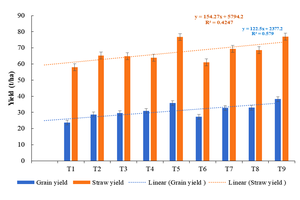
Rice, a vital staple food, plays a critical role in ensuring food and nutrition security for millions of people. Rice production faces various challenges from both biotic and abiotic stresses, with soil moisture stress being a significant limitation, especially in rainfed upland ecologies. While crop improvement strategies have made progress in addressing abiotic stressors, the complex and diverse nature of these challenges requires a combination of crop improvement and agronomic interventions to stabilize rice productivity and profitability. To explore these factors, an experiment was conducted during the Kharif (rainy) season of 2019 at the instructional farm of the College of Agriculture in Kerala. The aim was to investigate how cropping patterns and in-situ soil moisture conservation practices impact the growth and yield of upland rice. The research employed a Randomized Complete Block Design (RCBD), incorporating two distinct crop configurations and strategies for conserving soil moisture. The findings showed that paired-row planting in conjunction with live cowpea mulching, hydrogel application, and coir pith compost was superior in terms of crop growth, as evidenced by elevated Leaf Area Index (LAI) at 4.81 and increased dry matter production at 5.5 t/ha. Furthermore, this approach resulted in higher grain yield (3.8 t/ha), straw yield (7.7 t/ha), improved moisture content (29.12% at 60 days after sowing and 18.49% at physiological maturity), and reduced proline content (0.26 µmol/g FW). The maximized net returns of 62887 Rs/ha. and a Benefit-to-Cost (B:C) ratio of 1.8 was recorded for upland rice.
References
[1] N. Sharma, N. S. Murty, P. Mall and S. B. Bhardwaj (2018). An analysis on the yield and yield contributing characters of rice in tarai region of Uttarakhand. Int. J. Chem. Stud., 6: 42-47.
[2] N. K. Singh, D. B. Patel and G. D. Khalekar (2018). Methanogenesis and methane emission in rice/paddy fields In: Lichtfouse, E. (eds) Sustainable Agriculture Reviews 33. Sustainable Agriculture Reviews, vol 33. Springer, Cham. doi: 10.1007/978-3-319-99076-7_5.
[3] S. M. Haefele, A. Nelson and R. J. Hijmans (2014). Soil quality and constraints in global rice production. Geoderma, 235: 250-259.
[4] A. S. Lithourgidis, C. A. Dordas, C. A. Damalas and D. Vlachostergios (2011). Annual intercrops: an alternative pathway for sustainable agriculture. Aust. J. Crop Sci., 5: 396-410.
[5] R. Iqbal, M.A.S. Raza, M. Valipour, M.F. Saleem, M.S. Zaheer, S. Ahmad and M. Toleikiene et al., (2020). Potential agricultural and environmental benefits of mulches-a review. Bull. Natl. Res. Cent., 44(1):75. doi: 10.1186/s42269-020-00290-3.
[6] J. B. Fausett and C. R. Rom (2001). The effects of transitioning a mature high-density orchard from standard herbicide ground-cover management system to organic ground-cover management systems. Arkan. Agric. Exp. Stat. Res. Ser., 483: 33-36.
[7] G. Alekhya and V. Jayakrishnakumar (2021). Effect of crop geometry and in situ soil moisture conservation practices on yield attributes and yield of upland rice (Oryza sativa L.). Oryza, 58: 26-32. doi: 10.35709/ory.2021.58.1.5.
[8] T. M. Neethu, P. K. Dubey and A. R. Kaswala (2018). Prospects and applications of hydrogel technology in agriculture. Int. J. Curr. Microbiol. App. Sci., 7: 3155-3162.
[9] V. Prakash, J. R. Kavitha and P. Maheshwari (2021). Moisture conservation practice by using hydrogel in agriculture: A review. Plant Archiv., 21: 526-528.
[10] V. Prakash, J. R. Kavitha, R. Kamaleshwaran, P. Prabharan and S. Alagendran (2021). Effect of coir pith compost in agriculture. J. Med. Plants., 9: 106-110.
[11] T. Prabhu, P.R. Narwadkar, A.K. Sajindranath and N.G. Rathod (2002). Effect of integrated nutrient management on growth and yield of coriander. South Indian Hortic., 50: 680-684.
[12] S. Yoshida, D. A. Forno and J. H. Cock (1971). Laboratory Manual for Physiological Studies in Rice. The International Rice Research Institute, Los Banos, Laguna, The Philippines.
[13] L.S. Bates, R. P. Waldren and I. D. Teare (1973). Rapid determination of free proline for water-stress studies. Plant Soil., 39: 205-207.
[14] R. S. Mehta, M. M. Anwer and Y. K. Sharma (2012). Effect of irrigation, nutrient levels and crop geometry on growth and yield of dill (Anethum sowa L.). J. Spices Aromat. Crops, 21: 20-24.
[15] R. A. Aparna (2018). Irrigation scheduling and live mulching in upland rice (Oryza sativa L.). M.Sc. Thesis, Kerala Agricultural University. India.
[16] A. R. Sharma, R. Singh, S. K. Dhyani and R. K. Dube (2010). Effect of live mulching with annual legumes on performance of maize (Zea mays) and residual effect on following wheat (Triticum aestivum). Indian J. Agron., 55: 177-184.
[17] R. S. Kumar, T. K. Bridgit and A. Chanchala (2018). Physical and chemical properties of sandy soil as influenced by the application of hydrogel and mulching in maize (Zea mays L.). Int. J. Curr. Microbiol. App. Sci., 7: 3612-3618.
[18] G. Langangmeilu (2019). Phosphorus nutrition and partial N substitution of upland rice (Oryza sativa L.). M.Sc., Thesis, Kerala Agricultural University. India
[19] A. Rehman, R. Ahmad and M. Safdar (2011). Effect of hydrogel on the performance of aerobic rice sown under different techniques. Plant Soil Environ., 57: 321-325.
[20] H. Kilic and T. Yağbasanlar (2010). The effect of drought stress on grain yield, yield components and some quality traits of durum wheat (Triticum turgidum ssp. durum) cultivars. Not. Bot. Horti. Agrobot. Cluj-Napoca, 38: 164-170.
[21] R. S. Bana, S. E. Sepat, K. S. Rana, V. Pooniya and A. K. Choudhary (2018). Moisture-stress management under limited and assured irrigation regimes in wheat (Triticum aestivum): Effects on crop productivity, water use efficiency, grain quality, nutrient acquisition and soil fertility. Indian J. Agric. Sci., 88: 1606-1612.
[22] R. S. Kumar (2018). Effect of hydrogel and mulching on maize (Zea mays L.) in sandy Soil. M.Sc. Thesis, Kerala Agricultural University. India.
Downloads
Published
Issue
Section
License
Copyright (c) 2023 Author (s)

This work is licensed under a Creative Commons Attribution-NonCommercial-NoDerivatives 4.0 International License.
Copyright © The Author(s). This is an open access article distributed under the terms of the Creative Commons Attribution-NonCommercial-NoDerivatives 4.0 International License (CC BY-NC-ND 4.0), which permits unrestricted non-commercial use, distribution, and reproduction in any medium, provided the original author(s) and source are properly credited, and the work is not modified or adapted.