Evaluation of the repeatability of male calves' birth weights in different grades of Jersey x Red Sindhi crosses
DOI:
https://doi.org/10.31783/elsr.2023.92215220Keywords:
birth weight, crossbred, cows, repeatability, selectionAbstract
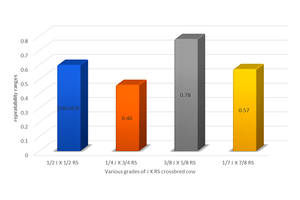
To assess the consistency of birth weight among male calves born to half-J x half-RS, quarter-J x ¾ RS, three-eighths Jersey x five-eighths RS, and one-eighth J x seven-eight RS cows. The SHUATS in Prayagraj, Uttar Pradesh, India obtained the data from a pedigree cum history sheet. Male calves born to 77 cows during the first (L1), second (L2), and third (L3) lactations, as well as 127 observations of Jersey x Red Sindhi cows of varying quality, were all measured and recorded in kilos. Increased reproducibility across many cross-breed dairy cow performance tiers indicates superiority. This research shows that choosing cows with higher estimations based on the birth weight. of their male calves can increase the output of herds. The mean of birth weight of male calves L1, L2, and L3 were 18.11, 20.15, 22.07 kg. of ½ J × ½ RS, 20.50, 19.88, 20.77 Kg f ¼ J × ¾ RS crosses, 20.06, 20.88, 22.24 kg. of 3/8 J × 5/8 RS, 19.08, 18.76, 22.83 kg of 1/8 J ×7/8 R.S proportionately. The ranges of birth weight of male calves from the Ist (L1), IInd (L2) and third (L3) lactations were 15.80 - 20.10, 15.80 - 26.6, 19.6 - 25.8 kg. of ½ J × ½ RS, 15.42 - 24.94, 14.51 - 25.70, 13.6 - 28.12 Kg. of ¼ J × ¾ R.S, 14.96 - 26.40, 16.32 - 24.30, 15.42 - 27.50 kg. of 3/8 J × 5/8 RS crosses, 15.87 - 24.23, 12.70 - 24.51, 18.14 - 25.80 kg. of 1/8 J ×7/8 RS respectively.
References
[1] H. Baspinar, M. Ogan, E. S. Batmaz., F. Balci, E. Karakas and C. Baklaci (1998). The effect of some environmental factors on growth and survival of Brown and Holstein calves. Lalahan Hay. Araşt. Enst. Derg., 38: 19-31.
[2] D. S. Falconer and T. F. C. Mackay (1996). Introduction to quantitative Genetics. Harlow, UK: PrenticeHall. pp464, 4th ed.
[3] O. Akubulut, B. Bayram, N. Tuzeman and R Aydin (2002). Phenotypic and genetic parameters estimation of body measurements at birth in Brown Swiss bull calves. Atatürk Üniv. Zir. Fak. Derg., 33: 59-64.
[4] O. Akubulut, B. Bayram and M. Yanar (2001). Estimates of phenotypic and genetic parameters on birth weight of the Brown Swiss and Holstein Friesian calves raised in semi-intensive conditions. Lalahan Hay. Arst. Derg., 41: 11-20.
[5] A. Karygisiz, I. Akyol and I. Yilmaz (1995). Genetic and phenotypic parameter estimates for birth weight in Brown Swiss calves raised at regional school in Van. J. Animal Res., 5: 71-73.
[6] G. Bakir, A. Kaygisiz and H. Ulker (2004). Estimates of the genetic and phenotypic parameters for birth weight in Holstein Friesian cattle. Pak J Biol. Sci., 7: 1221-1224.
[7] A. J. Heinrichs, B. S. Heinrichs, O. Harel, G. W. Rogers and N. T. Place (2005). A prospectives study of calf factors affecting age, body size and body condition score at first calving of HF dairy heifers. J. Dairy Sci., 88: 2828-2835.
[8] D. Pietersma, R. Lacroix, D. Lefebvre, R. Cue and K. M. Wade (2006). Trends in growth and age at first calving for Holstein and Ayrshire heifers in Quebec. Can. J. Anim. Sci., 86: 325-336.
[9] J. M. Johanson and P. J. Berger (2003). Birth weight as a predictor of calving ease and perinatal mortality in Holstein cattle. J. Dairy Sci., 86: 3745-3755
[10] F. Kutsiya (2002). Analisis performans reproduksi pada crossbreed (Sapi Madura x Limousin) dan Purebreed (Sapi Madura) dan performans produksi Hasil Keturunannya. M.S. Thesis. Universitas Brawijaya, Malang.
[11] N. Bilgic and D. Alic (2004). Genetic and phenotypic parameter estimates of birth weight in Holstein Friesian calves. J Agric. Sci., 10: 72-75.
[12] A. Swali and D. C. Wathes (2006). Influence of the dam and sire on size at birth and subsequent growth, milk production and fertility in dairy heifers. Theriogenology, 66: 1173-1184.
[13] H. K. Kunbhar, A. B. Lasi and A. A. Memon (2015). Reproductive performance of crossbred cattle under intensive management condition. Adv. Anim. Vet. Sci., 3: 7-13.
[14] A. Kijlstra and I. A. J. M Eijck (2006). Animal health in organic livestock production system: A review. NJAS Wageningen J. Life Sci., 54: 77-94.
[15] R. M. Bourdon (2000). Understanding animal breeding. 2nd ed. Prentice Hall, Inc, New Jersey, USA.
[16] W. P. B. Putra, Sumadi, and T. Hartatik (2014). The estimation of breeding value and most probable producing ability of production traits Aceh cattle at Indrapuri district Aceh province. Buletin Anim. Sci., 38: 1- 7.
[17] J. M. Nix, J. C. Spitzer, L. W. Grimes, G. L. Burns, and B. B. Plyler (1998). A retrospective analysis of factors contributing to calf mortality and dystocia in beef cattle. Theriogenology, 49: 1515-1523.
[18] A. Gunawan, R. Sari, Y. Parwoto, and M. J. Uddin (2011). Non genetic factors effect on reproductive performance and preweaning mortality from artificially and naturally bred in Bali cattle. J. Indonesian Trop. Anim. Agric., 36: 83-90.
[19] S. Vinothraj, A. Subramanian, R. Venkataramanan, C. Joseph and S. N. Sivaselvam (2016). Life time production performance of Jersey x Red Sindhi crossbred cows. Livestock Res. Int., 4: 59-62.
[20] I. Sulistiyoningtiyas, V. M. A. Nurgiartiningsih and G. Ciptadi (2017). Evaluation of performance for body weight and vital statistic of madura cattle based on year of birth. J. Ilmiah Peternakan Terpadu, 5: 40-43.
[21] K. D. J. Arifin (2007). Study on Madura cattle productivity. J. Ilmu Ternak, 7: 135-139.
[22] A. F. Kertz, L. F. Reutzel, B. A. Barton and R. L. Ely (1997). Body weight, body condition score and wither height of prepartum Holstein cows and birth weight and sex of calves by parity. A database and summary. J. Dairy Sci., 80: 525-529.
[23] S. Kocak, M. Tekerli, C. Ozbeyaz and B. Yuceer (2007). Environmental and genetic effect on birth weight and survival rate in Holstein calves. Turk. J. Vet. Anim. Sci., 31: 241-246.
[24] E. J. Warwick and J. E. Legates (1979). Breeding and improvement of farm animal. McGraw-Hill Book Company, New York, pp624.
[25] E. Kurnianto, I. Sumeidiana and P. P. Astuti (2008). Evaluation of dairy cow genetic superiority for selection program. J. Indon.Trop. Anim. Agric., 33: 186-190.
[26] F. K. Euclides, P. R. C. Nobre and A. N. Rosa (1991). Age of cow and its interaction with herd, sire and sex of calf. Rev. Bras. Zootec., 20: 40-46.
[27] H. O. K. Ulusan (1992). The change of calf growth according to birth season and repeatability of birth weight in brown Swiss cattle raised in Elazıg sugar factory farm. Uludağ Univ. Vet. Fak. Derg., 11: 57-67.
[28] M. D. Holland and K. G. Odde (1992). Factors affecting calf birth weight: A review. Theriogenology, 38: 769-798.
[29] Y. A. Tribudi and P. W. Prihandini (2019). Repeatability estimates for birth, weaning and yearling weight in Madura cattle. Int. Res. J. Adv. Eng. Sci., 4: 207-208.
[30] F. Shahzad, M. Yaqoob, M. Younas, U. Farooq, F. Sher, M. Asim and S. Qamar et al., (2010). Factors affecting the birth weight of Cholistani cattle calves. Pak. Vet. J., 30: 247-248.
Downloads
Published
Issue
Section
License
Copyright (c) 2023 Author (s)

This work is licensed under a Creative Commons Attribution-NonCommercial-NoDerivatives 4.0 International License.
Copyright © The Author(s). This is an open access article distributed under the terms of the Creative Commons Attribution-NonCommercial-NoDerivatives 4.0 International License (CC BY-NC-ND 4.0), which permits unrestricted non-commercial use, distribution, and reproduction in any medium, provided the original author(s) and source are properly credited, and the work is not modified or adapted.