Screening of pea germplasms against insect pests
DOI:
https://doi.org/10.31783/elsr.2023.92221233Keywords:
aphid, field pea, leafhopper, screening, whiteflyAbstract
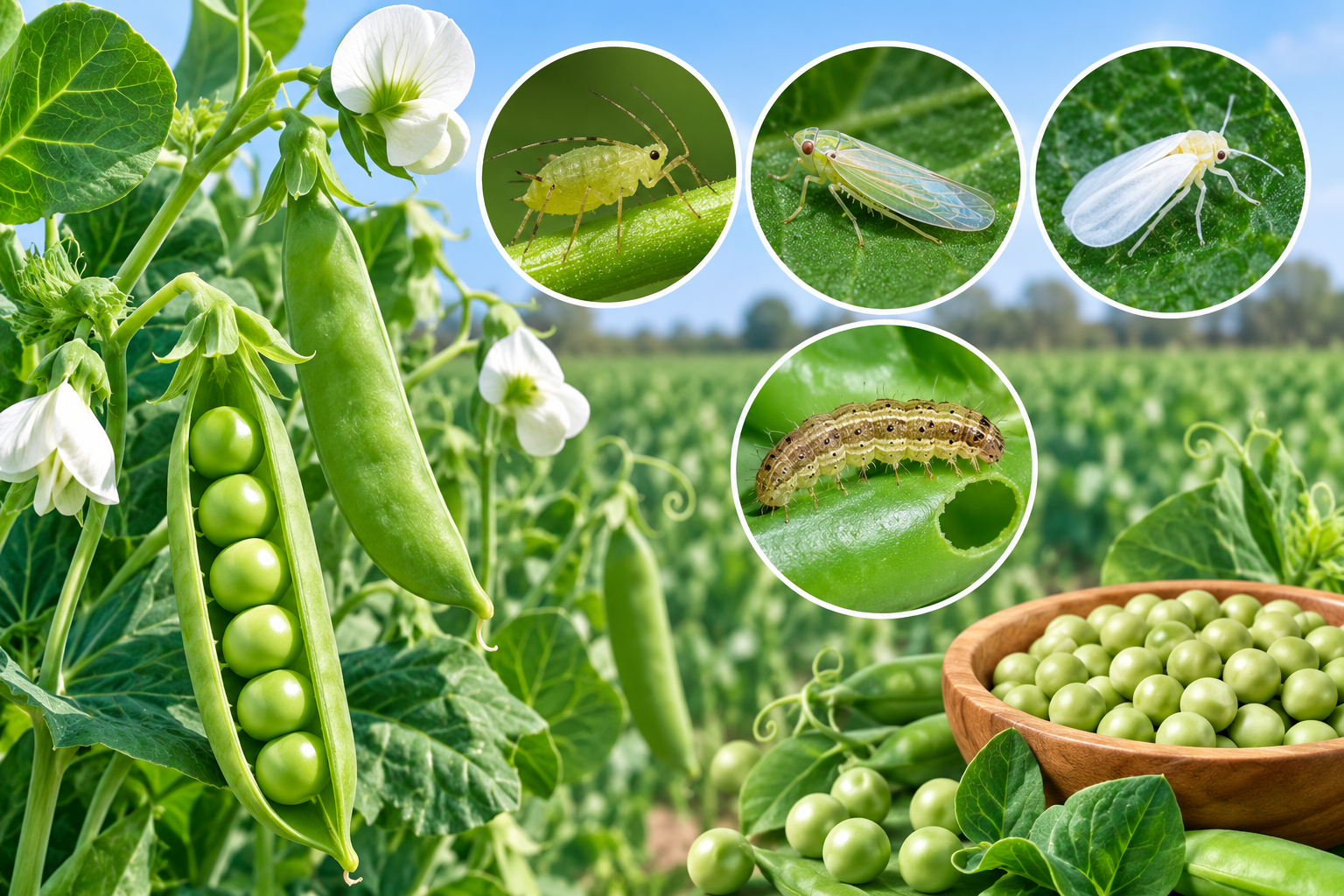
A field experiment was conducted to screen fifteen germplasms of peas against different insect pests at Pulses Research Station, Sardarkrushinagar Dantiwada Agricultural University, Sardarkrushinagar, Gujarat during rabi 2019-20 and 2020-21. The germplasm HFP 1502 recorded significantly minimum aphid (Aphis craccivora Koch) (3.78 aphids/10 cm shoot) whereas, the germplasm Pant P 476 recorded significantly lowest leafhopper (Empoasca kerri Pruthi) population (1.96 leafhoppers/3 leaves). Out of fifteen field pea germplasm significantly lowest whitefly (Bemisia tabaci Gennadius) population (0.94 whitefly/3 leaves) was noticed on the IPFD 10-12. The Helicoverpa armigera Hubner larval population indicated a significant minimum (0.39 larva/plant) on germplasm Pant P 418 and also recorded significantly lower (3.24%) pod damage. The significantly highest seed yield (937 kg/ha) was recorded on Pant P 476 followed by genotypes IPFD 10-12, Prakash, and IPF 18-14.
References
[1] D. Gu, K. Andreev and M. E. Dupre (2021). Major trends in population growth around the world. China CDC Weekly. 3: 604-613. doi: 10.46234/ccdcw2021.160.
[2] N. A. Sahruzaini, N. A. Rejab, J. A. Harikrishna, N. K. K. Ikram, I. Ismail, H. M. Kugan and A. Cheng (2020). Pulse crop genetics for a sustainable future: Where we are now and where we should be heading. Front. Plant Sci., 11: 531. doi: 10.3389/fpls.2020.00531.
[3] N. S. Affrifah, M. A. Uebersax and S. Amin (2023). Nutritional significance, value‐added applications, and consumer perceptions of food legumes: A review. Legume Sci., e192. doi.org/10.1002/leg3.192.
[4] S. Langyan, P. Yadava, F. N. Khan, Z. A. Dar, R. Singh and A. Kumar (2022). Sustaining protein nutrition through plant-based foods. Front. Nutr., 8: 772573. doi: 10.3389/fnut.2021.772573.
[5] I. Chamkhi, S. Cheto, J. Geistlinger, Y. Zeroual, L. Kouisni, A. Bargaz and C. Ghoulam (2022). Legume-based intercropping systems promote beneficial rhizobacterial community and crop yield under stressing conditions. Ind. Crops Prod., 183: 114958. doi: 10.1016/j.indcrop.2022.114958.
[6] J. K. Ladha, M. B. Peoples, P. M. Reddy, J. C. Biswas, A. Bennett, M. L. Jat and T. J. Krupnik (2022). Biological nitrogen fixation and prospects for ecological intensification in cereal-based cropping systems. Field Crops Res., 283: 108541. doi: 10.1016/j.fcr.2022.108541.
[7] J. Jena, S. Maitra, A. Hossain, B. Pramanick, H. I. Gitari, S. Praharaj and T. Shankar et al., (2022). Role of legumes in cropping system for soil ecosystem improvement. In: Jatav HS, Rajput VD (Eds). Ecosystem Services: Types, Management and Benefits. Nova Science Publishers, Inc. 415 Oser Avenue, Suite N Hauppauge, NY, 11788 USA. doi: 10.52305/PFZA6988.
[8] FAOSTAT (2022). Food and Agriculture Organization of the United Nations. Rome: FAO. Available online at: http://www.fao.org/faostat/en/#data (assessed in February, 2021).
[9] U. N. Shukla, M. L. Mishra, R. S. Meena, S. Kumar, S. Sheoran, S. Bedwal and C. K. Jangir et al. (2022). Recent strategies for pulse biofortification to combat malnutrition. In: Ram S. Meena and S. Kumar (Eds). Advances in Legumes for Sustainable Intensification. pp179-204. doi: 10.1016/B978-0-323-85797-0.00023-9.
[10] V. Mihailovic, A. Mikic, B. Cupina and P. Eric (2005). Field pea and vetches in Serbia and Montenegro. Grain Legu., 44: 25-26.
[11] A. K. Singh, N. Verma, C. S. Singh, S. Kumar and A. K. Gupta (2012). Faba Bean (Vicia faba L.) Potential leguminous crop of India. A. K. Singh, B. P. Bhatt (Eds.), Ethnobotany of Faba Bean (Vicia Faba L.), ICAR, RC for ER, Patna, pp431-450.
[12] Pritchard (1993). Growing field peas. Department of Agriculture, Western Australia. https://agric.wa.gov.au/n/1755.
[13] D. Zohary, M. Hopf and E. Weiss (2012). Domestication of plants in the World. Oxford University Press, New York.
[14] FAOSTAT (2021). Production data of Crops and livestock products. Available on: https://www.fao.org/faostat/en/#data/QCL.
[15] Directorate of Pulses Development (2022). Contribution of pulses to food grains basket. Annual Report 2021-22 by Government of India, Ministry of Agriculture & Farmers Welfare, Directorate of Pulses Development, Vindhyachal Bhavan, Bhopal. pp3.
[16] V. Vaibhav, G. Singh, R. Deshwal, N. K. Maurya and Vishvendra (2018). Seasonal incidence of major pod borers Etiella zinckenella (Treitschke) and Helicoverpa armigera (Hubner) of vegetable pea in relation with abiotic factors. J. Entomol. Zool. Stud., 6: 1642-1644.
[17] FAO (2018). United States Food and Agriculture Organization. Available on: http://www.fao.org/faostat/in.
[18] M. Singh and T. Mishra (2013). Seasonal incidence of pea leaf miner, Chromatomyia horticola infesting pea. Plant Arch., 13: 941-943.
[19] H. Saxena, S. M. Bandi and Revanasidda (2020). Sucking Pests of Pulse Crops. In: Omkar (eds) Sucking Pests of Crops. Springer, Singapore. doi: 10.1007/978-981-15-6149-8_3.
[20] A Banerjee and S Pal (2020). Estimation of crop losses due to major insect pests of field pea in Gangetic plains of West Bengal. J. Entomol. Zool. Stud., 8: 1063-1067.
[21] K. El Fakhour, A. Sabraoui, Z. Kehel and M. El Bouhssini (2021). Population dynamics and yield loss assessment for pea aphid, Acyrthosiphon pisum (Harris) (Homoptera: Aphididae), on lentil in Morocco. Insects, 12: 1080. doi: 10.3390/insects12121080.
[22] M. N. Naqqash, A. Gokce, A. Bakhsh and M. Salim (2016). Insecticide resistance and its molecular basis in urban insect pests. Parasitol. Res., 115: 1363-1373.
[23] K. V. Patel, V. B. Kundaria, H. P. Patel and B. N. Patel (2022). A medium maturing high yielding pigeon pea variety Gujarat tur 106 (GT 106: Mahi) for middle & north Gujarat. J. Pharm. Innov., SP-11: 3155-3162.
[24] S. Jegadeesan and D. Punniyamoorthy (2023). Potential of mutation breeding in genetic improvement of pulse crops. In: S. Penna, S. M. Jain (eds) Mutation Breeding for Sustainable Food Production and Climate Resilience. Springer, Singapore. doi: 10.1007/978-981-16-9720-3_15.
[25] M. Kumar, M. Rani and S. Chopra (2022). Screening for resistance against rust in pea genotypes under plains of Jammu Region. In: Sustainable Agricultural Innovations for Resilient Agri-Food Systems. Proceedings of the Indian Ecological Society International Conference. pp221.
[26] H. Krishna, A. K. Singh, P. Kumar and S. Kumar (2019). Germplasm screening against major insect pests in field pea. J. Entomol. Zool. Stud., 7: 270-272.
[27] V. Omar, P. Kumar, U. Chandra, S. K. Singh, P. K. Patel, V. Kumar, A. Kumar and R. Veer (2023). Screening of field pea germplasms against their major insect pests of field pea. J. Exp. Zool. India, 26: 121-124.
[28] V. Mittal and R. Ujagir (2005). Field screening of pea (Pisum sativum L.) germplasm for resistance against major insect pests. J. Plant Prot. Environ., 2: 50-58.
Downloads
Published
Issue
Section
License
Copyright (c) 2023 Author (s)

This work is licensed under a Creative Commons Attribution-NonCommercial-NoDerivatives 4.0 International License.
Copyright © The Author(s). This is an open access article distributed under the terms of the Creative Commons Attribution-NonCommercial-NoDerivatives 4.0 International License (CC BY-NC-ND 4.0), which permits unrestricted non-commercial use, distribution, and reproduction in any medium, provided the original author(s) and source are properly credited, and the work is not modified or adapted.