Chemical and microbiological characterization of organic supplements and compost used in agriculture
DOI:
https://doi.org/10.31783/elsr.2023.92234244Keywords:
beejamrit, farmyard manure, ghanjeevamrit, vermicompostAbstract
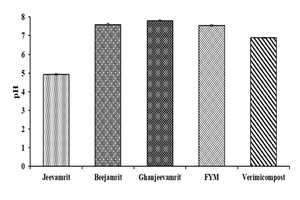
Excessive use of chemical fertilizers in agriculture enhances crop production but it may pose a risk to food quality and soil environment. One alternative to agrochemicals is the natural make organic supplements to supply essential nutrients for crop growth and promote healthy soil function. Therefore, an experimental study was performed to analyze the chemical and microbiological properties of locally produced supplements based on cow dung, such as vermicompost, farmyard manure, Beejamrit, Jeevamrit, and Ghanjeevarmrit. The Jeevamrit and farmyard manure had the lowest pH (4.93) and electrical conductivity (1.73 dS m-1), whereas Ghanjeevamrit and Jeevamrit observed highest values (7.80 and 3.62 dS m-1). Vermicompost had the highest concentrations of total N (1.76%), P (0.77%), K (0.81 %), Fe (398 mg kg-1), Mn (65.9 mg kg-1), Cu (15.5 mg kg-1), and Zn (18.2 mg kg-1). Under Ghanjeevamrit, 35.9 % of the total carbon was found, followed by farmyard manure (34.5 %) and vermicompost (24.1%). The counts of soil heterotrophic bacteria, fungi, actinomycetes, and beneficial microbial diversity such as P solubilizer, and nitrogen (N) fixer were found highest in vermicompost. However, in Jeevamrit there was no growth of actinomycetes and N-fixing bacteria whereas, in Beejamrit preparation except actinomycetes all other microbial growth was visible. Organic supplements such as farmyard manure had the lowest indole acetic acid production (1.66 μg ml-1), while Ghanjeevamrit showed the highest (6.38 μg ml-1). The liquid formulation (Beejamrit and Jeevamrit) indicated more levels of indole acetic acid than the farmyard manure (2.18 and 1.87 times more, respectively).
References
[1] S. K. Patel, A. Sharma and G. S. Singh (2020). Traditional agricultural practices in India: an approach for environmental sustainability and food security. Energy Ecol. Environ., 5: 253-271.
[2] N. Devakumar, S. Shubha, S. B. Gouder and G. G. E. Rao (2014). Microbial analytical studies of traditional organic preparations beejamrutha and jeevamrutha. In: Proceedings of the 4th ISOFAR Scientific Conference. ‘Building Organic Bridges’, at the Organic World Congress 2014, 13-15 Oct., Istanbul, Turkey (eprint ID 23621), pp639-642.
[3] M. Barooah and A. Pathak (2009). Indigenous knowledge and practices of Thengal Kachari women in sustainable management of bari system of farming. Indian J. Tradit. Knowl., 8: 35-40.
[4] Z. P. Bharucha S. Mitjans and J. Pretty (2020). Towards redesign at scale through zero budget natural farming in Andhra Pradesh, India. Int. J. Agric. Sustain., 18: 1-20.
[5] A. Khadse and P. M. Rosset (2019). Zero budget natural farming in India–from inception to institutionalization. Agroecol. Sustain. Food Syst., 43: 848-871.
[6] S. Chadha, Rameshwar, Ashlesha, J. P. Saini and Y. S. Paul (2012). Vedic Krishi: Sustainable livelihood option for small and marginal farmers. Indian J. Tradit. Know., 11: 480–486.
[7] I. P. Sharma, C. Kanta, T. Dwivedi and R. Rani (2020). Indigenous agricultural practices: A supreme key to maintaining biodiversity. In: R. Goel, R. Soni, D. Suyal (eds) Microbiological advancements for higher altitude agro-ecosystems & sustainability. Rhizosphere Biology. Springer, Singapore. pp91-112. doi: 10.1007/978-981-15-1902-4_6.
[8] D. Jain, P. Jain, A. A. Bhojiya, R. K. Jain, R. Choudharya, S. K. Sharma and S. K. Yadav et al., (2021). Microbiological and enzymatic properties of diverse Jaivik Krishi inputs used in organic farming. Indian J. Tradit. Know., 20: 237–243.
[9] M. N. Sreenivasa, M. N. Nagaraj and S. N. Bhat (2009). Beneficial traits of microbial isolates of organic liquid manures. First Asian PGPR Congress for sustainable agriculture, 21-24 June, ANGRAU, Hyderabad.
[10] S. Palekar (2006). Text book on Shoonya Bandovalada naisargika Krushi, published by Swamy Anand, Agri Prakashana, Bangalore.
[11] K. Gangadhar, N. Devakumar, Vishwajith and G. Lavanya (2020). Influence of different sources of organic manures and decomposers on enzymatic activity and microbial dynamics of rhizosphere soil of Chilli (Capsicum annum L.). Int. J. Curr. Microbiol. App. Sci., 9: 542-555.
[12] M. L. Jackson (1973). Soil chemical analysis. Prentice- Hall Inc, N.J., USA.
[13] D. W. Nelson and L. E. Sommers (1982). Total carbon, organic carbon and organic matter. In: A. L. Page, R. H. Miller, D. R. Keeney (Eds.), methods of soil analysis: Part II (2nd edn.), Chemical and Microbiological Properties-Agronomy Monograph No. 9, American Soc. Agronomy, Soil Sci. Soc. America, Madison, WI, USA (1982), pp539-579.
[14] G. Estefan, R. Sommer and J. Ryan (2013). Methods of soil, plant, and water analysis. A manual for the West Asia and North Africa region. 3rd edn. ICARDA, West Asia.
[15] W. L. Lindsay and W. A. Norvell (1978). Development of a DTPA soil test for zinc, iron, manganese, and copper. Soil Sci. Soc. Amer. J., 42: 421-428.
[16] P. K. Chhonkar, S. Bharduraraj, A. K. Patra and T. J. Pudukayastha (2007). Enumeration of soil biota. In: Experiment in Soil Biology and Biochemistry. Westrile Publishing House, New Delhi.
[17] E. Salkowski (1885). Uber das verhalten der skatolcarbonsaure im organismus. Z Physiol. Chem., 9: 23-33.
[18] Q. Jin and M. F. Kirk (2018). pH as a primary control in environmental microbiology: 1. Thermodynamic Perspective. Front. Environ. Sci., 6: 21. doi: 10.3389/fenvs.2018.00021.
[19] G. Tripathi and P. Bhardwaj (2004). Decomposition of kitchen waste amended with cow manure using an epigeic species (Eisenia fetida) and an anecic species (Lampito mauritii). Bioresour. Technol., 92: 215-218.
[20] M. M. R. Malik, M. J. Akhtar, I. Ahmad and M. Khalid (2014). Synergistic use of rhizobium, compost and nitrogen to improve growth and yield of mung bean (Vigna radiate). Pak. J. Agric. Sci., 51: 393-398.
[21] K. Sharma and V. K. Garg (2017). Vermimodification of ruminant excreta using Eisenia fetida. Environ. Sci. Pollut. Res., 24: 19938-19945.
[22] A. B. Singh and T. K. Ganguly (2005). Quality comparison of conventional compost, vermicompost and chemically enriched compost. J. Indian Soc. Soil Sci., 53: 352-355.
[23] S. K. Singh, M. Kumar, R. P. Singh, J. S. Bohra, J. P. Srivastava, S. P. Singh and Y. V. Singh (2018). Conjoint application of organic and inorganic sources of nutrients on yield, nutrient uptake and soil fertility under Rice (Oryza sativa)-Wheat (Triticum aestivum) system. J. Indian Soc. Soil Sci., 66: 287-294.
[24] P. H. Shinde, R. L. Naik, R. B. Nazikar, S. K. Kadam and V. M. Khare (1992). Evaluation of vermicompost. Proceedings of National Seminar on Organic Farming, MPKV, Pune.
[25] Z. Aslam, A. Ahmad, M. Ibrahim, N. Iqbal, M. Idrees, A. Ali and I. Ahmad et al., (2021). Microbial enrichment of vermicompost through earthworm Eisenia fetida (Savigny, 1926) for agricultural waste management and development of useful organic fertilizer. Pak. J. Agric. Sci., 58: 851-861.
[26] T. Rao Nagendra (2009). Phosphorus and Potassium nutrient management options for organic production systems. Efficient use of on-Farm and Off-Farm Resources in Organic Farming. IISS, Bhopal., pp82-91.
[27] A. Sowjanya, M. Rekha Sree and V. R. K. Murthy (2017). Effect of integrated nitrogen management on growth components, yield and nutrient uptake of rice. The Andhra Agric. J., 64: 753-756.
[28] T. P. Gangmei, N. Kaur, A. Thakur, S. Baghla, K. K. Sahu, A. Kumar and S. Manuja (2022). Studies on irrigation scheduling and nutrient management on wheat growth and productivity. Himachal J. Agric. Res., 48: 48-55.
[29] R. Choudhary, R. Kumar, G. D. Sharma R. P. Sharma, N. Rana and P. Dev (2022). Effect of natural farming on yield performances, soil health and nutrient uptake in wheat + gram inter cropping system in sub-temperate regions of Himachal Pradesh. J. Crop Weed., 18: 01-08.
[30] R. Sharma and I. Thakur (2022). Impact of bioorganic nutrients and chemical fertilizers on sustainable production of French bean and soil health. J. Environ. Biol., 43: 430-439.
[31] S. Mukherjee, S. Sain, M. N. Ali, R. Goswami, A. Chakraborty, K. Ray and R. Bhattacharjee et al., (2022). Microbiological properties of Beejamrit, an ancient Indian traditional knowledge, uncover a dynamic plant beneficial microbial network. World J. Microbiol. Biotechnol., 38: 111. doi: 10.1007/s11274-022-03296-3.
[32] N. Gore and M. N. Sreenivasa (2011). Influence of liquid organic manures on growth, nutrient content and yield of tomato (Lycopersicon esculentum) in the sterilized soil. Karnataka J. Agric. Sci., 24: 153-157.
[33] M. Leharwan, M. Gupta, and S. Leharwan (2020). In-vitro evaluation of six bio-product against coriander stem gall disease. Bhartiya Krishi Anusandhan Patrika., 35: 33-38.
[34] P. Dev, S. S. Paliyal and N. Rana (2022). Subhash palekar natural farming-scope, efficacy and critics. Environ. Conserv. J., 23: 99-106.
[35] A. B. Basak and M. W. Lee (2001). Efficacy of cow dung in controlling root rot and Fusarium wilt of cucumber plants. Abstract published In: Korean Society of Plant Pathology annual meeting and International conference, held on 25-30 th October, 2001, Kyongju TEMF hotel, Korea, pp49.
[36] C. Bindushree, R. N. Lakshmipathi, M. C. Nagaraju and M. Siddu (2023). Effect of different farming practices on total beneficial microorganisms in direct seeded rice. The Pharma Innov., 12: 2412-2420.
[37] M. N. Sreenivasa, M. N. Nagaraj and S. N. Bhat (2010). Beejamruth: A source for beneficial bacteria. Karnataka J. Agric. Sci., 17: 72-77.
[38] E. Somasundaram, N. Sankaranan, S. Meena, T. M. Thiyagarajan, K. Chandaragiri and S. Pannerselvam (2003). Response of green gram to varied levels of Panchagavya (organic nutrition) foliar spray. Madras Agric. J., 90: 169-172.
[39] R. A. Ram, A. Singha and A. Kumar (2019a). Microbial characterization of cow pat pit and biodynamic preparations used in biodynamic agriculture. Indian J. Agric. Sci., 89: 210-214.
[40] R. A. Ram, A. Singha and S. Vaish (2018b). Microbial characterization of on-farm produced bio-enhancers used in organic farming. Indian J. Agrc. Sci., 88: 35-40.
[41] R. A. Ram, A. Singha and V. K. Singh (2019). Improvement in yield and fruit quality of mango (Mangifera indica) with organic amendments. Indian Journal of Agricultural Sciences., 89: 1429-1433.
[42] L. Goswami, A. Nath, S. Sutradhar, S. S. Bhattacharya, A. Kalamdhad, K. Vellingiri and K. H. Kim (2017). Application of drum compost and vermicompost to improve soil health, growth, and yield parameters for tomato and cabbage plants. J. Environ. Manag., 200: 243-252.
[43] K. Sharma and V. K. Garg (2019). Vermicomposting of waste: a zero-waste approach for waste management. In: Sustainable resource recovery and zero waste approaches, Elsevier., pp133-164.
Downloads
Published
Issue
Section
License
Copyright (c) 2023 Author (s)

This work is licensed under a Creative Commons Attribution-NonCommercial-NoDerivatives 4.0 International License.
Copyright © The Author(s). This is an open access article distributed under the terms of the Creative Commons Attribution-NonCommercial-NoDerivatives 4.0 International License (CC BY-NC-ND 4.0), which permits unrestricted non-commercial use, distribution, and reproduction in any medium, provided the original author(s) and source are properly credited, and the work is not modified or adapted.