Effect of summer legumes incorporation on quality parameters of succeeding Kharif rice
DOI:
https://doi.org/10.31783/elsr.2023.92245252Keywords:
amylopectin, amylose, milling quality parameters, protein content, summer legumesAbstract
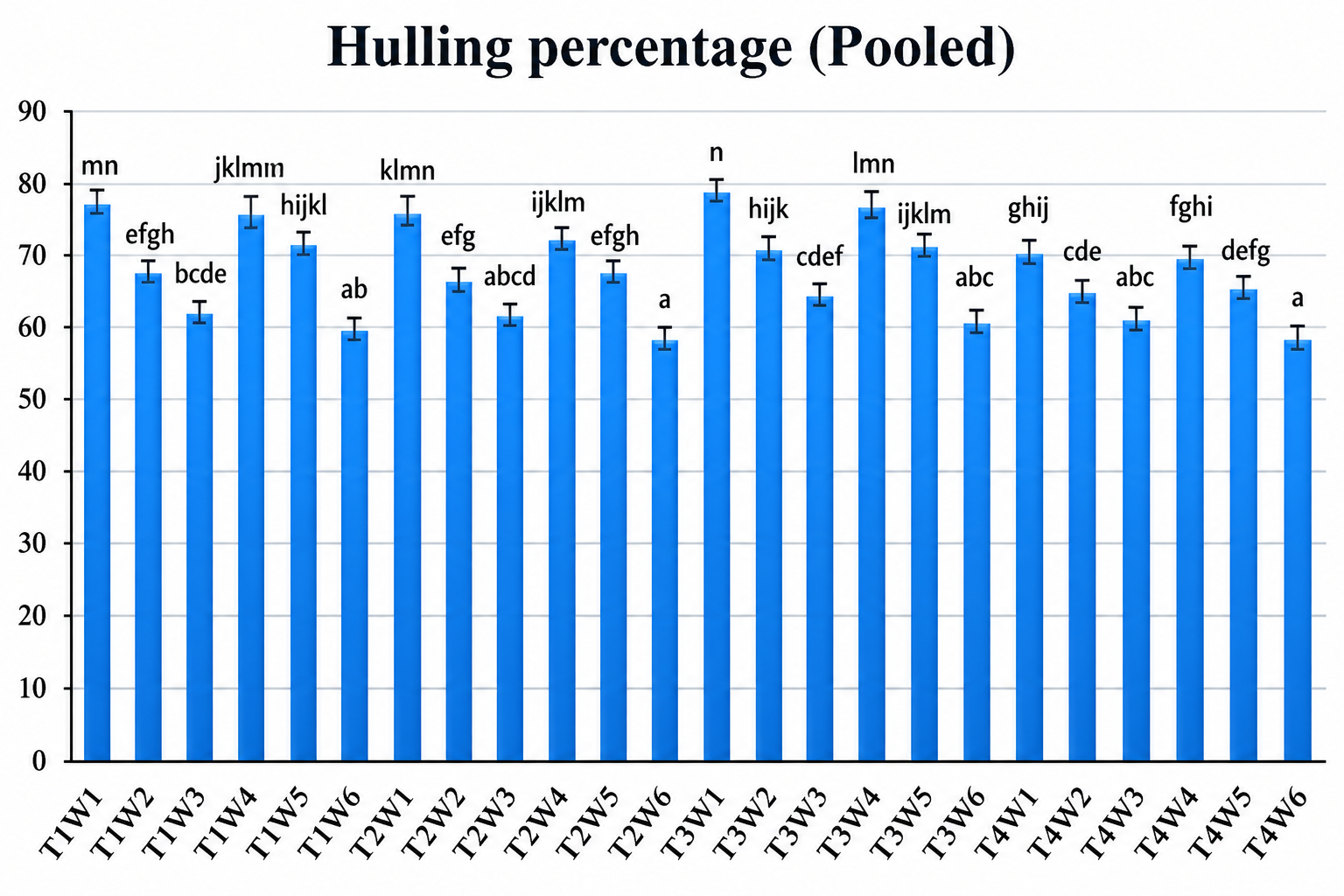
In Navsari, Gujarat, at the College Farm of Navsari Agricultural University, a field experiment was conducted in the summer and kharif of 2021 and 2022. With 4 main plots and 6 subplot treatments, the experiment comprised of twenty-four treatment combinations that were replicated 3 times in a split plot design. Results posed that significantly higher milling quality parameters and protein content of rice was found when rice grown in dhaincha incorporated plots (T3) and it was followed by green gram (T1), cowpea (T2) incorporated plots, and significantly lower values were seen in the fallow treatment (T4) for both years and in the pooled analysis. However, amylose and amylopectin content in rice was non-significant during the study. In the case of recommended levels tested during kharif in rice, significantly higher values of milling quality parameters, amylose, amylopectin, and protein content percentage were higher with application of 100% RDF (W1) and fb 75% RDF + 25% N from FYM (W4) during 2021-2022 and in pooled basis. Whereas the treatment No-fertilizer application (W6) recorded lower values throughout both the years and on a pooled basis. The experimentation revealed that dhaincha incorporation and 100% RDF proved as better in enhancing milling quality attributes and protein content whereas amylose and amylopectin percentages did not vary under residue incorporation.
References
[1] NAAS (2017). Innovative viable solution to rice residue burning in rice wheat cropping system through concurrent use of super straw management system fitted combines and turbo happy Seeder. National academy of agricultural sciences, New Delhi. pp16.
[2] S. K. Yadav and B. Saha (2022). Partial substitution of nitrogenous fertilizer through organics enhances yield, nutrients uptake and physiological characteristics of transplanted rice (Oryza sativa L.). Soil Environ., 33: 96-102.
[3] F. Lin, L. Zhou, B. He, X. Zhang, H. Dai, Y. Qian and L. Ruan et al., (2019). QTL mapping for maize starch content and candidate gene prediction combined with co-expression network analysis. Theor Appl Genet., 132: 1931-1941.
[4] N. Sharma and R. Khanna (2019). Rice grain quality: current developments and future prospects. In: Recent Advances in Grain Crops Research. Intechopen. pp137-144.
[5] S. Sadasivam and A. Manickam (1996). Biochemical methods. New Age International (P) Ltd. Publishers, pp126-128.
[6] S. Bandyopadhyay and N. C. Roy (1992). Rice process technology, Oxford and IBH publishing Co. Pvt. Ltd. New Delhi, ISBN 978-8120407510.
[7] S. Sadasivam and A. Manickam (1992). Biochemical methods for agricultural sciences, Wiley Eastern Limited. New Delhi.
[8] J. G. Torruco-Uco, L. A. Chel-Guerrero, and D. Betancur-Ancona (2006). Isolation and molecular characterization of makal (Xanthosoma yucatanensis) starch, Starch, 58: 300-307.
[9] V. G. Panse and P. V. Sukhatme (1978). Statistical methods for agricultural workers, ICAR, New Delhi.
[10] W. G. Cochran and G. M. Cox (1957). Experimental design, 2nd edition, John Wiley & Sons.
[11] M. S. Bartlett (1947). The general canonical correlation distribution, Ann. Math. Stat., 18: 1-17.
[12] N. V. Quyen, S. N. Sharma and R. C. Gautum (2002). Comparative study of organic and traditional farming for sustainable rice production. Omonrice, 10: 74-78.
[13] O. P. Premi and B. D. Kalia (2003). Effect of organic and inorganic sources of nitrogen on yield, yield attributes and quality of rice. Agric. Sci. Dig., 23: 152-154.
[14] M. F. Hossain, M. S. U. Bhuiya, M. Ahmed and M. H. Mian (2009). Effect of organic and inorganic fertilizer on the milling and physico-chemical properties of aromatic rice. Thai J. Agric. Sci., 42: 213-218.
[15] T. K. Jana, M. K. Bhowmick and K. Surekha (2016). Nutrient management for improving grain yield, nutrient uptake, and quality of aromatic rice varieties. SATSA Mukhapatra- Annual Tech. Issue, 20: 138-144.
[16] S. P. Sangeetha, A. Balakrishnan and P. Devasenapathy (2013). Influence of organic manures on yield and quality of rice (Oryza sativa L.) and black gram (Vigna mungo L.) in rice-black gram cropping sequence. Am. J. Plant Sci., 4: 1151-1157.
[17] K. Surekha, K. V. Rao, N. S. Rani, P. C. Latha, R. M. Kumar (2013). Evaluation of organic and conventional rice production systems for their productivity, profitability, grain quality and soil health. Agrotechnology, S11: 006. doi: 10.4172/2168-9881.S11-006.
[18] S. K. Kumar, C. H. P. Rao, V. R. K. Murthy, Y. A. Rani and P. R. K. Prasad (2020). Yield and quality of rice as influenced by nutrient management interventions in rice: No till ragi cropping system. Int. J. Chemical Stud., 8: 1474-1478.
[19] M. Ram, M. R. Davari and S. N. Sharma (2011). Effect of organic manures and biofertilizers on basmati rice (Oryza sativa L.) under organic farming of rice-wheat cropping system. Intl. J. Agri. Crop Sci., 3: 76-84.
[20] V. Pooniyaa and Y. S. Shivay (2015). Effect of green manuring and zinc fertilization on quality parameters of Basmati rice. Commun. Soil Sci. Plant Anal., 46: 382-392.
Downloads
Published
Issue
Section
License
Copyright (c) 2023 Author (s)

This work is licensed under a Creative Commons Attribution-NonCommercial-NoDerivatives 4.0 International License.
Copyright © The Author(s). This is an open access article distributed under the terms of the Creative Commons Attribution-NonCommercial-NoDerivatives 4.0 International License (CC BY-NC-ND 4.0), which permits unrestricted non-commercial use, distribution, and reproduction in any medium, provided the original author(s) and source are properly credited, and the work is not modified or adapted.