Sunburn and fruit cracking in Litchi (Litchi chinensis Sonn.) cv. ‘Rose Scented’
DOI:
https://doi.org/10.31783/elsr.2023.92260264Keywords:
fruit cracking, fruit surface temperature, litchi, sunburnAbstract
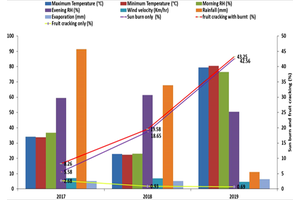
Litchi (Litchi chinensis Sonn.) is originally from southern China, but due to its higher adoptability and profitability, it is being cultivated in India. In India, litchi is harvested and sold during April-May and fruits have nutritional and economical values. Litchi cv. 'Rose Scented' is highly preferred in India for its taste, but sunburn and fruit cracking are a major drawback for its cultivation. Studies were conducted to quantify the severity of sunburn and incidence of fruit cracking. Fruits first affected by sunburn and burnt outer skin or peel or cuticle part, later turned into cracking. So sunburn acted as a predisposition to fruit cracking in ‘Rose Scented’. Thus, sun burn and cracking can be seen in the same fruit. These types (cracked fruit with sunburn) of fruits were 8.26%, 19.58% and 43.25% in 2017, 2018 and 2019, respectively. Lower thickness of cuticle and spongy layer and higher temperature of fruit surface in burnt and cracked fruit may be accountable for fruit burning and cracking. A close correlation was observed between sunburn, cracking and weather situation over two months. A positive relationship was found between maximum temperature, sunburn and fruit cracking.
References
[1] L. Schrader, J. Sun, D. Felicetti, J.-H. Seo, L. Jedlow and J. Zhang (2003). Stress-induced disorders: Effects on apple fruit quality. Washington tree fruit postharvest conference, 2nd – 3rd December.
[2] E. S. Marboh, A. K. Gupta, N. Lal, S. D. Pandey and V. Nath (2018). An overview of differential response of litchi trees to water stress. Int. J. Innov. Hortic., 7: 17-26.
[3] G. Singh, V. Nath, S. D. Pandey, P. K. Ray and H. S. Singh (2012). Cultivars and genetic enhancement. In: The litchi. M. K. Papademetriou and F. J. Dent (Ed.), Food and Agricultural Organization of the United Nations, New Delhi, India, pp18-24.
[4] D. Holland, K. Hatib and I. Bar-Yaakov (2009). Pomegranate: botany, horticulture, breeding. Hortic. Rev., 35: 127-191.
[5] S. Ranganna (1977). Manual of analysis of fruit and vegetable products. Co., Ltd., New Delhi, Tata McGraw-Hill Pub, pp634.
[6] N. Lal, N. Sahu, A. Kumar and S. D. Pandey (2022). Effect of rainfall and temperature on sun burn and fruit cracking in litchi. J. Agrometeorol., 24: 169-171.
[7] N. Lal and N. Sahu (2022). Screening of litchi (Litchi chinensis Sonn.) genotypes against sun burn. Bangladesh J. Bot., 51: 37–43
[8] A. Lang and H. During (1990). Grape berry splitting and some mechanical properties of the skin. Vitis, 29: 61-70.
[9] P. L. Saran, R. Kumar, S. Ercisli and R. Choudhary (2015). Fruit cracking in mango (Mangifera indica L.) cv. ‘Dashehari’. Erwerbs-Obstbau, 57: 93-96.
[10] L. U. Opara, C. J. Studman and N. H. Banks (1996). Fruit skin splitting and cracking. In: J. Janick (Ed.), Horticultural Reviews. pp217-262.
[11] N. Lal, Kumar A. Kumar, S. Pandey and V. Nath (2023). Screening of litchi genotypes for fruit cracking and the relationship of cracking to fruit and leaf traits. Erwerbs-Obstbau, 65: 479-485.
Downloads
Published
Issue
Section
License
Copyright (c) 2023 Author (s)

This work is licensed under a Creative Commons Attribution-NonCommercial-NoDerivatives 4.0 International License.
Copyright © The Author(s). This is an open access article distributed under the terms of the Creative Commons Attribution-NonCommercial-NoDerivatives 4.0 International License (CC BY-NC-ND 4.0), which permits unrestricted non-commercial use, distribution, and reproduction in any medium, provided the original author(s) and source are properly credited, and the work is not modified or adapted.