
Response of foliar application of humic acid and micronutrient mixture on growth and grain yield of maize crop
DOI:
https://doi.org/10.31783/elsr.2023.92325331Keywords:
humic acid, maize, silking, tasselling, yieldAbstract
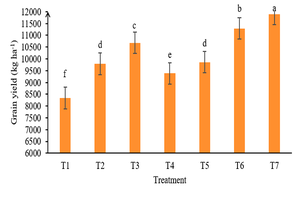
The efficiency of humic acid (HA) and micronutrient (MN) mixtures as a source, either separately or in combination, was studied to increase the productivity and growth of maize (Zea mays L.). The research was carried out in the College of Agriculture, Azamgarh, Uttar Pradesh, India during the spring season of 2022. The treatments were replicated three times in a randomized complete block design. The HA and MN mixtures were sprayed separately at 0.2% and 0.4% each. Further, the combination of HA @ 0.2% + MN @ 0.2% and HA @ 0.4% + MN @ 0.4% was also applied. The application was done by foliar spray twice on 35 and 50 DAS, along with control using water. The result revealed that foliar spraying of HA at 0.4% + MN at 0.4% significantly (P=0.05) improved the height (cm), LAI, and dry matter accumulation (g m-2) of the maize crop. In comparison to the MN combination, HA generally had more maize growth and yield. A foliar spray with a combination of HA and MN at 0.4% each could result in a higher grain yield of the maize crop, which recorded a 42.62% higher grain yield than the control. Hence, based on the study, foliar application of the HA+MN mixture at 0.4% could be advised to boost maize crop growth and grain yield during the spring season.
References
[1] MAFW (2022). Directorate of economic and statistics, Department of Agriculture and Farmers Welfare.
[2] S. Albayrak and N. Cama (2005). Effects of different levels and application times of Humic acid on root and leaf yield and yield components of forage turnip (Brassica rapa L.). J. Agron., 4: 130-133.
[3] M. Majidian, A. Ghalavand, N. Karimian and A. K. Haghighi (2006). Effects of water stress, nitrogen fertilizer and organic fertilizer in various farming systems in different growth stages on physiological characteristics, physical characteristics, quality and chlorophyll content of maize single cross hybrid 704. Iranian Crop Sci. J., 10: 303-330.
[4] M. Schnitzer and S. U. Khan (1972). Humic substances in the environment. Marcel Dekker, New York.
[5] C. L. Mackowiak, P. R. Grossl and B. G. Bugbee (2001). Beneficial effects of humic acid on micronutrient availability to wheat. Soil Sci. Soc. Am. J., 65: 1744-1750.
[6] R. U. Rahmat, A. Rashid, M. S. Khan and E. Ozturk (2010). Impact of humic acid and chemical fertilizer application on growth and grain yield of rainfed wheat (Truticum aestivum L.). Pak. J. Agric. Res., 23: 113-121.
[7] W. Schmidt, S. Santi, R. Pinton and Z. Varanini (2007). Water-extractable humic substances alter root development and epidermal cell pattern in Arabidopsis. Plant Soil 300: 259-267
[8] S. Nardi, D. Pizzeghello, A. Muscolo and A. Vianello (2002). Physiological effects of humic substances on higher plants. Soil Biol. Biochem., 34: 1527-1536
[9] R. E. Pettit (2004). Organic matter, humus, humate, humic acid, fulvic acid and humin: their importance in soil fertility and plant health. CTI Research, 10: 1-7.
[10] Y. Chen, C. E. Clapp, H. Magen and V. W. Cline (1999). Stimulation of plant growth by humic substances: Effects on iron availability. In: E. A. Ghabbour, G. Davies (eds.), Understanding humic substances: Advanced methods, properties and applications. Royal Society of Chemistry, Cambridge, UK. pp255-263.
[11] L. B. Taiwo, J. A. Adediran, M. O. Akande, V. A. Banjoko and G. A. Oluwatosin (2001). Influence of legume fallow on soil properties and yield of maize in south western Nigeria. J. Agric. Trop. Subtrop., 102: 109-117.
[12] M. Z. Khan, S. Muhammed, M. A. Naeem, E. Akhtar and M. Khalid (2006). Response of some wheat (Triticum aestivum L.) varieties to foliar application under rainfed conditions Pak. J. Bot., 38: 1027-1034.
[13] R. Suleimani (2006). The effects of integrated application of micronutrient on wheat in low organic carbon conditions of alkaline soils of Western Iran. Proceedings of the 18th World Congress of Soil Science, July 9-15, Philadelphia, USA.
[14] G. W. McKee (1964). A coefficient for computing leaf area in hybrid corn. J. Agron., 56: 240-241.
[15] H. Celik, A. V. Katkat, B. B. Asik and M. A. Turan (2010). Effects of humus on growth and nutrient uptake of maize under saline and calcareous soil conditions. Žemdirbystė (Agriculture), 97: 15-22
[16] M. A. Zambre, B. K. Konde and K. R. Sonar (1984). Effect of Azotobacter chroccocum and Azospirillum brasilenes inoculation under graded levels of nitrogen growth and yield of wheat. Plant Soil, 79: 61-69.
[17] N. Hussain, M. A. Khan and M. A. Javed (2005). Effect of foliar application of plant micronutrient mixture on growth and yield of wheat (Triticum aestivum L.). Pak. J. Biol Sci., 8(8): 1096-1099.
[18] J. Potarzycki and W. Grzebisz (2009). Effect of zinc foliar application on grain yield of maize and its yielding components. Plant Soil Environ., 55: 519-527.
[19] V. Römheld and H. Marschner (1991). Function of micronutrients in plants. In: J. J. Mortvedt, F. R. Cox, L. M. Shuman, R. M. Welch (Eds.), Micronutrients in Agriculture. Soil Science Society of America, Inc. Madison, Wisconsin, USA, pp297-328.
[20] P. A. Moore and W. H. Patrick (1988). Effect of Zinc deficiency on alcohol dehydrogenase activity and nutrient uptake in rice. Agron. J., 80: 882-885.
[21] S. Delfine, R. Tognetti, E. Desiderio and A. Alvino (2005). Effect of foliar application of N and humic acids on growth and yield of durum wheat. Agron. Sustain. Dev., 25: 183-191.
[22] D. B. Zandanadi, L. P. Canellas and A. R. Facanha (2007). Indolacetic and humic acids induce lateral root development through a concerted plasmalemma and tonaplast H+ pumps activation. Planta, 225: 1583-1598.
[23] A. Mohammadpourkhaneghah, R. Shahryari, Y. Alaei and B. Shahmoradmoghanlou (2012). Comparison of the effect of liquid humic fertilizers on yield of maize genotypes in Ardabil region. Afr. J. Biotechnol., 11: 4810-4814.
[24] M. S. Zeidan, F. Manal and H. A. Hamouda (2010). Effect of foliar fertilization of Fe, Mn and Zn on wheat yield and quality in low sandy soils fertility. World J. Agric. Sci., 6: 696-699.
[25] M. S. Zeidan (2001). Response of wheat plants (Triticum aestivum L.) To different methods of zinc fertilization in reclaimed soils of Egypt. Plant Nutrition-Food Security and Sustainability of Agro-ecosystems.
[26] M. S. Zeidan and O. A. Nofal (2002). Effect of urea on the efficiency of spraying iron, manganese, zinc and copper on wheat. Egypt. J. Agron., 24: 121-131.
[27] M. Habib (2009). Effect of foliar application of Zn and Fe on wheat yield and quality. African J. Biotechnol., 8: 6795-6798.
[28] H. Hegazi, A. M. Awad and A. G. Salem (2002). Influence of foliar K, Mg and micro-nutrients on the yield, quality and essential oil constituents of garlic in sandy soil. J. Agric. Sci. Mansoura Univ., 27: 3413-3437.
Downloads
Published
Issue
Section
License
Copyright (c) 2023 Author (s)

This work is licensed under a Creative Commons Attribution-NonCommercial-NoDerivatives 4.0 International License.
Copyright © The Author(s). This is an open access article distributed under the terms of the Creative Commons Attribution-NonCommercial-NoDerivatives 4.0 International License (CC BY-NC-ND 4.0), which permits unrestricted non-commercial use, distribution, and reproduction in any medium, provided the original author(s) and source are properly credited, and the work is not modified or adapted.