
Evaluation of maize germplasm for physio-morphological traits against fall armyworm
DOI:
https://doi.org/10.31783/elsr.2023.92349355Keywords:
leaf area, leaf length, leaf width, leaf trichomes, resistant cultivars, relative water contentAbstract
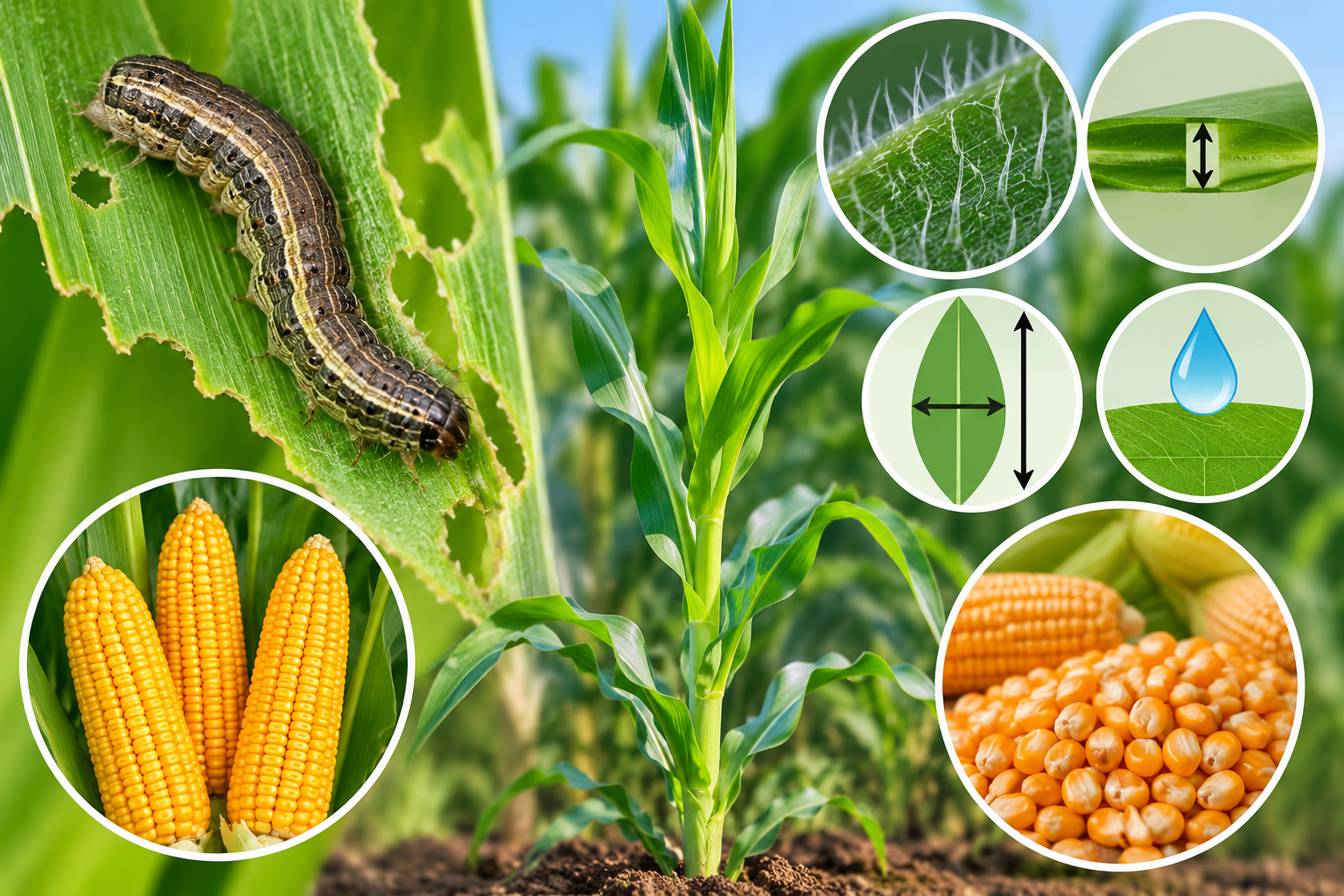
The fall armyworm (FAW), scientific name Spodoptera frugiperda (J.E. Smith), poses a significant challenge to farmers and agricultural systems due to its ability to adapt, reproduce rapidly, and develop resistance to pesticides. Hence, it is essential to adopt effective and feasible approaches to managing FAW. The present research aimed at identifying the physio-morphological traits in 22 diverse maize genotypes that influence resistance to FAW. Among the tested ones, moderately resistant genotypes had the highest trichome density (CML 71, CML 67, and CML 335), minimum leaf area, and leaf width (DMRE 63, CML 71, and CML 67). Moderately resistant genotypes, viz., CML 67 (0.14 mm), CML 71 (0.14 mm), CML 561 (0.14 mm), and DMRE 63 (0.14 mm), exhibited significantly higher leaf toughness. Furthermore, the lowest relative water content was recorded in moderately resistant genotypes (DMRE 63, CML 71, and CML 67). The maximum cob length was observed in the moderately resistant genotype, CML 71 (18.56 cm), followed by CML 67 (18.26 cm), which was on par. Among moderately resistant genotypes, CML 71 had the greatest cob width of 4.97 cm, followed by CML 67 (4.88 cm), CML 561 (4.66 cm), CML 335 (4.66 cm), and DMRE 63 (4.62 cm), and these were statistically comparable. Of the genotypes evaluated, the moderately resistant genotypes CML 71, CML 67, and DMRE 63 registered significantly higher yields of 135.04 g/plant, 120.65 g/plant, and 117.92 g/plant, respectively. This information on physio-morphological traits is helpful in breeding programs focusing on maize resistance to FAW.
References
[1] S. K. Tripathy, S. Patra and J. Kar (2020). Scope of double haploid production for inbred development in tropical maize. Emerg. Life Sci. Res., 6: 21-27.
[2] B. M. Aruna Balla, P. Bagade and N. Rawal (2019). Yield losses in maize (Zea mays) due to fall armyworm infestation and potential IoT-based interventions for its control. J. Entomol. Zool. Stud., 7: 920-927.
[3] P. L. Soujanya, J. Sekhar, K. Yathish, C. G. Karjagi, K. S. Rao, S. Suby, S. Jat, et al. (2022). Leaf Damage Based Phenotyping Technique and Its Validation Against Fall Armyworm, Spodoptera frugiperda (JE Smith), in Maize. Front. Plant Sci., 13: 906207. doi: 10.3389/fpls.2022.906207
[4] H. Barrs and P. Weatherley (1962). A re-examination of the relative turgidity technique for estimating water deficits in leaves. Aust. J. Biol. Sci., 15: 413-428.
[5] M. P. Gowda, J. Sekhar, P. Soujanya, K. Yathish, S. Rahman and B. Mallaiah (2022). Screening of Maize Genotypes against Fall Armyworm, Spodoptera frugiperda (JE Smith) under Artificial Infestation. Biol. Forum, 14: 249-254.
[6] L. A. M. Abdalla and S. Raguraman (2014). Screening maize genotypes for resistance to stem borer, Chilo partellus (Swinhoe)(Lepidoptera: Crambidae). Trends Biosci., 7: 2212-2216.
[7] A. Ali, N. Khalil, M. Abbas, R. Tariq and H. D. Zia-ullah (2015). Plant traits as resistance influencing factors in maize against Chilo partellus (Swinhoe). J. Entomol. Zool. Stud., 3: 246-250.
[8] S. Kulkarni, C. Mallapur and R. Balikai (2015). Influence of plant morphological traits on the incidence of stem borers in different maize hybrids. J. Eco-friendly Agric., 10: 157-162.
[9] T. Rakesh, R. Soundararajan, S. S. J. Roseleen and P. Jeyaprakash (2021). Evaluation of wild rice MAGIC population for biophysical parameters and yellow stem borer resistance. Electron. J. Plant Breed., 12: 998-1010.
[10] P. W. Williams, F. M. Davis, P. M. Buckley, P. A. Hedin, G. T. Baker and D. S. Luthe (1998). Factors associated with resistance to fall armyworm (Lepidoptera: Noctuidae) and southwestern corn borer (Lepidoptera: Crambidae) in corn at different vegetative stages. J. Econ. Entomol., 91: 1471-1480.
[11] D. Bergvinson, J. Arnason, R. Hamilton, J. Mihm and D. Jewell (1994). Determining leaf toughness and its role in maize resistance to the european com borer (lepidoptera: Pyralidae). J. Econ. Entomol., 87: 1743-1748.
[12] N. Jinsa, R. Giraddi and D. Biradar (2014). Biophysical basis of induced resistance as influenced by bio-rational nutrient management on lepidopteran pests of soybean. J. Eco-friendly Agric., 9: 48-52.
[13] A. Mohammad Saleem, K. Gopalakrishna Naidu, P. Tippannavar and H. Nadaf (2019). Biophysical and biochemical mechanism of resistance to Spodoptera litura in groundnut (Arachis hypogaea L.). J. Entomol. Zool. Stud., 4: 86-96.
[14] I. Rasool, A. R. Wani, M. Nisar, Z. A. Dar, R. Nehru and B. Hussain (2017). Antixenosis and antibiosis as a resistance mechanism to Chilo partellus (Swinhoe)(Lepidoptera: Pyralidae) in some maize genotypes. J. Entomol. Zool. Stud., 5: 22-27.
[15] B. Shah, I. A. Khan, A. Khan, M. M. U. Din, M. Adnan, K. Junaid, S. Shah, et al. (2016). Determination of physio-morphic basis of resistance in different maize cultivars against insect pests. J. Entomol. Zool. Stud., 4: 317-321.
[16] P. M. Matova, C. N. Kamutando, D. Kutywayo, C. Magorokosho and M. Labuschagne (2022). Fall armyworm tolerance of maize parental lines, experimental hybrids, and commercial cultivars in southern Africa. Agronomy, 12: 1463. doi: 10.3390/agronomy12061463.
[17] C. M. Somashekhar (2020). Screening of different hybrids and evaluation of insecticides against fall armyworm, Spodoptera frugiperda (J.E. Smith) on maize. M.Sc. (Ag.) Thesis. University of Agricultural and Horticultural Sciences, Shivamogga.
Downloads
Published
Issue
Section
License
Copyright (c) 2023 Author (s)

This work is licensed under a Creative Commons Attribution-NonCommercial-NoDerivatives 4.0 International License.
Copyright © The Author(s). This is an open access article distributed under the terms of the Creative Commons Attribution-NonCommercial-NoDerivatives 4.0 International License (CC BY-NC-ND 4.0), which permits unrestricted non-commercial use, distribution, and reproduction in any medium, provided the original author(s) and source are properly credited, and the work is not modified or adapted.