Response of fertilizer and planting time on yield and economics of Zucchini (Cucurbita pepo) in Assam condition
DOI:
https://doi.org/10.31783/elsr.2023.92356361Keywords:
economics, fertilizers, planting dates, production, yield, zucchiniAbstract
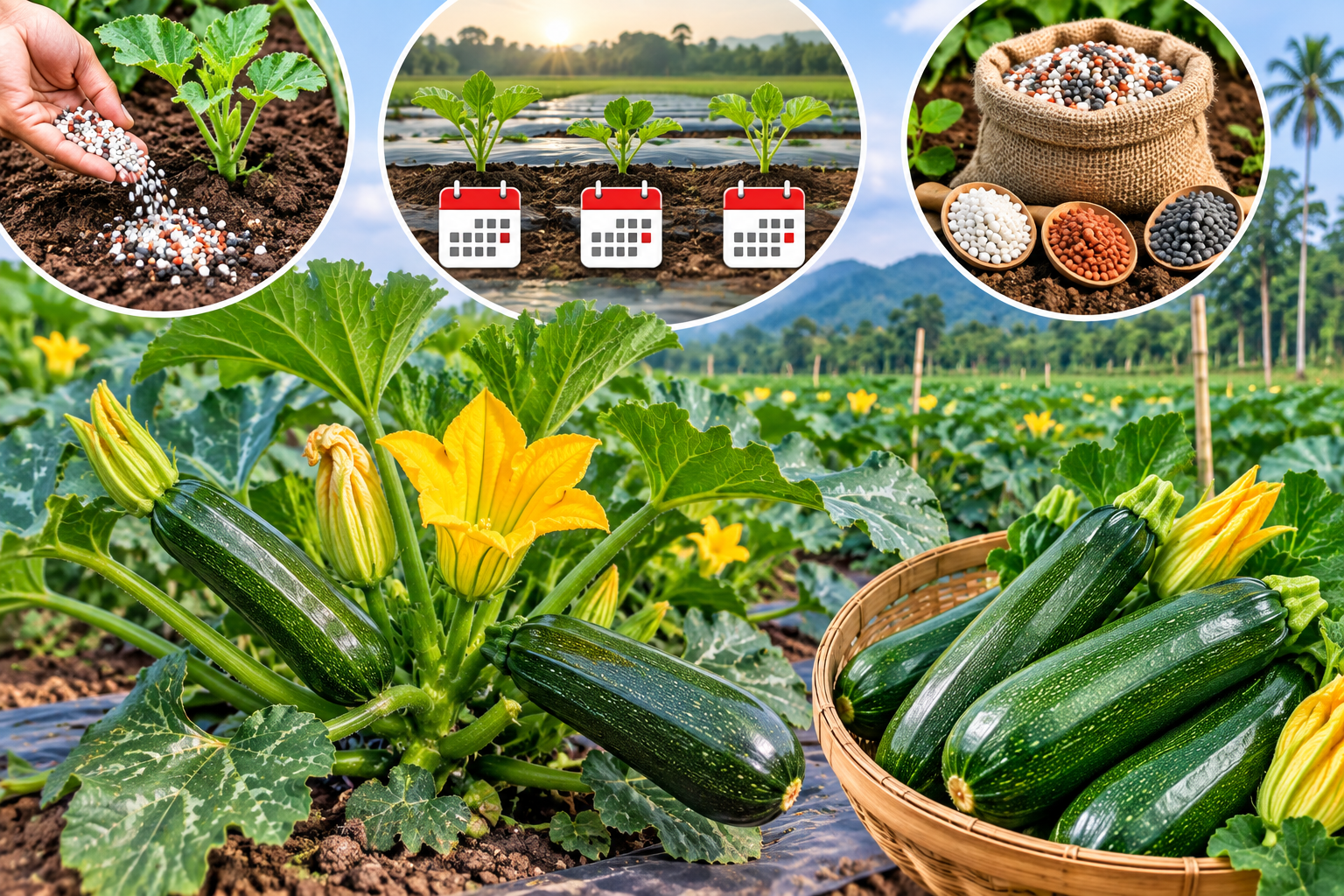
In the agricultural sector, the vitally important factors to achieve higher production in a crop are fertilizer management and planting time. To maintain healthy plant growth and to boost crop production and productivity, fertilizer application, and planting dates have a pivotal role in the present scenario of climate change. However, the effect of fertilizer and planting dates on zucchini in agro-climatic conditions of Assam has not been properly studied. So, during the year 2019-20, it was assessed in the Experimental Farm, Department of Horticulture, Assam Agricultural University, Jorhat. Four fertilizer treatments 45: 48: 48 kg NPK/ha, 60: 64: 64 kg NPK/ha, 75: 80: 80 kg NPK/ha and keeping one treatment as control with three planting dates 1st December, 15th December, 1st January was imposed in twelve treatment combinations. The zucchini seedlings were planted at a 60 cm x 60 cm distance in a plot size of 3.24 m2 in a split-plot design. During the growing period, the diameter of fruit, length of fruit, weight of fruit, number of days to opening of flower to harvest, number of days to first harvest, number of days to last harvest, number of harvests, number of fruits per plant and fruit yield per plant/ plot/ hectare were recorded. From this trial, it is concluded that early planting and maximum fertilizer dose were better in terms of the above physical and yield attributes.
References
[1] Amit, BS Ghanghas, V. Yadav and P. Chahal (2023). Knowledge Status of Onion Growers Regarding Pre and Post-Harvest Management Practices. Indian Res. J. Ext. Edu., 23: 59-63.
[2] D. Y. Abd-Elkader, A. A. Mohamed, M. N. Feleafel, A. A. Al-Huqail, M. Z. Salem, H. M. Ali and H. S. Hassan (2022). Photosynthetic pigments and biochemical response of zucchini (Cucurbita pepo L.) to plant-derived extracts, microbial, and potassium silicate as biostimulants under greenhouse conditions. Front. Plant Sci., 13: 879545. doi: 10.3389/fpls.2022.879545.
[3] D. Bhattacharjee, D. B. Phookan, S. Chamuah, M. K. Nath, S. Gogoi, S. Das and P. Debnath (2023). Influence of planting time and spacing on quality of Zucchini (Cucurbita pepo) under naturally ventilated polyhouse. Emerg. Life Sci. Res., 9: 43-50.
[4] D. Martínez-Valdivieso, P. Gómez, R. Font and M. D. Río-Celestino (2015). Mineral composition and potential nutritional contribution of 34 genotypes from different summer squash morphotypes. Eur. Food Res. Technol., 240: 71-81.
[5] F. Oloyede, G. Agbaje, E. Obuotor and I. Obisesan (2012). Nutritional and antioxidant profiles of pumpkin (Cucurbita pepo Linn.) immature and mature fruits as influenced by NPK fertilizer. Food chemistry, 135: 460-463.
[6] D. Martínez-Valdivieso, R. Font, Z. Fernández-Bedmar, T. Merinas-Amo, P. Gómez, Á. Alonso-Moraga and M. del Río-Celestino (2017). Role of zucchini and its distinctive components in the modulation of degenerative processes: genotoxicity, anti-genotoxicity, cytotoxicity and apoptotic effects. Nutrients, 9: 755. doi: 10.3390/nu9070755.
[7] T. W. Whitaker and G. Bohn (1950). The taxonomy, genetics, production and uses of the cultivated species of Cucurbita. Econ. Bot., 4: 52-81.
[8] T. Sannikova, V. Machulkina, L. Pavlov and A. Gulin (2020). The effect of variety and degree of maturity of the fruit on the organoleptic characteristics of candied zucchini. Veg. Crops Russia, 1: 42-44.
[9] L. Formisano, C. El-Nakhel, G. Corrado, S. De Pascale and Y. Rouphael (2020). Biochemical, physiological, and productive response of greenhouse vegetables to suboptimal growth environment induced by insect nets. Biology, 9: 432. doi: 10.3390/biology9120432.
[10] A. Shaheen, M. A. Naeem, G. Jilani and M. Shafiq (2010). Integrated soil management in eroded land augments the crop yield and water-use efficiency. Acta Agric. Scand. B Soil Plant Sci., 60: 274-282.
[11] K. Waseem, Q. M. Kamran and M. S. Jilani (2008). Effect of different nitrogen levels on growth and yield of cucumber (Cucumis sativus L.). J Agric Res., 46: 259-266.
[12] H. Hamad (2010). Effect of spacing between plants and nitrogen fertilization on flowering, growth and yield of squash (Cucurbita pepo). Diyala Agril. Sci. J, 2: 239-244.
[13] O. Niyokuri, J. Rono, A. Fashaho and J. Ogweno (2013). Effect of different rates of nitrogen fertilizer on the growth and yield of Zucchini (Cucurbita pepo cv. Diamant L.) hybrid F1 in Rwandan high altitude zone. Int. J. Agric. Crop Sci., 5: 54-62.
[14] R. S. Shareef, S. M. Rasheed and P. J. Zeebaree (2022). Effect of organic and inorganic fertilizers on growth and yield of summer squash (Cucurbita pepo L.). J. Duhok Univ., 25: 17-25.
[15] H. Lata, R. G. Khandekar, P. C. Haldavanekar, S. G and B. Salvi (2017). Effect of spacing and fertilizer levels on flowering and yield of zucchini (Cucurbita pepo L.). Int. J. Sci. Nat., 8: 802-805.
[16] S. Narke, Y. Parulekar, P. Haldavanekar, P. Haldankar, R. Dhopawkar and S. Hinge (2015). Effect of spacing and fertilizer levels on growth and yield of zucchini (Cucurbita pepo L.) under Konkan agro-climatic conditions. J. Indian Soc. Coastal Agric. Res., 33: 22-27.
[17] D. NeSmith, G. Hoogenboom and D. Groff (1994). Staminate and pistillate flower production of summer squash in response to planting date. HortScience, 29: 256-257.
[18] M. Hazarika, D. B. Phookan, H. Choudhury and P. Saikia (2012). Effect of different levels of NPK on yield and quality parameters of watermelon (Citrullus lanatus Thunb.). Crop Res., 44: 370-374.
[19] M. S. Jilani, A. Bakar, K. Waseem and M. Kiran (2009). Effect of different levels of NPK on the growth and yield of cucumber (Cucumis sativus) under the plastic tunnel. J. Agric. Soc. Sci, 5: 99-101.
[20] N. Jan, M. Iqbal, A. Ghafoor, K. Waseem and M. Jillani (2000). Effect of NPK fertilizers and spacing on the yield of bottle gourd (Lagenaria siceratia M). Pak. J. Biol. Sci., 3: 448-449.
[21] S. Karde (2014). Effect of spacing and fertilizer levels on growth and yield of zucchini (Cucurbita pepo L.) under naturally ventilated polyhouse. M. Sc.(Hort.) Thesis, Dr. Balasaheb Sawant Konkan Krishi Vidyapeeth, Dapoli (MS).
[22] B. J and F. Causin (1996). The central role of amino acids on N utilization and plant growth. J. Plant Physiol., 149: 358–362.
[23] M. Jannesari, A. M. Ghehsareh and J. Fallahzade (2016). Response of tomato plant towards amino acid under salt stress in a greenhouse system. J. Environ. Sci. Technol., 9: 131-139.
[24] S. Brahma, D. Phookan, B. Gautam and D. Bora (2002). Effect of nitrogen, phosphorus and potassium on production of broccoli (Brassica oleracea var. italica L.) cv. KTS-1. Veg. Sci., 29: 154-156.
[25] A. Singh (2004). Effect of nitrogen and phosphorus on growth and curd yield of cauliflower var. snowball-16 under cold arid region of Ladakh. Haryana J. Hort. Sci., 33: 127-129.
[26] B. A. Ouda and A. Y. Mahadeen (2008). Effect of fertilizers on growth, yield, yield components, quality and certain nutrient contents in broccoli (Brassica oleracea). Int. J. Agric. Biol., 10: 627-632.
[27] M. Maluki, J. Ogweno and R. Gesimba (2016). Evaluation of nitrogen effects on yield and quality of watermelon {Citrullus lanatus (Thunb.) Matsumara & Nakai} grown in the coastal regions of Kenya. Int. J. Plant Soil Sci., 9: 1-8.
[28] E. Eifediyi and S. Remison (2010). Growth and yield of cucumber (Cucumis sativus L.) as influenced by farmyard manure and inorganic fertilizer. J. Plant Breed. Crop Sci., 2: 216-220.
Downloads
Published
Issue
Section
License
Copyright (c) 2023 Author (s)

This work is licensed under a Creative Commons Attribution-NonCommercial-NoDerivatives 4.0 International License.
Copyright © The Author(s). This is an open access article distributed under the terms of the Creative Commons Attribution-NonCommercial-NoDerivatives 4.0 International License (CC BY-NC-ND 4.0), which permits unrestricted non-commercial use, distribution, and reproduction in any medium, provided the original author(s) and source are properly credited, and the work is not modified or adapted.