Assessment of molecular diversity through ISSR markers in muskmelon (Cucumis melo L.)
DOI:
https://doi.org/10.31783/elsr.2023.92362368Keywords:
ISSR, genotypes, genetic polymorphism, muskmelon, molecular diversity, molecular markerAbstract
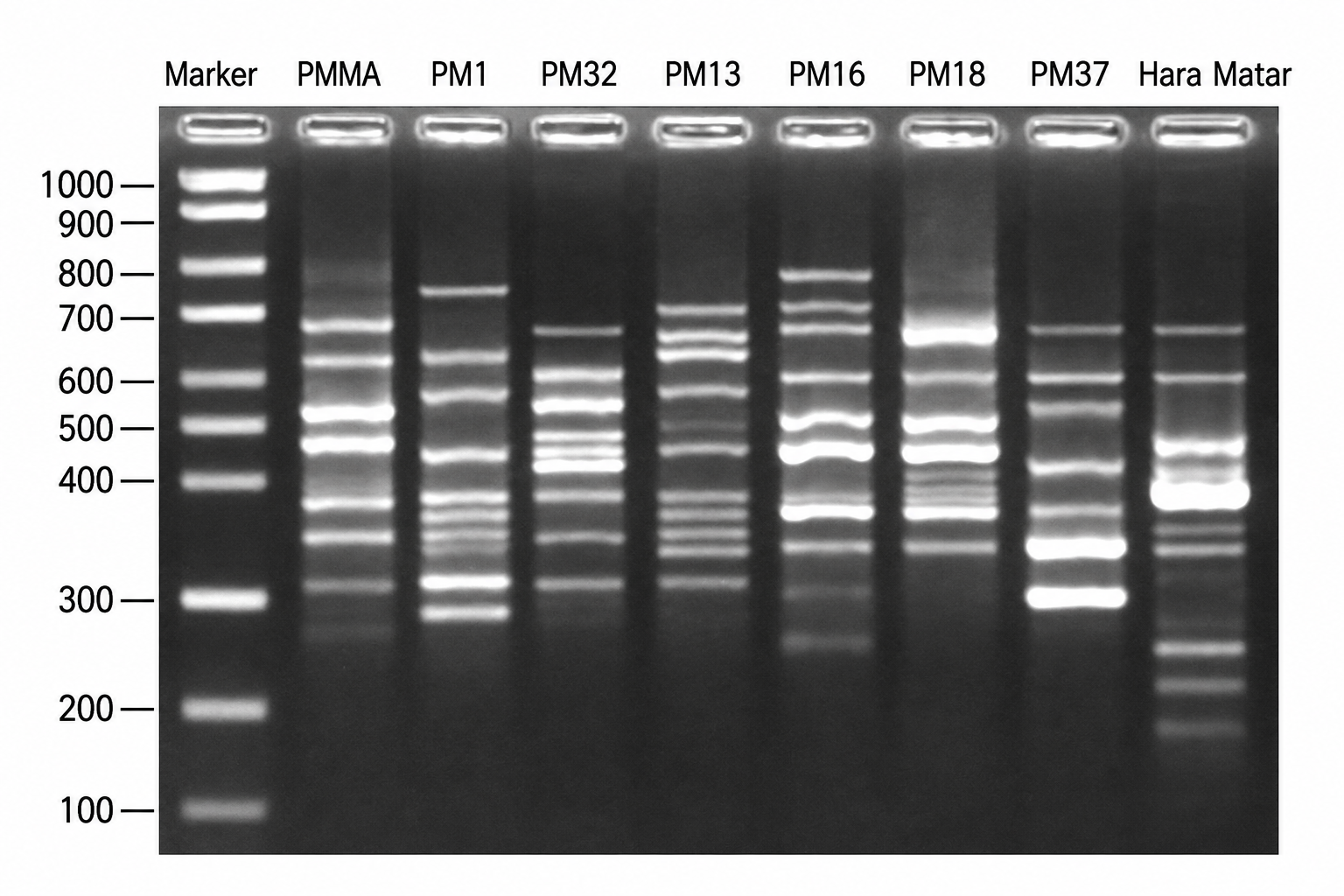
The present investigation was carried out for the assessment of molecular diversity in parental lines of muskmelon to be used for the crossing programs to get hybrids with desirable traits. A total of eight inbred lines of andromonoecious muskmelon were assessed with twenty ISSR (Inter Simple Sequence Repeat) primers. Based on polymorphism four primers were selected for whole molecular analysis. The polymorphism varied from 50.00 to 90.90% with an average of 82.97 percent. Pair-wise similarity matrix in accordance with Jaccard’s coefficient revealed the similarity estimation ranging from 55.00% to 75.00%. The maximum similarity value was recorded for the PMM-37 (0.75) with Hara Madhu while the lowest was observed for PMM-4A (0.55) with PMM-16 and between PMM-32 (0.55) and PMM-18. Eight genotypes were categorized into two main clusters. Cluster I included 6 genotypes and Cluster II comprised 2 genotypes with approximately 70.80% similarity among themselves. Cluster I is further subdivided into two sub-clusters IA and IB with 63.00% similarity. Sub-cluster IA further forked into two small clusters IAi and IAii. IAi is comprised of PMM 4A. IAii is further subdivided into 2 groups; Group 1 and Group 2 with approximately 73.60% similarity. Group 1 consists of PMM 16 and group 2 consists of PMM 37 and check variety Hara Madhu with approximately 74.00% similarity. Sub-cluster IB comprised two genotypes PMM 32 and PMM 18 with approximately 70.90% similarity among themselves.
References
[1] P. Sebastian, H. Schaefer, I. R. Telford and S. S. Renner (2010). Cucumber (Cucumis sativus) and melon (C. melo) have numerous wild relatives in Asia and Australia, and the sister species of melon is from Australia. Proc. Natl. Acad. Sci., 107: 14269-14273.
[2] R. Joshi, M. Kundu and C. Singh (2013). Morphological characters: efficient tool for identification on different mango cultivars. Environ. Ecol., 31: 385-388.
[3] S. Sinha, D. S. Thakur, M. Kundu and F. Ahmad (2020). Genetic analysis of exotic germplasms of pomegranate (Punica granatum L.). Bangladesh J. Bot., 49: 105-112.
[4] A. A. Malik, V. Vashisht, K. Singh, A. Sharma, D. Singh, H. Singh and A. Monforte et al. (2014). Diversity among melon (Cucumis melo L.) landraces from the Indo-Gangetic plains of India and their genetic relationship with USA melon cultivars. Genet. Resour. Crop Evol., 61: 1189-1208.
[5] J. D. McCreight, J. E. Staub, T. C. Wehner and N. P. Dhillon (2013). Gone global: familiar and exotic cucurbits have Asian origins. HortScience, 48: 1078-1089.
[6] M. Sarkar and D. K. Singh (2018). Electrophoretic protein profile and ISSR marker based genetic relationship study in ridge gourd [Luffa acatangula (Roxb.) L.]. Veg. Sci., 45: 14-21.
[7] V. G. Baldaniya, A. V. Narwade, P. B. Patel and N. Karmakar (2022). Molecular diversity analysis of rice (Oryza sativa L.) genotypes using RAPD and SSR marker. Emerg. Life Sci. Res., 8: 113-123.
[8] S. Pandey, W. A. Ansari, M. Pandey and B. Singh (2018). Genetic diversity of cucumber estimated by morpho-physiological and EST-SSR markers. Physiol. Mol. Biol. Plants, 24: 135-146.
[9] S. K. Singh, P. K. Majhi, A. Anandan, M. Korada, S. V. Habde, A. R. Khaire and D. K. Singh et al. (2022). Microsatellites based parental polymorphism survey for moisture stress in Rice (Oryza sativa L.) between the parental genotypes HUR-1309 and CR Dhan 801. Emerg. Life Sci. Res., 8: 248-258.
[10] N. Dhillon, J. Singh, M. Fergany, A. J. Monforte and A. Sureja (2009). Phenotypic and molecular diversity among landraces of snapmelon (Cucumis melo var. momordica) adapted to the hot and humid tropics of eastern India. Plant Genet. Resour., 7: 291-300.
[11] M. Pradeep Reddy, N. Sarla and E. Siddiq (2002). Inter simple sequence repeat (ISSR) polymorphism and its application in plant breeding. Euphytica, 128: 9-17.
[12] Y. Dje, G. Tahi, I. Z. Bi, M. Malice, J.-P. Baudoin and P. Bertin (2006). Optimization of ISSR marker for African edible-seeded Cucurbitaceae species’ genetic diversity analysis. Afr. J. Biotechnol., 5: 83-87.
[13] A. Levi, C. E. Thomas, A. M. Simmons and J. A. Thies (2005). Analysis based on RAPD and ISSR markers reveals closer similarities among Citrullus and Cucumis species than with Praecitrullus fistulosus (Stocks) Pangalo. Genet. Resour. Crop Evol., 52: 465-472.
[14] H. S. Paris, N. Yonash, V. Portnoy, N. Mozes-Daube, G. Tzuri and N. Katzir (2003). Assessment of genetic relationships in Cucurbita pepo (Cucurbitaceae) using DNA markers. Theor. Appl. Genet., 106: 971-978.
[15] Y. Akashi, N. Fukuda, T. Wako, M. Masuda and K. Kato (2002). Genetic variation and phylogenetic relationships in East and South Asian melons, Cucumis melo L., based on the analysis of five isozymes. Euphytica, 125: 385-396.
[16] A. Monforte, J. Garcia‐Mas and P. Arus (2003). Genetic variability in melon based on microsatellite variation. Plant Breed., 122: 153-157.
[17] R. K. Parvathaneni, S. Natesan, A. A. Devaraj, R. Muthuraja, R. Venkatachalam, A. P. Subramani and P. Laxmanan (2011). Fingerprinting in cucumber and melon (Cucumis spp.) genotypes using morphological and ISSR markers. J. Crop Sci. Biotechnol., 14: 39-43.
[18] Y. Zhang, X. Fan, Y. Aierken, X. Ma, H. Yi and M. Wu (2017). Genetic diversity of melon landraces (Cucumis melo L.) in the Xinjiang Uygur autonomous region on the basis of simple sequence repeat markers. Genet. Resour. Crop Evol., 64: 1023-1035.
[19] J. J. Doyle and J. L. Doyle (1987). A rapid DNA isolation procedure for small quantities of fresh leaf tissue. Phytochem. bull., 19: 11-15.
[20] F. J. Rohlf (1998). NTSYSpc numerical taxonomy and multivariate analysis system version 2.0 user guide.
[21] M. A. Yeboah, C. Xuehao, C. R. Feng, G. Liang and M. Gu (2007). A genetic linkage map of cucumber (Cucumis sativus L) combining SRAP and ISSR markers. Afr. J. Biotechnol., 6: 2784-2791.
[22] B. Sikdar, M. Bhattacharya, A. Mukherjee, A. Banerjee, E. Ghosh, B. Ghosh and S. Roy (2010). Genetic diversity in important members of Cucurbitaceae using isozyme, RAPD and ISSR markers. Biol. Plant., 54: 135-140.
[23] M. R. Islam, G. B. Gregorio, M. A. Salam, B. C. Collard, R. K. Singh and L. Hassan (2012). Validation of SalTol linked markers and haplotype diversity on chromosome 1 of rice. Mol. Plant Breed., 3: 103-114.
[24] E. Ramadan, A. Elmoghazy and H. El-Mowafi (2015). Molecular markers based genetic diversity analysis for drought tolerance in rice (Oryza sativa L.) Using SSR Markers. Int. J. Sci. Res. Agric. Sci, 2: 137-146.
[25] W. Ansari, N. Atri, B. Singh, P. Kumar and S. Pandey (2018). Morpho-physiological and biochemical responses of muskmelon genotypes to different degree of water deficit. Photosynthetica, 56: 1019-1030.
[26] N. P. Dhillon, A. J. Monforte, M. Pitrat, P. Sudhakar, P. K. Singh, K. R. Reitsma and J. Garcia-Mas et al. (2012). Melon landraces of India: contributions and importance. Plant breeding reviews, 35: 85-150.
[27] M. Fergany, B. Kaur, A. J. Monforte, M. Pitrat, C. Rys, H. Lecoq and N. Dhillon et al. (2011). Variation in melon (Cucumis melo) landraces adapted to the humid tropics of southern India. Genet. Resour. Crop Evol., 58: 225-243.
[28] A. Roy, S. Bal, M. Fergany, S. Kaur, H. Singh, A. A. Malik and J. Singh et al. (2012). Wild melon diversity in India (Punjab state). Genet. Resour. Crop Evol., 59: 755-767.
Downloads
Published
Issue
Section
License
Copyright (c) 2023 Author (s)

This work is licensed under a Creative Commons Attribution-NonCommercial-NoDerivatives 4.0 International License.
Copyright © The Author(s). This is an open access article distributed under the terms of the Creative Commons Attribution-NonCommercial-NoDerivatives 4.0 International License (CC BY-NC-ND 4.0), which permits unrestricted non-commercial use, distribution, and reproduction in any medium, provided the original author(s) and source are properly credited, and the work is not modified or adapted.