Evaluation of mango (Mangifera indica L.) different cultivars for flowering attributes of Chhattisgarh plain zone under rained condition
DOI:
https://doi.org/10.31783/ELSR.2024.1020106Keywords:
flowers, panicle, sex ratio, varietiesAbstract
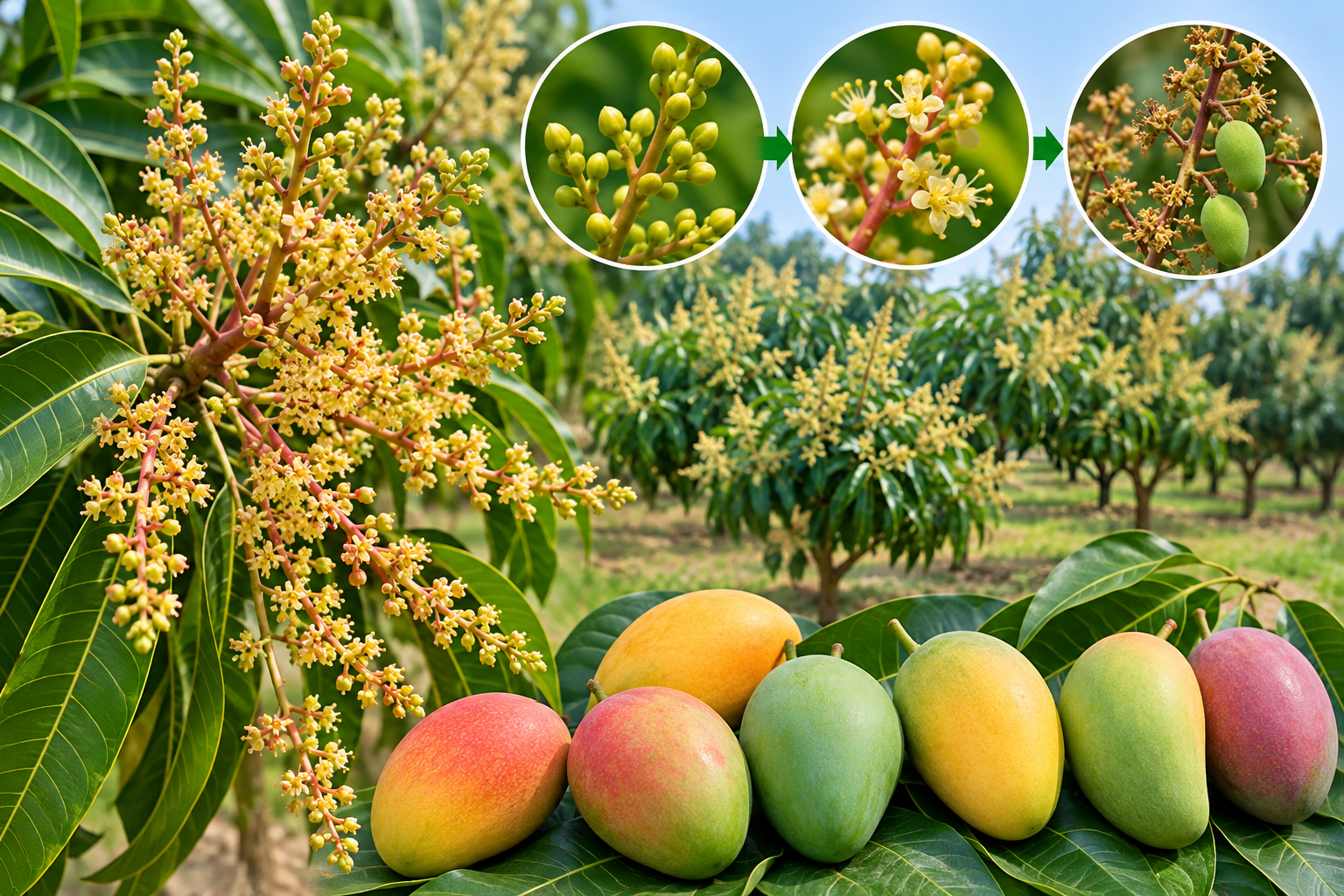
A conducted field experiment that is an investigation of flowering characteristic attributes of some mango varieties in the Chhattisgarh plain zone at a field of Horticulture Farm, CoA, IGKV, Raipur (C.G.) in the years 2019-20 and 2020-21. In the results of research work of both the years, the difference in flower buds was different. It was noticed that the Chhattisgarh Raj variety was the earliest panicle emergence and the late variety Amarpali experimental years. In the same way are varieties Chhattisgarh Raj is earliest and late is Amrapali different parameters like- flower bud differentiation, the emergence of inflorescence, the start of the first flowering date, 25% flower opening, 50% flower opening, and days of full bloom and start date of a bearing. The both years (2019-20 and 2020-21) observed that in total number of flowers in panicle1 was the maximum variety Chhattisgarh Gaurav (1780.16) and the minimum is Chhattisgarh Pawan (704.50), in case number of hermaphrodite flower panicle1 Dashehari (518.00) highest and lowest Chhattisgarh Raj (68.33) and several male flower panicle1 is highest Chhattisgarh Gaurav (1265.16) and least value Chhattisgarh Pawan (522.833), sex ratio is highest is Chhattisgarh Raj (14.21) and the minimum is Langra (1.56).
References
[1] Anonymous (2007). USDA Table of nutrient retention factors, 6. http://www.ars.usda.gov/nutrientdata.
[2] Anonymous (2019). National horticulture board. http://nhb.gov.in.
[3] D. N. Kuhn, I. S. E. Bally, N. L. Dillon, D. Innes, A. M. Groh, J. Rahaman and R. Ophir et al., (2017). Genetic map of mango: a tool for mango breeding. Front. Plant Sci., 8: 577. doi: 10.3389/fpls.2017.00577.
[4] A. Singh, C. P. Singh and A. K. Singh (2015). Flowering behaviour of mango genotypes under tarai conditions of Uttarakhand. Int. J. Basic Appl. Agric., 13: 400-406.
[5] R. Kumar, A. Raj, M. Prasad, K. Azam, J. Kumari, S. Sahay and S. Sengupta et al., (2018). Assessing the Flowering and Fruiting Behaviour in Some Important Cultivars of Mango (Mangifera indica L.). Curr. J. Appl. Sci. Technol., 31: 1-8.
[6] H. E. Beck, N. E. Zimmermann, T. R. McVicar, N. Vergopolan, A. Berg and E. F. Wood (2018). Present and future Köppen-Geiger climate classification maps at 1-km resolution. Sci. Data, 5: 180214. doi:10.1038/sdata.2018.214.
[7] S. K. Mandal, K. Kumari, A. Kumar, A. Mankar and S. Sahay (2020). Floral biology and pollen viability of some Mango (Mangifera indica L.) cultivars. Int. J. Curr. Microbiol. App. Sci., 9: 2390-2400.
[8] Anonymous (2006). IPGRI, descriptors for mango (Mangifera indica L.). International Plant Genetic Resource, Rome, Italy, pp60. Available at: https://hdl.handle.net/10568/72607.
[9] K. A. Gomez and A. A. Gomez (1984). Statistical procedures in agricultural research, 2nd edn. Wiley, New York.
[10] M. Humayun and R. S. Babu (2002). Studies on fruit-bud differentiation in mango (Mangifera indica L.) under South Indian conditions. J. Appl. Hortic., 4: 27-29.
[11] R. N. Kanpure, H. P. Singh and R. K. Reja (2009). Evaluation of mango hybrids for Kymore Plateau of Madhya Pradesh. J. Community Mobilization Sustain. Dev., 4: 1-3.
[12] R. Kher and R. M. Sharma, (2002). Performance of some mango cultivars under subtropical rainfed region of Jammu. Haryana J. Hort. Sci., 31: 8-10.
[13] G. Indian, E. Naik, M. Deenavarman, K. Jagathesan and T. Janani (2020). Studies on the Growth and Flowering Behavior of Different Mango (Mangifera indica L.) Genotypes. Int.J. Curr. Microbiol. App. Sci., 9: 1981-1989.
[14] K. V. Malshe, P. C. Haldavanekar and M. S. Gawankar (2018). Improvement in fruit retention and yield in mango (Mangifera indica L.) Cv. Alphonso through irrigation, NAA and Potassium nitrate. Contem. Res. India., 8: 2231-2137.
Downloads
Published
Issue
Section
License
Copyright (c) 2024 Author (s)

This work is licensed under a Creative Commons Attribution-NonCommercial-NoDerivatives 4.0 International License.
Copyright © The Author(s). Effective from 1 July 2026, articles published in Emergent Life Sciences Research (ELSR) are distributed under the Creative Commons Attribution 4.0 International License (CC BY 4.0), which permits use, sharing, distribution, reproduction, and adaptation in any medium or format, provided that appropriate credit is given to the original author(s) and the source, a link to the license is provided, and any changes made are indicated.
Articles published before 1 July 2026 remain subject to the license applicable at the time of their original publication, including the Creative Commons Attribution-NonCommercial-NoDerivatives 4.0 International License (CC BY-NC-ND 4.0), where applicable.