Assessment of oxidative stress induced immunotoxic effect mediated by in vitro exposure to methyl parathion in lymphocytes isolated from chicken spleen
DOI:
https://doi.org/10.31783/ELSR.2024.1020714Keywords:
chicken lymphocytes, methyl parathion, nitric oxide estimation, oxidative stressAbstract
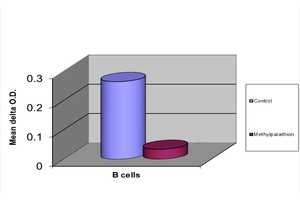
Immunotoxicology examines the adverse effects of xenobiotics- including pesticides, heavy metals from emissions, drugs and other substances- on the body’s defense system of humans and animals. The term pesticide encompasses a diverse array of substances, including insecticides, fungicides, herbicides, rodenticides, etc. Pesticides are widely used around the globe; however, there has been an increase in reports highlighting their harmful effects. The broad-spectrum activity of methyl parathion allows elimination a vast range of pests, making it a popular choice for pest control in agriculture. However, its use is increasingly regulated due to its high toxicity to humans, non-target organisms and the environment. Methyl parathion, a widely used organophosphate pesticide, is reported to pose significant health risks through its neurotoxic, immunotoxic and oxidative stress-inducing effects. Methyl parathion primarily exerts toxicity by inhibiting acetylcholinesterase, leading to neural overstimulation. This study investigates the in vitro immunotoxic effects of methyl parathion induced due to increased oxidant stress (OS) in mitogen-stimulated avian lymphocytes. Utilizing lymphocyte proliferation and nitric oxide (NO) estimation assays, the findings showed a marked reduction in B and T-cell proliferation following exposure to a thousand-fold dilution of the No Observable Effect Level (NOEL/103) dose of methyl parathion. Additionally, oxidative stress, as indicated by NO levels, was significantly elevated in methyl parathion treated cells as compared to control cells. Thus, our results indicate that in vitro exposure to methyl parathion caused considerable immunotoxic effects in the exposed lymphocytes that could be linked with enhanced OS.
References
[1] J. E. Casida and G. B. Quistad (1998). Golden age of insecticide research: past, present, or future? Annu. Rev.Entomol., 43: 1-16.
[2] A. Ranjbar, P. Pasalar, and M. Abdollahi (2002). Induction of oxidative stress and acetylcholinesterase inhibition in organophosphorous pesticide manufacturing workers. Hum. Exp. Toxicol., 21: 179-182.
[3] T. Galloway and R. Handy (2003). Immunotoxicity of organophosphorous pesticides. Ecotoxicology, 12: 345-363.
[4] S. Ambwani, T. K. Ambwani and R. S. Chauhan (2018a). Immunotoxic effects of cypermethrin in mitogen stimulated chicken lymphocytes due to Oxidative stress and apoptosis. J. Entomol. Zool. Stud., 6: 37-42.
[5] S. Ambwani, T. K. Ambwani, S. P. Singh and R. S. Chauhan (2010). Evaluation of allethrin induced immunotoxicity in avian lymphocytes. J. Vet. Pharmacol. Toxicol., 9: 68-70.
[6] S. Kevekordes, T. Gebel, K. Pav, R. Edenharder and H. Dunkelberg (1996). Genotoxicity of selected pesticides in the mouse bone-marrow micronucleus test and in the sister-chromatid exchange test with human lymphocytes in vitro. Toxicol. Lett., 89: 35-42.
[7] M. Balls and E. Sabbioni (2001). Promotion of research on in vitro immunotoxicology. Sci. Total Environ., 270: 21-25.
[8] R. Cicchetti and G. Argentin (2003). The role of oxidative stress in the in vitro induction of micronuclei by pesticides in mouse lung fibroblasts. Mutagenesis. 18: 127-132.
[9] A. Ogutcu, M. Uzunhisarcikli, S. Kalender, D. Durak, F. Bayrakdaa and Y. Kalender (2008). The effects of organophosphate insecticide diazinon on malondialdehyde levels and myocardial cells in rat heart tissue and protective role of vitamin E. Pest. Biochem. Physiol., 86: 93-98.
[10] F. L. Edwards and P. B. Tchounwou (2005). Environmental toxicology and health associated with methyl parathion exposure-A scientific review. Int. J. Environ. Res. Public Health, 2: 430-441.
[11] R. T. Gahukar (1999). Agro-medical guide of synthetic pesticides. Nagpur, Agri-Horticultural Publishing House.
[12] S. Ambwani, T. K. Ambwani and R. S. Chauhan (2018b). Evaluation of immunotoxicity and oxidative stress due to in vtiro exposure of Dimethoate in chicken lymphocytes. J. Immunol. Immunopathol., 20: 30-37
[13] S. Ambwani, T. K. Ambwani and R. S. Chauhan (2019). Phorate induced down regulation of chicken lymphocytes proliferation through oxidative stress due to in vitro exposure. Bulletin Environ. Pharmacol. Life Sci., 8: 75-80.
[14] S. Ambwani, T.K. Ambwani and R.S. Chauhan (2022). Reversal of phorate induced immunotoxicity and oxidative stress due to in vitro exposure of indigenous Hill cattle cow urine in chicken lymphocytes. J. Immunol. Immunopathol., 24: 28-35.
[15] R. O. Sule, L. Condon and A. V. Gomes (2022). A common feature of pesticides: oxidative stress-the role of oxidative stress in pesticide-induced toxicity. Oxid. Med. Cell. Longev., 2022: 5563759. doi: 10.1155/2022/5563759.
[16] D. Bagchi, M. Bagchi, E. A. Hassoun and S. J. Stohs (1995). In vitro and in vivo generation of reactive oxygen species, DNA damage and lactate dehydrogenase leakage by selected pesticides. Toxicology, 104: 129-40.
[17] B. D. Banerjee, V. Seth, A. Bhattacharya, S. T. Pasha and A. K. Chakraborty (1999). Biochemical effects of some pesticides on lipid peroxidation and free-radical scavengers. Toxicol. Lett., 107: 33-47.
[18] F. Gultekin, M. Ozturk and M. Akdogan (2000). The effect of organophosphate insecticide chlorpyrifos-ethyl on lipid peroxidation and antioxidant enzymes (in vitro). Arch. Toxicol., 74: 533-538.
[19] F. Kamel and J. A. Hoppin (2004). Association of pesticide exposure with neurologic dysfunction and disease. Environ. Health Perspect., 112: 950-958.
[20] I. Altuntas, N. Delibas and R. Sutcu (2002). The effects of organophosphate insecticide methidathion on lipid peroxidation and anti-oxidant enzymes in rat erythrocytes: role of vitamins E and C. Hum. Exp. Toxicol., 21: 681-685.
[21] S. Kalender, Y. Kalender, D. Durak, A. Ogutcu, M. Uzunhisarcikli, B. S. Cevrimli and Murat Yildirim (2007). Methyl parathion induced nephrotoxicity in male rats and protective role of vitamins C and E. Pestic. Biochem. Phys., 88: 213-218.
[22] R. S. Verma, A. Mehta, and N. Srivastava (2007). In vivo chlorpyrifos induced oxidative stress: Attenuation by antioxidant vitamins. Pestic. Biochem. Physiol., 88: 191-196.
[23] S. Ambwani, R. Dolma, R. Sharma, A. Kaur, H. Singh, A. Ruj and T. K. Ambwani (2023). Modulation of inflammatory and oxidative stress biomarkers due to dexamethasone exposure in chicken splenocytes. Vet. Immunol. Immunopathol., 262: 110632. doi: 10.1016/j.vetimm.2023.110632.
[24] E. A. Boyse (1964). Cytotoxic test for demonstration of mouse antibody. Method Med. Res., 10: 39-47.
[25] D. J. Stuehr and C.F. Nathan (1989). Nitric oxide. A macrophage product responsible for cytostasis and respiratory inhibition in tumor target cells. J. Exp. Med., 169: 1543-1555.
[26] G. W. Snedecor and W. E. Cochran (1967). Statistical methods. 6th ed., sec. 11.16. Iowa State Univ. Press, Ames.
[27] F. L. Edwards and P. B. Tchounwou (2005). Environmental toxicology and health associated with methyl parathion exposure-A scientific review. Int. J. Environ. Res. Public Health, 2: 430-441.
[28] R. Solecki, A. S. Fagi, R. Pfeil and V. Hilbig (1996). Effects of methyl parathion on reproduction in the Japanese quail. Bull. Environ. Contam. Toxicol., 57: 902-908.
[29] A. W. Abu-Qare, A. Abdel-Rahman, C. Brownie, A. M. Kishk and M. B. Abou-Donia (2001). Inhibition of cholinesterase enzymes following a single dermal dose of chlorpyrifos and methyl parathion, alone and in combination, in pregnant rats. J. Toxicol. Environ. Health Part A, 63: 173-189.
[30] U. Undeğer and N. Başaran (2005). Effects of pesticides on human peripheral lymphocytes in vitro: induction of DNA damage. Arch. Toxicol., 79: 169-176.
[31] L. Institoris, O. Siroki and I. Desi (1995). Immunotoxicity study of repeated small doses of dimethoate and methylparathion administered to rats over three generations. Hum. Experi. Toxicol., 14: 879-883.
[32] D. S. Rupa, P. P. Reddy and O. S. Reddy (1990). Cytogenicity of quinalphos and methyl parathion in human peripheral lymphocytes. Hum. Exp. Toxicol., 9: 385-387.
[33] P. Liu, X. Song, W. Yuan, W. Wen, X. Wu, J. Li and X. Chen (2006). Effects of cypermethrin and methyl parathion mixtures on hormone levels and immune functions in Wistar rats. Arch. Toxicol., 80: 449-457.
[34] J. Tigges, F. Worek, H. Thiermann and T. Wille (2022). Organophosphorus pesticides exhibit compound specific effects in rat precision-cut lung slices (PCLS): mechanisms involved in airway response, cytotoxicity, inflammatory activation and antioxidative defense. Arch. Toxicol., 96: 321-334.
[35] A. Lukaszewicz-Hussain (2010). Role of oxidative stress in organophosphate insecticide toxicity–Short review. Pestic. Biochem. Physiol., 98: 145-150.
[36] M. Guney, B. Oral, H. Demirin, M. Ozguner, G. Take, T. Mungan and I. Altuntas (2007). Evaluation of caspase apoptosis during methyl parathion-induced endometrial damage in rats: ameliorating effect of vitamins E and C. Environ. Toxicol. Pharmacol., 23: 221-227.
[37] S. Bartoli, B. Bonora, A. Colacci, A. Niero and S. Grilli (1991). DNA damaging activity of methyl parathion, Res. Communi. Chem. Patolh. Pharmacol., 71: 209-218.
[38] V. Sivapiriya, T. Jayanthisak and S. Venkatraman (2006). Effect of dimethoate and ethanol in antioxidant status of liver and kidney of experimental rats. Pest. Biochem. Physiol., 85: 115-121.
Downloads
Published
Issue
Section
License
Copyright (c) 2024 Author (s)

This work is licensed under a Creative Commons Attribution-NonCommercial-NoDerivatives 4.0 International License.
Copyright © The Author(s). Effective from 1 July 2026, articles published in Emergent Life Sciences Research (ELSR) are distributed under the Creative Commons Attribution 4.0 International License (CC BY 4.0), which permits use, sharing, distribution, reproduction, and adaptation in any medium or format, provided that appropriate credit is given to the original author(s) and the source, a link to the license is provided, and any changes made are indicated.
Articles published before 1 July 2026 remain subject to the license applicable at the time of their original publication, including the Creative Commons Attribution-NonCommercial-NoDerivatives 4.0 International License (CC BY-NC-ND 4.0), where applicable.