Studies on the effect of variation of different types of powdered millet on quality attributes of muffins
DOI:
https://doi.org/10.31783/ELSR.2024.1023239Keywords:
finger millet, muffins, millets, nutritional profile, pearl milletAbstract
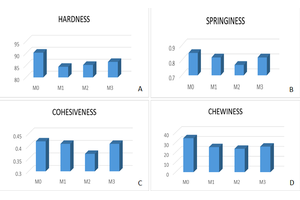
In the whole world, millets are found to be one of the oldest cultivated crops in gaining popularity as a nutritious and healthy food due to its high nutritional value and great application scope in the bakery industry such as muffins. In this study, we discuss the nutritional profile, textural analysis and microbial study of the millet based muffin. This muffin has been prepared by mixing three different millets on different levels i.e., pearl millet flour, finger millet flour and little millet flour. The different samples were prepared in various treatments viz., M1, M2, M3 in the ratios of (Pearl millet flour: Finger millet flour: Little millet flour) 10:10:20, 10:15:15, and 10:20:10 respectively. Among all the three samples M2 was found to give an appropriate study. The moisture, fat, protein, carbohydrate and ash were 22.19, 17.53, 12.65, 45.60 and 1.93 respectively. The multi-millet muffin adversely affected the hardness, cohesiveness, springiness and chewiness as compared to the control sample which was (100%) wheat based. There was no alteration in the physical appearance of the millet muffins as there was no microbial growth found on the muffins for 60 days at ambient temperature.
References
[1] S. Beegum, M. Sharma, M. R. Manikantn and R. K. Gupta (2017). Effect of Virgin coconut oil cake on physical, textural, microbial and sensory attributes of muffins. Int. J. Food Sci. Technol., 52: 540-549.
[2] A. Kumari, A. Das, K. V. D. Karthik, P. B. Gautam and B. K. Bharti (2022). Studies on quality characteristics of muffins prepared using pearl millet flour and jackfruit seed powder. Int. J. Food Nutr. Sci., 11(SI): 2898-2980.
[3] D. Goswami, R. K. Gupta, D. Mridula, M. Sharma and S. K. Tyagi (2015). Barnyard millet based muffins: Physical, textural and sensory properties. LWT Food Sci. Technol., 64: 374-380.
[4] P. Bamal and S. B. Dhull (2024). Development of functional muffins from wheat flour-carrot pomace powder using fenugreek gum as fat replacer. Curr. Res. Nutr Food Sci. Jour., 12: 306-319.
[5] L. O. H. Mallasiy, F. M. Elezaly and M. M. A. Mohammed (2023). Effect of replacing wheat flour with pearl millet flour on chemical and sensory properties of bound cake. J. Food Dairy Sci., 14: 293-299.
[6] S. Balasubramanian, D. N. Yadav, J. Kaur and T. Anand (2014). Development and shelf life evaluation of pearl millet based upma dry mix. J. Food Sci. Technol., 51: 1110-1117.
[7] J. J. Pei, V. R. Umapathy, S. Vengadassalapathy, S. F. J. Hussain, P. Rajagopal, S. Jayaraman and V. P. Veeraraghavan et al., (2022). A review of the potential consequences of pearl millet (pennisetum glaucum) for diabetes mellitus and other biomedical applications. Nutrients. 14: 2932. doi: 10.3390/nu14142932.
[8] C. Gopalan, B. V. Ramasastri and S. C. Balasubramanian (1999). Nutritive value of Indian foods. Hyderabad, India: National Institute of Nutrition, ICMR, India.
[9] J. Rajiv, C. Soumya, D. Indrani and G. V. Rao (2011). Effect of replacement of wheat flour with finger millet flour (Eleusine coracana) on the batter microscopy, rheology and quality characteristics of muffins. J. Texture Stud., 42: 478-489.
[10] N. Singh and A. Chaudhry (2023). Little millets-Review on nutritional profile and health benefits. J. Emerging Technol. Innov. Res., 10: 688-690.
[11] T. D. Karuna and P. Nazni (2018). Texture and sensory characteristics of little millet based RTC (Ready-To-Cook) noodles. Int. J. Creat. Res. Thoughts, 6: 60-71.
[12] S. Itagi, R. Naik and N. Yenagi (2013). Versatile little millet therapeutic mix for diabetic and non diabetics. Asian J. Food Sci. Technol., 4: 33-35.
[13] AACC. (2000). Approved methods of American association of cereal chemists. St. Paul, MN: The American Association of Cereal Chemists. Inc.
[14] S. Martínez-Cervera, T. Sanz, A. Salvador, S. M. Fiszman (2012). Rheological, textural and sensorial properties of low-sucrose muffins reformulated with sucralose/ polydextrose. LWT Food Sci. Technol., 4: 213-220.
[15] J. W. Lee, G.‐J. Kim, K.‐A. Rho, K.‐H. Chung, J.‐A. Yoon and J. H. An (2015). Quality characteristics and antioxidant activity of muffins containing lemongrass powder. Korean J. Food Nutr., 28: 794-801.
Downloads
Published
Issue
Section
License
Copyright (c) 2024 Author (s)

This work is licensed under a Creative Commons Attribution-NonCommercial-NoDerivatives 4.0 International License.
Copyright © The Author(s). Effective from 1 July 2026, articles published in Emergent Life Sciences Research (ELSR) are distributed under the Creative Commons Attribution 4.0 International License (CC BY 4.0), which permits use, sharing, distribution, reproduction, and adaptation in any medium or format, provided that appropriate credit is given to the original author(s) and the source, a link to the license is provided, and any changes made are indicated.
Articles published before 1 July 2026 remain subject to the license applicable at the time of their original publication, including the Creative Commons Attribution-NonCommercial-NoDerivatives 4.0 International License (CC BY-NC-ND 4.0), where applicable.