Analysis of skewness and kurtosis in F2 generation of four crosses in American cotton (Gossypium hirsutum L.)
DOI:
https://doi.org/10.31783/ELSR.2024.1025257Keywords:
kurtosis, mean performance, skewness, upland cottonAbstract
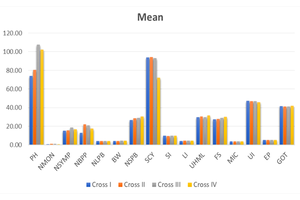
The current study was conducted to assess the mean, range, skewness, and kurtosis of four crosses in the F2 generation of upland cotton. The study consists of eight parents hybridized in a diallel method to obtain fifty-six hybrids. From these hybrids, four elite hybrids were forwarded to the F2 generation based on high boll weight, high yield of cotton per plant and high fiber quality. Based on the mean performance in the F2 population, Cross I (CO 14 x IC 359538) documented a high mean value for the locules number per boll and uniformity index. Cross II (GISV 328 x IC 359538) recorded the highest mean value for the number of monopodial branches per plant, boll number per plant, yield of cotton per plant and lint index. Cross III (IC 292130 x GISV 328) recorded a high mean for plant height, number of sympodial branches per plant, seed index and fiber fineness. Cross IV (MCU 5 x IC 359464) registered a high mean value for boll weight, number of seeds per boll, upper half mean length, fiber strength, elongation percentage and ginning outturn. All four crosses showed positive skewness for monopodial branches per plant, sympodial branches per plant, boll number per plant, locules number per boll, yield of cotton per plant, seed index, fiber strength and elongation percentage. Positive skewness is associated with complementary gene interactions, while negative skewness is associated with duplicate gene interactions. The platykurtic curve was observed for sympodial branches per plant, boll weight, seed index, fiber fineness and ginning outturn in all four crosses, whereas the leptokurtic peak was noted for yield of cotton per plant and boll number per plant in all four crosses.
References
[1] K. H. Deshmukh, V. N. Chinchane, H. V. Kalpande and A. V. Shinde (2021). Combining ability studies for yield and yield contributing traits in desi cotton (Gossypium arboreum L.). J. Pharm. Innov. J., 10: 39-41.
[2] P. Mandal and R. S. Patil (2021). Heterosis studies for yield, yield attributes and fiber properties in new hybrids of upland cotton (Gossypium hirsutum L.). J. Farm Sci., 34: 343-347.
[3] H. Raza, N. U. Khan, S. A. Khan, S. Gul, A. Latif, I. Hussain and J. Khan et al., (2016). Genetic variability and correlation studies in F4 populations of upland cotton. J. Ani. Plant Sci., 26: 1048-1055.
[4] A. Muhammad, S. A. Khan, M. Sajid, H. Khurshid, J. Iqbal and N. Saleem (2016). Improvement in F3 population of upland cotton (Gossypium hirsutum L.) through heritability analysis. J. Agric. Res., 54: 143-151.
[5] A. H. Jarwar, X. Wang, L. Wang, Z. H. Jarwar, Q Ma and S Fan (2018). Genetic advancement, variability and heritability in upland cotton (Gossypium hirsutum L.). J. Agric. Environ. Sci., 6: 24-31.
[6] C. C. Doak (1934). A new technique in cotton hybridizing: Suggested changes in existing methods of emasculating and bagging cotton flowers. J. Hered., 25: 201-204.
[7] S. K. Kapur (2008). Elements of practical statistics, 3/E. Oxford & IBH Publishing Company Pvt. Limited. ISBN 10: 8190625624.
[8] D. Shao, T. Wang, H. Zhang, J. Zhu and F. Tang (2016). Variation, heritability and association of yield, fiber and morphological traits in a near long staple upland cotton population. Pak. J. Bot., 48:1945-1949.
[9] E. S. Khokhar, A. Shakeel, M. A. Maqbool, M. W. Anwar, Z. Tanveer, and M. F. Irfan (2017). Genetic study of cotton (Gossypium hirsutum L.) genotypes for different agronomic, yield and quality traits. Pak. J. Agric. Res., 30: 363-372.
[10] F. Nizamani, M. J. Baloch, A. W. Baloch, M. Buriro, G. S. Nizamani, M. R. Nizamani and I. A. Baloch (2017). Genetic distance, heritability and correlation analysis for yield and fiber quality traits in upland cotton genotypes. Pak. J. Biotech., 14: 29-36.
[11] M. Gnanasekaran, K Thiyagu, and M Gunasekaran (2018). Genetic variability heritability and genetic advance studies in cotton (Gossypium hirsutum l.). Electron. J. Plant Breed., 9: 377-382.
[12] B. Nawaz, M. Naeem, T. A. Malik, G. Muhae-Ud-Din, Q. Ahmad and S. Sattar (2019). Estimation of gene action, heritability and pattern of association among different yield related traits in upland cotton. Int. J. Innov. Approaches Agric. Res., 3: 25-52.
[13] Z. M. Kumbhar, W. A. Jatoi, J. K. Sootaher, M. I. Baloch, A. A. Gadahi, K. K. Menghwar and M. S. Chang et al., (2020). Studies on correlation and heritability estimates in upland cotton (Gossypium hirsutum L.) genotypes under the agro-climatic conditions of Tandojam, Sindh, Pakistan. Pure Appl. Biol., 9: 2272-2278.
[14] M. Yaqoob, S. Fiaz and B. Ijaz (2016). Correlation analysis for yield and fiber quality traits in upland cotton. Commun. Plant Sci., 6: 55-60.
[15] K. Nandhini, P. A. Balu and A. Isong (2018). Genetic analysis and inheritance studies in F2 population of upland cotton (G. hirsutum L.). Int. J. Pure App. Biosci., 6: 1499-1505.
[16] R. H. A. O. Gibely (2021). Estimation of genetic variance components and identification of transgressive segregants for two intraspecific extra-long staple cotton crosses. Menoufia J. Plant Prod., 6: 53-70.
Downloads
Published
Issue
Section
License
Copyright (c) 2024 Author (s)

This work is licensed under a Creative Commons Attribution-NonCommercial-NoDerivatives 4.0 International License.
Copyright © The Author(s). Effective from 1 July 2026, articles published in Emergent Life Sciences Research (ELSR) are distributed under the Creative Commons Attribution 4.0 International License (CC BY 4.0), which permits use, sharing, distribution, reproduction, and adaptation in any medium or format, provided that appropriate credit is given to the original author(s) and the source, a link to the license is provided, and any changes made are indicated.
Articles published before 1 July 2026 remain subject to the license applicable at the time of their original publication, including the Creative Commons Attribution-NonCommercial-NoDerivatives 4.0 International License (CC BY-NC-ND 4.0), where applicable.