Evaluation of Lactic acid bacteria for extending the shelf life of fruits and vegetables
DOI:
https://doi.org/10.31783/ELSR.2024.1025866Keywords:
biofilm, fruits, lactic acid bacteria, polysaccharide, shelf life, vegetablesAbstract
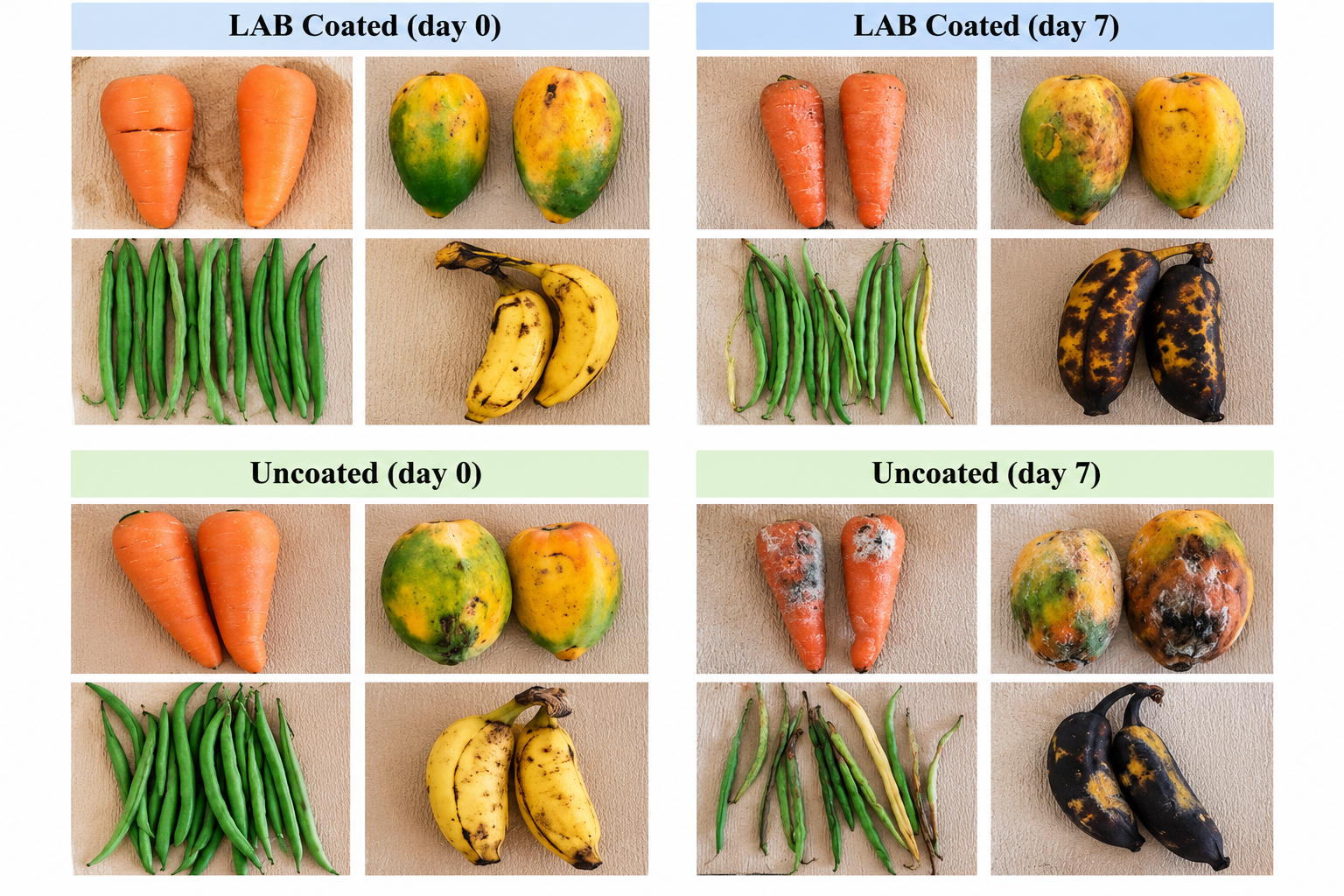
The preservation of fruits and vegetables using lactic acid bacteria (LAB) isolated directly from fruits and vegetables is a human-friendly approach. The fruits and vegetables which were available in the nearby local market were used for this experiment. LAB in these fruits and vegetables were enriched using skim milk broth. Then the cultures were isolated and purified. LAB was isolated using MRS media. Then after serious of morphological and biochemical characterization, their antimicrobial property was assessed against B. subtilis, E. coli, Pseudomonas sp., Xanthomonas sp., Serratia sp. and Collectotrichum sp., Alternaria sp., Sclerotia sp., Rhizopus sp. and best isolate which was performed well as selected and polysaccharide was extracted by centrifuge method at 10,000 rpm for 20 minutes. The Lactobacillus plantarum LABB3 was found to be the best isolate recorded maximum polysaccharide with antimicrobial activity. Then fruits and vegetables (banana, papaya, carrot, beans) were coated with these polysaccharides (biofilm). It is found that these biofilms reduce the weight loss of fruits and vegetables and also reduce atmospheric microbial attack on fruits and increase the shelf life of fruits and vegetables. Thus these edible biofilms can be used as bio preservatives for increasing the shelf life of fruits and vegetables.
References
[1] O. S. Qadri, B. Yousuf and A. K. Srivastava (2015). Fresh-cut fruits and vegetables: Critical factors influencing microbiology and novel approaches to prevent microbial risks-A review. Cogent. Food Agric., 1: 1121606. doi: 10.1080/23311932.2015.1121606.
[2] R. Rekhy and R. McConchie (2014). Promoting consumption of fruit and vegetables for better health. Have campaigns delivered on the goals? Appetite, 79(S): 113-123.
[3] S. Agriopoulou, E. Stamatelopoulou, M. Sachadyn-Król and T. Varzakas (2020). Lactic acid bacteria as antibacterial agents to extend the shelf life of fresh and minimally processed fruits and vegetables: quality and safety aspects. Microorganisms, 8: 952. doi: 10.3390/microorganisms8060952.
[4] L. Samedi and A. L. Charles (2019). Isolation and characterization of potential probiotic lactobacilli from leaves of food plants for possible additives in pellet feeding. Ann. Agric. Sci., 64: 55-62.
[5] F. C. Mgomi, Y.-R. Yang, G. Cheng and Z.-Q. Yang (2023). Lactic acid bacteria biofilms and their antimicrobial potential against pathogenic microorganisms. Biofilm, 5: 100118. doi: 10.1016/j.bioflm.2023.100118.
[6] C. Parolin, V. Croatti, L. Laghi, B. Giordani, M. R. Tondi, P. R. De Gregorio and C. Foschi et al., (2021). Lactobacillus biofilms influence anti-Candida activity. Front Microbiol., 12: 750368. doi: 10.3389/fmicb.2021.750368.
[7] S. Islam, S. Biswas, T. Jabin, M. Moniruzzaman, J. Biswas, M. S. Uddin and M. Akhtar-E-Ekram et al., (2023). Probiotic potential of Lactobacillus plantarum DMR14 for preserving and extending shelf life of fruits and fruit juice. Heliyon, 9: e17382. doi: 10.1016/j.heliyon.2023.e17382.
[8] L. De Vuyst and F. Leroy (2007). Bacteriocins from lactic acid bacteria: Production, purification, and food applications. J. Mol. Microbiol. Biotechnol., 13: 194-199.
[9] D. H. Tambekar and S. A. Bhutada (2009). Studies on antimicrobial activity and characteristics of bacteriocins produced by Lactobacillus strains isolated from milk of domestic animals. Internet J. Microbiol., 8:.
[10] V. Dhundale, V. Hemke, D. Desai and P. Dhundale (2018). Evaluation and exploration of lactic acid bacteria for preservation and extending the shelf life of fruit. Int. J. Fruit Sci., 18: 355-368.
[11] A. Saha, R. K. Gupta and Y. K. Tyagi (2014). Effects of edible coatings on the shelf life and quality of potato (Solanum tuberosum L.) tubers during storage. J. Chem. Pharm., 6: 802-809.
[12] AOAC (2000). Official methods of analysis of the Association of the Official Analysis Chemists. 17. Washington, DC: Association of Official Analytical Chemists.
[13] A. Patel, N. Shah, P. Ambalam, J. B. Prajapati, O. Holst and A. Ljungh (2013). Antimicrobial profile of lactic acid bacteria isolated from vegetables and indigenous fermented foods of India against clinical pathogens using microdilution method. Biomed. Environ. Sci., 26: 759-764.
[14] M. Z. Hoque F. Akter, K. M. Hossain M. S. M. Rahman, M. M. Billah and K. M. D. Islam (2010). Isolation, identification and analysis of probiotic properties of Lactobacillus Spp. from selective regional yogurts. World J. Dairy and Food Sci., 5: 39-46.
[15] E. S. Khalil, M. Y. A. Manap, S. Mustafa, A. M. Alhelli and P. Shokryazdan (2018). Probiotic properties of exopolysaccharide-producing Lactobacillus strains isolated from tempoyak. Molecules, 23: 398. doi: 10.3390/molecules23020398.
[16] A. S. N. Nawaz, K. S. Jagadeesh and P. U. Krishnaraj (2017). Isolation and screening of lactic acid bacteria for acidic pH and bile tolerance. Int. J. Curr. Microbiol. Appl. Sci., 6: 3975-3980.
[17] S. De, A. Pramanik, A. K. R. Das, S. Paul, S. Jana and P. Pramanik (2017). Isolation and characterization of Lactobacillus spp. from curd and its pharmacological application in probiotic chocolate. J. Phytopharmacol., 6: 335-339.
[18] H. L. Alakomi, E. Skytta, M. Saarela, T. Mattila-Sandholm, K. Latva-Kala and I. M. Helander (2000). Lactic acid permeabilizes gram-negative bacteria by disrupting the outer membrane. Appl. Environ. Microbiol., 66: doi: 10.1128/AEM.66.5.2001-2005.2000.
[19] M. Soni, H. R. Shah and S. M. Patel (2021). Isolation, identification and analysis of probiotic characteristics of Lactobacillus spp. from regional yoghurts from Surendranagar District, Gujarat. J. Dairy Foods Res., 40: 267-272.
[20] F. O. Ekundayo (2014). Isolation and identification of lactic acid bacteria from rhizosphere soils of three fruit trees, fish and ogi. Int. J. Curr. Microbiol. Appl. Sci., 3: 991-998.
[21] C. Prabhurajeshwar and K. Chandrakanth (2019). Evaluation of antimicrobial properties and their substances against pathogenic bacteria in-vitro by probiotic Lactobacilli strains isolated from commercial yoghurt. Clin. Nutr. Exp., 23: 97-115.
[22] W. Ma, W. Zhang, X. Wang, Y. Pan, M. Wang, Y. Xu and J. Gao et al., (2024). Molecular identification and probiotic potential characterization of lactic acid bacteria isolated from the pigs with superior immune responses. Front. Microbiol., 15: 1361860. doi: 10.3389/fmicb.2024.1361860.
[23] D. H. Tambekar and S. A. Bhutada (2010). Studies on antimicrobial activity and characteristics of bacteriocins produced by Lactobacillus strains isolated from milk of domestic animals. Internet J. Microbiol., 8: 1-5.
[24] S. Karami, M. Roayaei, H. Hamzavi, M. Bahmani, H. Hassanzad-Azar, M. Leila and M. Rafieian-Kopaei (2017). Isolation and identification of probiotic Lactobacillus from local dairy and evaluating their antagonistic effect on pathogens. Int. J. Pharm. Investing., 7: 137-141.
[25] M. S. Bin Masalam, A. Bahieldin, M. G. Alharbi, S. Al-Masaudi, S. K. Al-Jaouni, S. M. Harakeh and R. R. Al-Hindi (2018). Isolation, molecular characterization and probiotic potential of lactic acid bacteria in Saudi raw and fermented milk. Evid-Based Compl. Alt. Med., 2018: 7970463. doi: 10.1155/2018/7970463.
[26] T. T. Pham, L. L. P. Nguyen, M. S. Dam and L. Baranyai (2023). Application of edible coating in extension of fruit shelf life. AgriEngineering, 5: 520-536.
[28] V. Puttalingamma, K. Begum and A. S. Bawa (2006). Antimicrobial peptide-New weapons against enteric pathogens. Pak. J. Nutr., 5: 432-436.
Downloads
Published
Issue
Section
License
Copyright (c) 2024 Author (s)

This work is licensed under a Creative Commons Attribution-NonCommercial-NoDerivatives 4.0 International License.
Copyright © The Author(s). Effective from 1 July 2026, articles published in Emergent Life Sciences Research (ELSR) are distributed under the Creative Commons Attribution 4.0 International License (CC BY 4.0), which permits use, sharing, distribution, reproduction, and adaptation in any medium or format, provided that appropriate credit is given to the original author(s) and the source, a link to the license is provided, and any changes made are indicated.
Articles published before 1 July 2026 remain subject to the license applicable at the time of their original publication, including the Creative Commons Attribution-NonCommercial-NoDerivatives 4.0 International License (CC BY-NC-ND 4.0), where applicable.