Molecular detection of pathogenic bacteria in bovine milk samples collected from local vendors in Jabalpur
DOI:
https://doi.org/10.31783/ELSR.2024.1027785Keywords:
bovine milk, Escherichia coli, milk vendors, PCR, Staphylococcus aureusAbstract
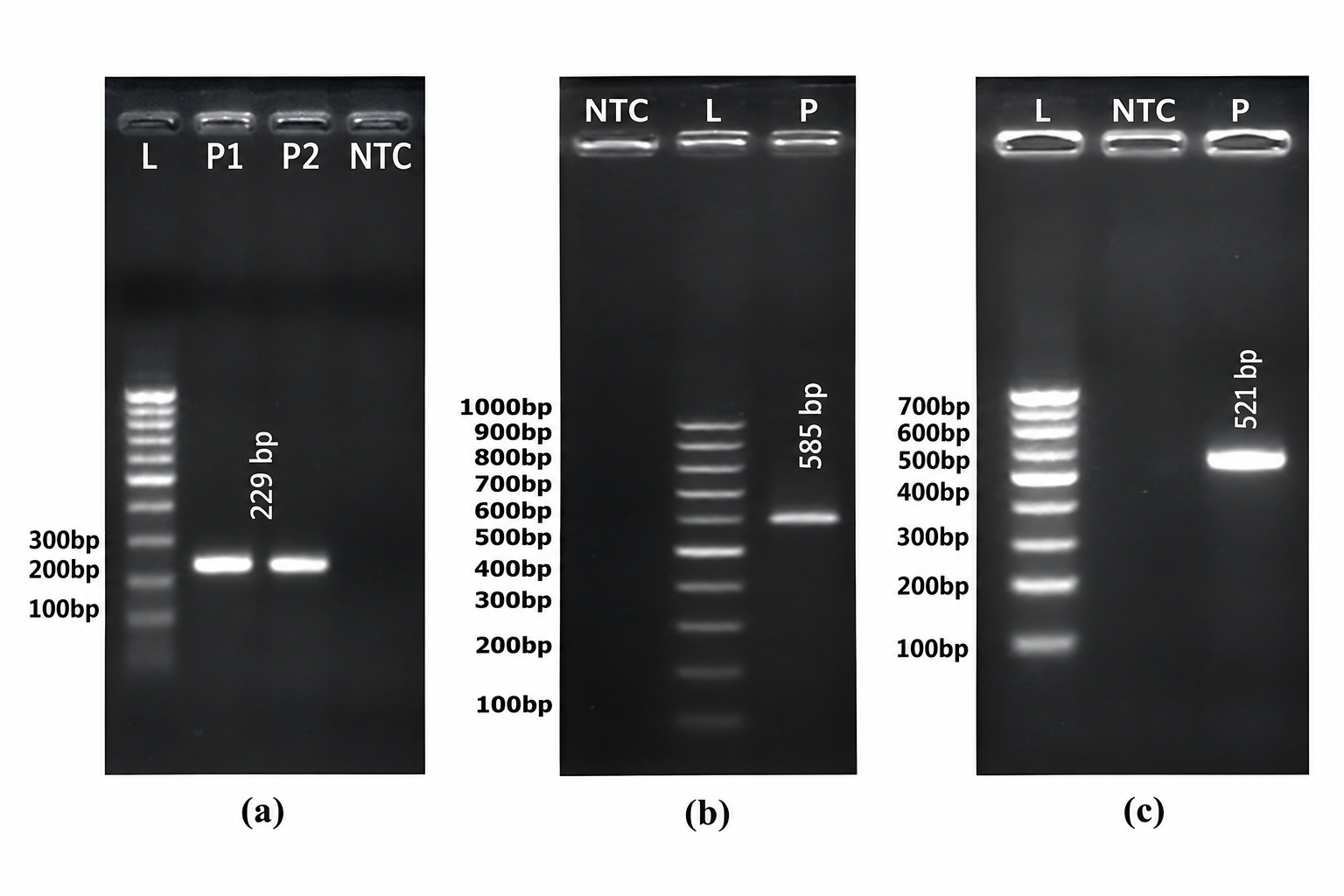
Milk provides essential nutrients for growth but also serves as a medium for various microbial growth. The milk gets contaminated with some pathogenic microbes, either from infected udder or due to poor milking practices like uncleaned udder and teat, unhygienic hands, uncleaned milk containers, improper sanitation of milking equipment, contaminated water source etc. The pathogenic microbes that contaminate milk Poses serious threats to public health and produce milk-borne diseases. It is essential to study the quality of milk supplied by the local vendors to avoid outbreaks of any food-borne illness. Identification of pathogens in milk samples is one of the important quality parameters. Conventional detection methods like bacterial culture and microscopy are time-consuming and less accurate. Molecular techniques like polymerase chain reaction offers rapid detection of pathogens with high sensitivity and specificity. This study utilized polymerase chain reaction to detect the presence of Staphylococcus aureus, Brucella spp., and Escherichia coli in milk samples collected from vendors in Jabalpur, India. A total of 40 samples were analyzed and results showed contamination rates of 37.5% for Staphylococcus aureus, 7.5% for Brucella spp., and 15% for Escherichia coli. The findings underscore the importance of implementing proper hygiene measures and routine microbial surveillance in dairy practices to ensure public health safety and to prevent the development of foodborne illnesses due to contaminated pathogenic microorganisms.
References
[1] K. Girma, Z. Tilahun and D. Haimanot (2014). Review on milk safety with emphasis on its public health. World J. Dairy Food Sci., 9: 166-183.
[2] M. B. Calahorrano-Moreno, J. J. Ordoñez-Bailon, R. J. Baquerizo-Crespo, A. A. Duenas-Rivadeneira, M. C. B. S. M. Montenegro and J. M.Rodriguez-Díaz (2022). Contaminants in the cow's milk we consume? Pasteurization and other technologies in the elimination of contaminants. F1000Res., 11: 91. doi: 10.12688/f1000research.108779.1.
[3] M. Ferone , A. Gowen, S. Fanning and A. G. M. Scannell (2020). Microbial detection and identification methods: Bench top assays to omics approaches. Compr. Rev. Food Sci. Food Saf., 19: 3106-3129.
[4] J. W. Law, N.-S. Ab Mutalib, K.-G. Chan and L.-H Lee (2015). Rapid methods for the detection of foodborne bacterial pathogens: principles, applications, advantages and limitations. Front. Microbiol., 5: 770. doi: 10.3389/fmicb.2014.00770.
[5] M. S. Islam, M. A. Islam, M. M. Khatun, S. Saha, M. S. Basir and M. M. Hasan (2018). Molecular detection of Brucella spp. from milk of seronegative cows from some selected area in bangladesh. Journal of Pathogen., 2018: 9378976. doi: 10.1155/2018/9378976.
[6] M. Allmann, C. Hofelein, E. Koppel, J. Luthy, R. Meyer, C. Niederhauser and B. Wegmuller et al., (1995). Polymerase chain reaction (PCR) for detection of pathogenic microorganisms in bacteriological monitoring of dairy productsUtilisation de la PCR pour la détection des bactéries pathogènes dans les produits laitiers. Res Microbiol., 146: 85-97.
[7] S. Margo, E. Visentin, E. Chiarin, F. Cendron, M. Penesa, A. Costa and M. Cassandro et al., (2023). Pathogen detection via quantitative PCR in milk of healthy cows collected using different sampling protocols. Pathogens, 12: 935. doi: 10.3390/pathogens12070935.
[8] P. Phuektes, P. D. Mansell and G. F. Browning (2001). Multiplex polymerase chain reaction assay for simultaneous detection of Staphylococcus aureus and Streptococcal causes of bovine mastitis. J. Dairy Sci.; 84: 1140-1148.
[9] A.G. Saglam, M. Sahin, E. Celik, O. Celebi, D. Akca and S. Otlu (2017). The role of staphylococci in subclinical mastitis of cows and lytic phage isolation against to Staphylococcus aureus. Vet. World., 10: 1481-1485.
[10] J.-A. Hennekinne, M.-L. De Buyser and S. Dragacci (2012). Staphylococcus aureus and its food poisoning toxins: characterization and outbreak investigation. FEMS Microbiol Rev., 36: 815-836.
[11] S. Ramos, V. Silva, M. L. E. Dapkevicius, M. Canica, M. T. Tejedor-Junco, G. Igrejas and P. Poeta (2020). Escherichia coli as commensal and pathogenic bacteria among food-producing animals: Health implications of extended spectrum β-lactamase (ESBL) production. Animals, 10: 2239. doi: 10.3390/ani10122239.
[12] M. J. Corbel (2006). Brucellosis in humans and animals. World Health Organization Organization in collaboration with the Food and Agriculture Organization of the United Nations and World Organization for Animal Health.
[13] G. Sharma, E. Leahy, R. P. Deka, B. R. Shome, S. Bandyopadhyay, T. K. Dey and N. K. Goyal, et al., (2022). Antibiotic use, knowledge, and practices of milk vendors in India’s informal dairy value chain. Front. Sustain. Food Syst., 6: 1058384. doi: 10.3389/fsufs.2022.1058384.
[14] H. C. Thaker, M. N. Brahmbhatt and J. B. Nayak (2013). Isolation and identification of Staphylococcus aureus from milk and milk products and their drug resistance patterns in Anand, Gujarat. Vet. World, 6: 10-13.
[15] M. N. Hoque, Z. C. Das, A. N. M. A. Rahman, M. G. Haider, and M. A. Islam (2018). Molecular characterization of Staphylococcus aureus strains in bovine mastitis milk in Bangladesh. Int. J. Vet. Sci. Med., 6: 53-60.
[16] M. T. Bottero, A. Dalmasso, D. Soglia, S. Rosati, L. Decastelli and T. Civera (2004). Development of a multiplex PCR assay for the identification of pathogenic genes of Escherichia coli in milk and milk products. Mol. Cell. Probes, 18: 283-288.
[17] W. Younis, S. Hassan and H. M. A. Mohamed (2021). Molecular characterization of Escherichia coli isolated from milk samples with regard to virulence factors and antibiotic resistance. Vet. World., 14: 2410-2418.
[18] A. Al-Mariri and N. Haj-Mahmoud (2010). Detection of Brucella abortus in bovine milk by Polymerase chain reaction. Acta. Veterinaria Brno., 79: 277-280.
[19] V. K. Gupta, D. K. Verma, P. K. Rout, S. V. Singh and V. S. Vihan (2006). Polymerase chain reaction (PCR) for detection of Brucella melitensis in goat milk. Small Ruminant Res., 65: 79-84.
[20] K. Wilson (2001). Preparation of genomic DNA from bacteria. Curr. Protc. Mol. Biol., 56: 2.4.1-2.4.5. doi:10.1002/0471142727.mb0204s56.
[21] W. S. Probert, K. N. Schrader, N. Y. Khuong, S. L. Bystrom and M. H. Graves (2004). Real-time multiplex PCR assay for detection of Brucella spp., B. abortus, and B. melitensis. J. Clin. Microbiol., 42: 1290-1293.
[22] J. Hassan, M. S. Parvej, M. B. Rahman, M. S. R. Khan, M. T. Rahman, T. Kamal and K. N. H. Nazir (2014). Prevalence and characterization of Escherichia coli from rectal swab of apparently healthy cattle in Mymensingh, Bangladesh. Microbes Health, 3: 12-14.
[23] S. R. Monday and G. A. Bohach (1999). Use of multiplex PCR to detect classical and newly described pyrogenic toxin genes in Staphylococcal isolates. J. Clin. Microbiol., 37: 3411-3414.
[24] A. Ojo-Okunola, S. Claassen-Weitz, K. S. Mwaikono, S. Gardner-Lubbe, H. J. Zar, M. P. Nicol and E. du Toit (2020). The Influence of DNA extraction and lipid removal on human milk bacterial profiles. Methods Protoc., 3: 39. doi: 10.3390/mps3020039.
[25] G. Lucena-Aguilar, A. M. Sanchez-Lopez, C. Barberan-Aceituno, J. A. Carrillo-Avila, J. A. Lopez-Guerrero and R. Aguilar-Quesada (2016). DNA source selection for downstream applications based on DNA quality indicators analysis. Biopreserv. Biobank., 14: 264-270.
[26] N. Shrivastava, V. Sharma, A. Nayak, A. B. Shrivastava, B. C. Sarkhel, P. C. Shukla and A. Shrivastava (2018). Prevalence and characterization of methicillin-resistant Staphylococcus aureus (MRSA) mastitis in dairy cattle in Jabalpur, Madhya Pradesh. J. Anim. Res., 8: 645-650.
[27] N. Shrivastava, V. Sharma, A. Shrivastava, A. Nayak and A. K. Rai (2018). Prevalence and characterization of panton-valentine leucocidin-positive Staphylococcus aureus in bovine milk in Jabalpur district of Madhya Pradesh, India. Vet. World, 11: 316-320.
[28] P. Singh, R.V. Singh, B. Gupta, V. Sharma, S.S. Tripathi, K. S. Tomar and, K. K. Jadav (2018). Occurrence of Shiga toxin-producing E. coli in milk and milk products collected in and around Jabalpur. J. Anim. Res., 8: 205-211.
Downloads
Published
Issue
Section
License
Copyright (c) 2024 Author (s)

This work is licensed under a Creative Commons Attribution-NonCommercial-NoDerivatives 4.0 International License.
Copyright © The Author(s). Effective from 1 July 2026, articles published in Emergent Life Sciences Research (ELSR) are distributed under the Creative Commons Attribution 4.0 International License (CC BY 4.0), which permits use, sharing, distribution, reproduction, and adaptation in any medium or format, provided that appropriate credit is given to the original author(s) and the source, a link to the license is provided, and any changes made are indicated.
Articles published before 1 July 2026 remain subject to the license applicable at the time of their original publication, including the Creative Commons Attribution-NonCommercial-NoDerivatives 4.0 International License (CC BY-NC-ND 4.0), where applicable.