Effect of seed soaking treatments on growth, yield and quality of baby corn (Zea mays L.)
DOI:
https://doi.org/10.31783/ELSR.2024.1028692Keywords:
baby corn, gibberellins, plant growth regulators, randomized block designAbstract
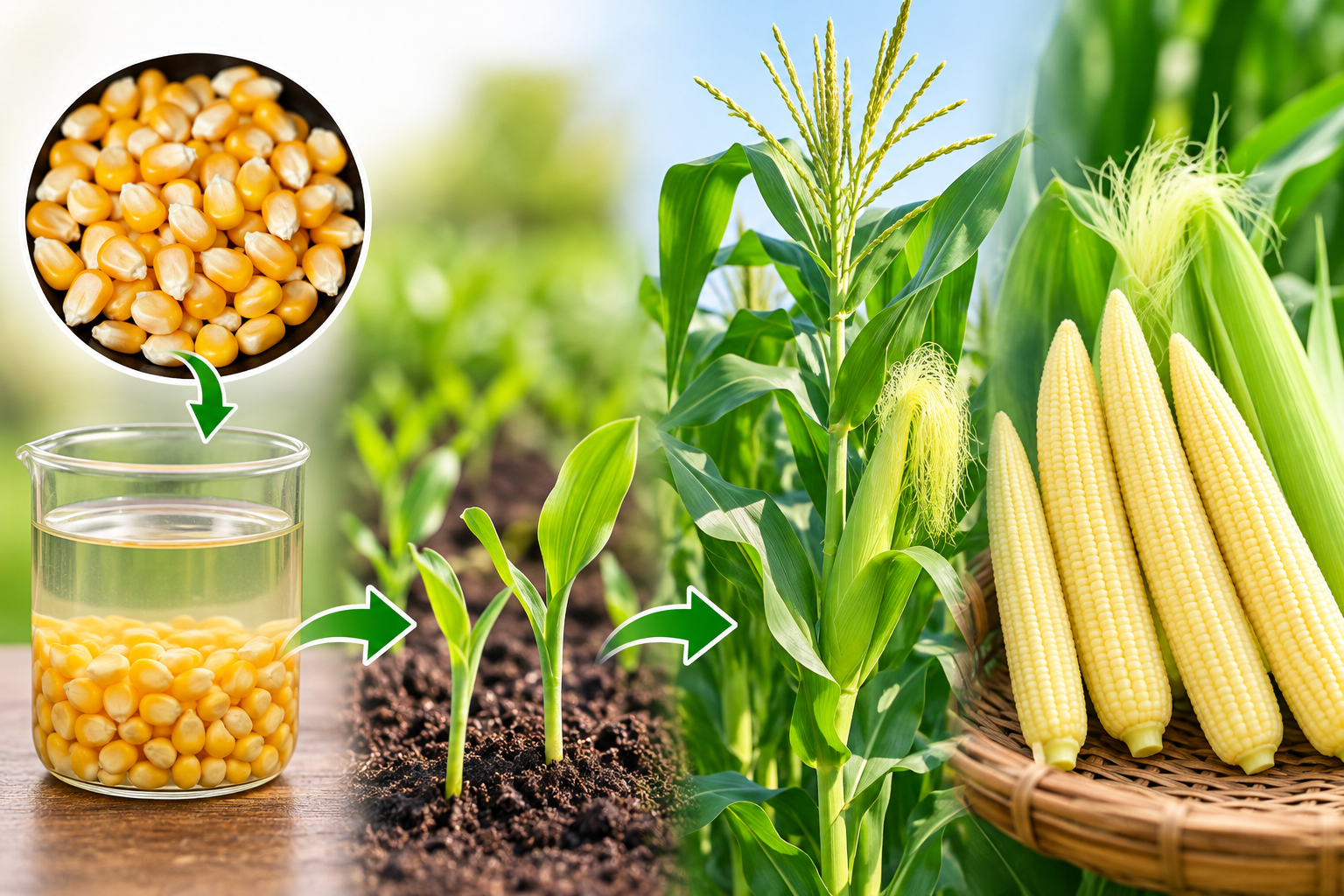
There was an investigation regarding, Effect of seed soaking treatments on growth, yield and quality of baby corn (Zea mays L.) at farm of the Horticulture Polytechnic, ACH, Navsari Agricultural University, Navsari, Gujarat, India during the summer of 2023 on var. GAYMH-1. The experiment had a randomized block design (RBD) and included seven different treatments, including, T1: 6-Benzyl adenine (Cytokinin) 50 ppm; T2: GA3100 ppm; T3: PBZ 50 ppm; T4: Mepiquat Chloride 100 ppm; T5: CCC 100 ppm; T6: NAA 50 ppm and T7: control (Water soaked). On the one day before sowing, seeds were soaked with all the treatments for 24 hours and kept in the shade for 3 hours. Among treatments, seeds soaked in GA3 100 ppm (T2) reached 50% germination one day earlier than the control with the highest germination percentage (93.03%). The highest plant height (77.17 cm, 211.20 cm, and 220.13 cm at 30, 60DAS, and at last picking, respectively), was recorded with NAA 50 ppm (T6) and it attained 50% silking in 57.67 days which was 0.33 days earlier than control.
References
[1] R. Rani, R. K. Sheoran, P. Gupta, S. Kaith and A. Sharma (2017). Baby corn: a wonderful vegetable. Int. J. Sci. Environ. Technol., 6: 1407-1412.
[2] B. R. Gondaliya, K. D. Desai, T. R. Ahlawat, R. M. Mangroliya and J. V. Mandaliya (2022). Effect of chemicals on growth and yield of baby corn (Zea mays L.). J. Pharm. Innov., 11: 2761-2764.
[3] I. Afzal, S. M. Basra, M. Shahid, M. Farooq and M. Saleem (2008). Priming enhances germination of spring maize (Zea mays L.) under cool conditions. Seed Sci. Technol., 36: 497-503.
[4] Kalpana, A. H. Khan, A. K. Singh, K. N. Maurya, Mubeen, R. K. Yadava and U. Singh et al., (2013). Effect of different seed priming treatments on germination, growth, biochemical changes and yield of wheat varieties under sodic soil. Int. J. Sci. Res., 4: 306-310.
[5] K. D. Chanu, and G. Singh (2020). Effects of 1-naphthaleneacetic acid, a plant hormone, on invertebrates and saccharomyces cerevisiae. Eur. J. Mol. Clin. Med., 7: 4239-4244.
[6] V. G. Panse and P. V. Sukhatme (1976). Statistical methods for agricultural workers. Indian Council of Agricultural Research, New Delhi, India, pp152-161.
[7] L. Tapfumaneyi, P. Dube, S. Mavengahama and W. Ngezimana (2023). Effect of gibberellic acid and potassium nitrate seed treatments on the emergence and seedling vigor of amaranth and Cleome gynandra. Agrosyst. Geosci. Environ., 6: e20359. doi: 10.1002/agg2.20359.
[8] S. L. Golada, G. L. Sharma and H. K. Jain (2013). Performance of baby corn (Zea mays L.) as influenced by spacing, nitrogen fertilization and plant growth regulators under sub humid condition in Rajasthan, India. Afr. J. Agric. Res., 8: 1100-1107.
[9] P. Maurya, J. Dawson, R. R. Kumar, A. K. Verma and R. Raj (2021). Effect of nitrogen level and plant growth regulators in maize (Zea mays L.). Int. J. Curr. Microbiol. App. Sci., 10: 1283- 1288.
[10] S. K. Singh, A. Kumar, K. Beer, V. P. Singh and S. K. Patel (2018). Effect of naphthalene acetic acid (NAA) and gibberellic acid (GA3) on growth and fruit quality of tomato (Lycopersicon esculentum Mill.). Int. J. Curr. Microbiol. App. Sci., 7: 306-311.
[11] S. C. Pargi, E. P. Lal, N. Singh and T. K. Biswas (2018). Effect of naphthalene acetic acid on biochemical parameters, growth and yield of tomato (Lycopersicon esculentum Mill.). J. Agric. Vet. Sci., 7: 16-18.
[12] S. Vishwakarma, S. Bala, P. Kumar, N. Prakash, V. Kumar, S. S. Singh and S. K. Singh (2017). Effect of nitrogen, naphthalene acetic acid and Gibberellic acid on growth, yield and quality of broccoli (Brassica oleracea var. italica L.) cv. ‘Sante’. J. pharmacogn. Phytochem., 6: 188-194.
[13] K. S. Rao, S. Singh, K. R. Chandra and J. Dawson (2021). Effect of nitrogen and foliar application of naphthalene acetic acid (NAA) on growth and yield of baby corn (Zea mays L.). Int. J. Plant Soil Sci., 33: 55-61.
[14] V. D. Kalariya, V. K. Parmar, P. Bhakti, P. M. Sankhla and S. G. Parekh (2016). Influence of plant growth regulators by seed treatment on yield and quality of okra (Abelmoschus esculentus (L.) Moench) cv. GAO-5. Int. J. Adv. Life Sci., 5: 4949-4951.
[15] A. K. M. A. Hoque, Q. M. Ahmed, M. M. Rahman and M. A. Islam (2018). Effect of application frequency of naphthalene acetic acid on physio-morphological characters and yield of brinjal. Res. Agric. Livest. Fish., 5: 151-155.
[16] V. B. Muthukumar, K. Velayudham and N. Thavaprakaash (2005). Growth and yield of baby corn (Zea mays L.) as influenced by plant growth regulators and different time of nitrogen application. Res. J. Agric. Bio. Sci., 1: 303-307.
[17] M. Podwyszynska (2003). Cell, tissue and organ culture rooting of micropropagated shoots. In: Encyclopedia of Rose Science, Elsevier, Poland, pp66-76. ISBN: 978-0-12-227620-0.
[18] V. S. Vani and K. R. Kumar (2014). Influence of pre-harvest spray of growth regulators on the quality and shelf life of baby corn during storage at room temperature. J. Crop Weed, 10: 118-121.
Downloads
Published
Issue
Section
License
Copyright (c) 2024 Author (s)

This work is licensed under a Creative Commons Attribution-NonCommercial-NoDerivatives 4.0 International License.
Copyright © The Author(s). Effective from 1 July 2026, articles published in Emergent Life Sciences Research (ELSR) are distributed under the Creative Commons Attribution 4.0 International License (CC BY 4.0), which permits use, sharing, distribution, reproduction, and adaptation in any medium or format, provided that appropriate credit is given to the original author(s) and the source, a link to the license is provided, and any changes made are indicated.
Articles published before 1 July 2026 remain subject to the license applicable at the time of their original publication, including the Creative Commons Attribution-NonCommercial-NoDerivatives 4.0 International License (CC BY-NC-ND 4.0), where applicable.