Evaluation of in-situ custard apple (Annona squamosa L.) genotypes in Bastar district of Chhattisgarh, India
DOI:
https://doi.org/10.31783/ELSR.2024.10293102Keywords:
cultivars, custard apple, genotypes, physical properties, variationsAbstract
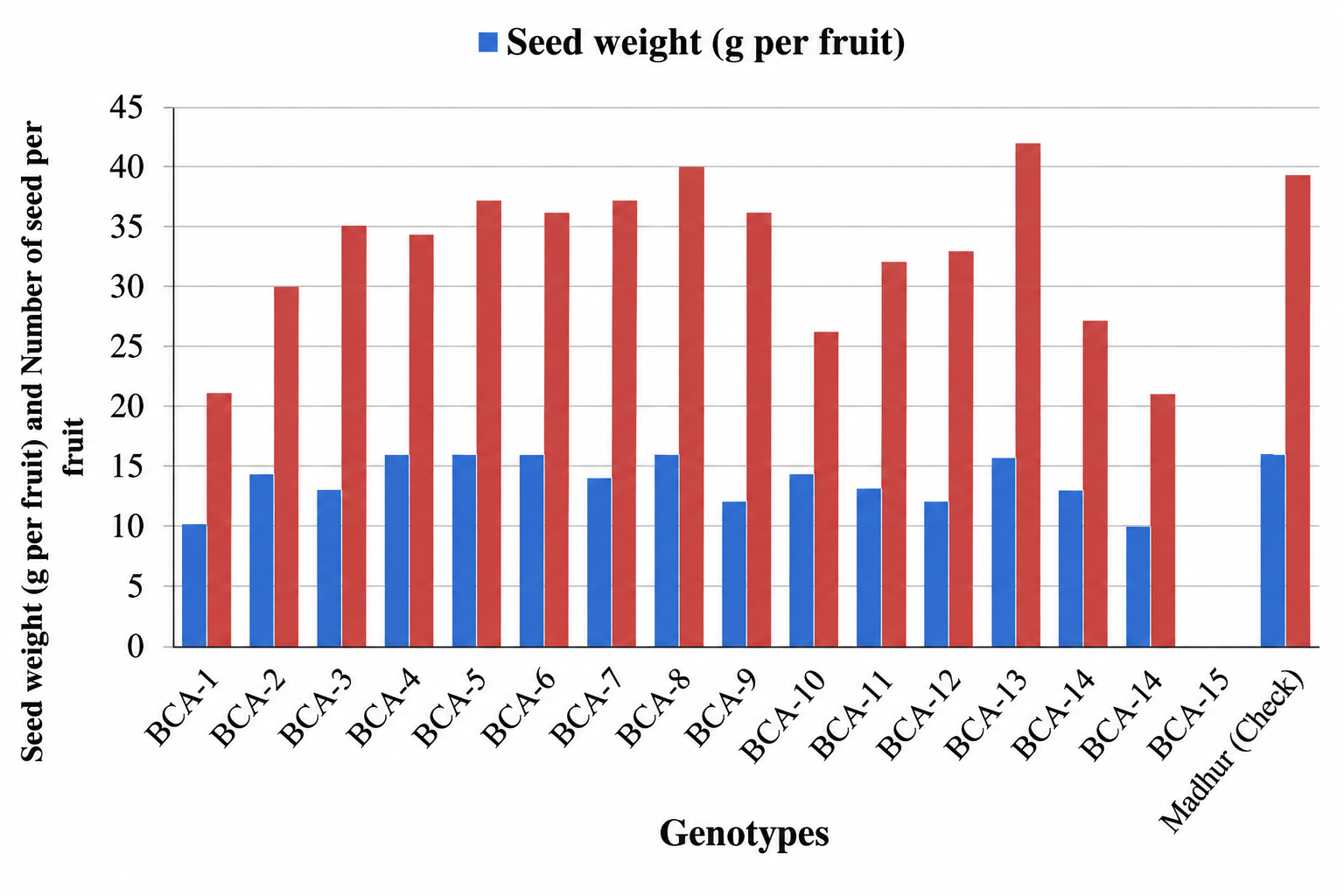
An experiment was carried out during 2022-23 to study the Physical properties of in-situ custard apple (Annona squamosa L.) genotypes in Bastar district of Chhattisgarh, India. The experiment was conducted in five villages and 16 different locations BCA-1is Chitrakote, BCA-2 to BCA-8 are Salpheepadar, BCA-9 to BCA-14 are Arracote, BCA-15 Mareeguda and Madhur (check) are Bakawand. The selected custard apple genotypes are about 8 to 10 year old plants. The results showed the physical properties of in-situ custard apple genotypes under the Bastar district. The variations in Fruit weight per fruit (135.9 to 276.9 g/fruit), Pericarp weight per fruit (60.93 to 146.47 g/fruit), Seeded pulp per fruit (69.80 to 137.13 g/fruit), De-seeded pulp per fruit ( 60.27 to 121.00 g/fruit), Seed weight per fruit (9.53 to 16.40 g/fruit), Number of seed per fruit (21 to 41.87 seed/fruit), Fruit to de-seeded pulp ratio per fruit (2.07-2.42), De-seeded pulp to seed ratio per fruit (5.32 to 7.99), De-deeded pulp recovery percentage per fruit (41.30 to 48.56 %) and peel or pericarp percentage per fruit (44.50 to 52.89 %) of custard apple fruits were observed. After the observation, Madhur (check), BCA-4, BCA-5, and BCA-8 custard apple genotypes were superior in quality traits and could be commercially viable cultivars.
References
[1] J. Popenoe (1974). Status of annona culture in South Florida. Proceedings of the Florida State Horticultural Society, 87: 342-344.
[2] Anonymous (2022). National Horticulture Board, Ministry of Farmers and Welfare, Government of India, Statistics, Area and Production of Horticulture Crops (3rd Estimates); c2022, 1-3.
[3] Anonymous (2021-2022). Directorate of horticulture and form forestry, Chhattisgarh, Department of Agriculture, Govt. of C.G. Raipur, Horticulture Statistics, Area and Production District wise; c2021-22, 1-6.
[4] C.-M. Li, N.-H. Tan, Q. Mu, H.-L. Zheng, X.-J. Hao, Y. Wu and J. Zhou (1997). Cyclopeptide from the seeds of Annona squamosa L. Phytochemistry, 45: 521-523.
[5] D. C. Hopp, L. Zeng, Z. Gu, J. F. Kozlowski, J. L. McLaughlin (1997). Novel mono-tetrahydrofuran ring acetogenins, from the bark of Annona squamosa, showing cytotoxic selectivities for the human pancreatic carcinoma cell line, PACA-2. J. Nat. Prod., 12: 581-586.
[6] S. N. Ghosh, B. Mathew and S. Manna (2001). Studies on physico-chemical characteristics of fruits of custard apples grown under rain fed semi-arid region of West Bengal. Orissa J. Hort., 29: 66-68.
[7] N. Dikshit, S. G. Bharad and M. P. Badge (2008). Diversity in custard apple germplasm collections from Maharashtra. J. Plant Genet. Resour., 21: 95-96.
[8] P. H. Bakane, P. A. Borkar, M. G. M. Gajabe and M. K. M. Khakare (2015). Physical properties of custard apple fruit (Annona squamosa L.). Int. J. Agric. Sci. Res., 5: 343- 352.
[9] S. R. Kadam, R. M. Dheware and P. S. Urade (2018). Effect of different levels of pruning on quality of custard Apple (Annona squmosa L.). Int. J. of Bio-resour. Stress Manag., 9: 573-575.
[10] T. D. Mathakar (2005). Assessment of custard apple (Annonasquamosa L.) hybrids. M.Sc. (Agri.) Thesis, MPKV, Rahuri (Maharashtra), India., pp1-90.
[11] J. L. Nag (2017). Studies on genetic variability and characterization of custard apple (Annona squamosa L.) Genotypes in Northern Bastar of Chhattisgarh. Ph.D. Thesis, IGKV Raipur (Chhattisgarh), pp1-179.
[12] G. Singh (2018). Characterization of landraces of custard apple ( Annona squamosa L.). M.Sc. Agri. (Hort. Fruit Science) Thesis JNKV, Jabalpur, M.P., India, pp1-61.
[13] S. Poyam, G. P. Nag, B. Kumar, D. P. Singh and S. Dewangan (2022). Physicochemical properties of custard apple (Annona squamosa L.) genotypes of Bastar Plateau.The Pharma Innovation J., 11: 3059-3063.
[14] K. D. Rao and K. Subramanyam (2011). Growth and yield performance of custard apple germplasm under scarce rainfall zone. Ind. J. Agric. Res., 45: 156-160.
[15] P. Bhatnagar, J. Singh, M. C. Jain and B. Singh (2012). Evaluation of landraces of Custard apple (Annona squamosa L.).J. Plant Arch., 12: 1045-1048.
[16] A. M. Chavan (2019). Morphological and biochemical characterization of Annona (Annona squamosa L.) genotypes for yield and yield attributing traits. M.Sc. (Hort.) in Fruit science. Thesis, College of Horticulture, Bagalkot, University of Horticultural Sciences Bagalkot, pp1-91.
[17] S. H. Jalikop and S. P. Kumar (2000). New fruit varieties for arid regions pomegranate 'Ruby' and custard apple 'ArkaSahan'. Ind. J. Hort., 45: 19-20.
[18] K. Kumar (2015). Evaluation of Annona genotypes for recipe standardization of nectar and RTS (ready-to-serve) beverages. M.Sc. (Ag.) Thesis, IGKV, Raipur. pp1-95.
[19] S. P. Chandel (2017). Collection and evaluation of custard apple (Annona squamosa L.) genotypes in Chhattisgarh plains. M.Sc. Thesis, Indira Gandhi KrishiVishwavidyalaya Raipur (Chhattisgarh), pp1-82.
[20] J. R. Tanaji (2018). Studies on morphological, biochemical and molecular characterization of custard apple (Annona squamosa L.). M.Sc. Thesis, Vasantrao Naik Marathwada Krishi Vidyapeeth Parbhani (M.S.) India, pp1-74.
[21] B. K. Ashokrao (2013). Survey for collection of promising types of custard apple (Annona squamosa L.) in beed district. M.Sc. Thesis, Vasantrao Naik Marathwada Krishi Vidyapeeth Parbhani (M.S.) India, pp1-95.
[22] V. P. Kad, M. S. Jadhav and C. A. Nimbalkar (2016). Studies on physical, morphological and rheological properties of custard apple (Annona squamosa L). Int. J. of App. and Pure Sci. and Agri., 2: 140-147.
[23] Y. Kumar, A. K. Chandra, A. Dubey and H. P. Gajera (2018). Fruit morphology and quality parameter studies of global custard apple (Annona squamosa L.) germplasm. Int. J. Curr. Microbiol. App. Sci., 7: 1297-1311.
[24] D. Patel (2006). Studies on physico-chemical characteristics, sensory quality and storage behaviour of squash and jam from custard apple (Annona squamosa L.). M.Sc. Thesis, IGKV, Raipur (C.G.). pp12-106.
Downloads
Published
Issue
Section
License
Copyright (c) 2024 Author (s)

This work is licensed under a Creative Commons Attribution-NonCommercial-NoDerivatives 4.0 International License.
Copyright © The Author(s). Effective from 1 July 2026, articles published in Emergent Life Sciences Research (ELSR) are distributed under the Creative Commons Attribution 4.0 International License (CC BY 4.0), which permits use, sharing, distribution, reproduction, and adaptation in any medium or format, provided that appropriate credit is given to the original author(s) and the source, a link to the license is provided, and any changes made are indicated.
Articles published before 1 July 2026 remain subject to the license applicable at the time of their original publication, including the Creative Commons Attribution-NonCommercial-NoDerivatives 4.0 International License (CC BY-NC-ND 4.0), where applicable.