Adverse impacts of heavy metal pollution on soil and plant growth in agriculture
DOI:
https://doi.org/10.31783/ELSR.2024.102103115Keywords:
agriculture, bioremediation, fertilizer, heavy metals, pesticideAbstract
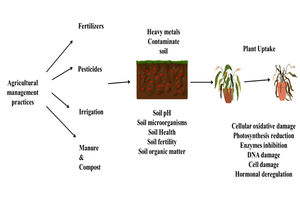
Agriculture is important for human beings because it provides food, employment, and other necessities, and pollution in agriculture causes several problems. Heavy metals are always at the top of the list regarding concerns about agriculture pollution. Heavy metals reach in agriculture from various sources but the uses of agrochemicals like fertilizers and pesticides in agriculture are the most common sources. The most common heavy metals are arsenic (As), cadmium (Cd), chromium (Cr), copper (Cu), mercury (Hg), lead (Pb), nickel (Ni) and zinc (Zn). Heavy metal pollution in agriculture threatens human and animal health, pollutes groundwater, causes plant phytotoxicity, and reduces agricultural productivity and soil health. Heavy metals enter the food chain mostly through the soil, where they are absorbed by plant roots. Once they enter the food chain, they pose a serious risk to each organism linked to that food chain. Heavy metals create imbalances in several crucial processes in plants and soil ecosystems. Heavy metal degradation takes too much time in soil and remains in the soil for a very long time. Heavy metal degradation from the soil ecosystem may be accomplished through the use of bioremediation.
References
[1] H. Ali, E. Khan and I. Ilahi (2019). Environmental chemistry and ecotoxicology of hazardous heavy metals: environmental persistence, toxicity, and bioaccumulation. J. Chem., Article ID: 6730305. doi: 10.1155/2019/6730305.
[2] Z. Li, Z. Ma, T. J. V. d. Kuijp, Z. Yuan and L. Huang (2014). A review of soil heavy metal pollution from mines in China: pollution and health risk assessment. Sci. Total Environ., 468-469: 843-853.
[3] G. Toth, T. Hermann, M. R. Da. Silva and L. Montanarella (2016). Heavy metals in agricultural soils of the European Union with implications for food safety. Environ. Pollut., 88: 299-309.
[4] S. Bakshi, C. Banik and Z. He (2018). The impact of heavy metal contamination on soil health. In: Reicosky, D. (ed.) Managing soil health for sustainable agriculture Volume 2: monitoring and management, Burleigh Dodds Science Publishing, Cambridge, UK, pp63-95. ISBN: 978 1 78676 192 7.
[5] V. Sridevi, M. Modi, M.V.V.C. Lakshmi and L. Kesavarao (2012). A review on integrated solid waste management. Int. J. Eng. Sci. Adv. Technol., 2: 1491-1499.
[6] A. Ugurlu (2004). Leaching characteristics of fly ash. Environ. Geol., 46: 890-895.
[7] M. R. D. Seaward and D. H. S. Richardson (1989). Atmospheric sources of metal pollution and effects on vegetation. In: A. J. Shaw (ed.), Heavy Metal Tolerance in Plants Evolutionary Aspects. Boca Raton, FL: CRC Press, pp75-94. ISBN: 9781003574903.
[8] P. C. Nagajyoti, K. D. Lee and T. V. M. Sreekanth (2010). Heavy metals, occurrence and toxicity for plants: a review. Environ. Chem. Lett., 8: 199-216.
[9] S. Clemens and J. F. Ma (2016). Toxic heavy metal and metalloid accumulation in crop plants and foods. Annu. Rev. Plant Biol., 67: 489-512.
[10] B. Pavilonis, J. Grassman, G. Johnson, Y. Diaz and J. Caravanos (2017). Characterization and risk of exposure to elements from artisanal gold mining operations in the Bolivian Andes. Environ. Res., 154: 1-9.
[11] A. Zahra, M. Z. Hashmi, R. N. Malik and Z. Ahmed (2014). Enrichment and geo-accumulation of heavy metals and risk assessment of sediments of the Kurang Nallah—feeding tributary of the Rawal Lake Reservoir, Pakistan. Sci. Total Environ., 470: 925-933.
[12] U.K. Singh and B. Kumar (2017). Pathways of heavy metals contamination and associated human health risk in Ajay River basin, India. Chemosphere, 174: 183-199.
[13] R. P. Singh, P. Singh, A. S. F. Araujo, M. H. Ibrahim and O. Sulaiman (2011). Management of urban solid waste: vermicomposting a sustainable option. Resour. Conserv. Recycl., 55: 719-729.
[14] V. Srivastava, S.A. Ismail, P. Singh and R.P. Singh (2015). Urban solid waste management in the developing world with emphasis on India: challenges and opportunities. Rev. Environ. Sci. Biotechnol., 14: 317-337.
[15] R. Aryal, S. Beecham, B. Sarkar, M. N. Chong, A. Kinsela, J. Kandasamy and S. Vigneswaran (2017). Readily wash-off road dust and associated heavy metals on motorways. Water Air Soil Pollut., 228: 1. doi: 10.1007/s11270-016-3178-3.
[16] B. Dubey, A. K. Pal and G. Singh (2017). Airborne particulate matter: source scenario and their impact on human health and environment. In: R.P. Singh, A. Singh and V. Srivastava (eds.), Environmental Issues Surrounding Human Overpopulation. Hershey, PA: IGI Global, pp202-223. doi: 10.4018/978-1-5225-1683-5.
[17] X. Wu, S. J. Cobbina, G. Mao, H. Xu, Z. Zhang and L. Yang (2016). A review of toxicity and mechanisms of individual and mixtures of heavy metals in the environment. Environ. Sci. Pollut. Res., 23: 8244-8259.
[18] H. K. Gill and H. Garg (2014). Pesticide: environmental impacts and management strategies. In: S. Soloneski and M. L. Larramenday (Eds.), Pesticides-Toxic Aspects, Intech., Rijeka, pp 187–230.
[19] S. Pastor, A. Creus, T. Parrón, A. Cebulska-Wasilewska, C. Siffel, S. Piperakis and R. Marcos (2003). Biomonitoring of four European populations occupationally exposed to pesticides: use of micronuclei as biomarkers. Mutagenesis, 18: 249-258.
[20] A. Özkara, D. Akyil and M. Konuk (2016). Pesticides, environmental pollution, and health. In: M. L. Larramendy, S. Soloneski (Eds.), Environmental Health Risk- Hazardous Factors to Living Species. Intech, doi: 10.5772/63094.
[21] W. J. Zhang (2018). Global pesticide use: profile, trend, cost/benefit and more. Proc. Int. Acad. Ecol. Environ. Sci., 8: 1-27.
[22] J. Cooper and H. Dobson (2007). The benefits of pesticides to mankind and the environment. Crop Prot., 26: 1337-1348.
[23] Meenakshi, P. Sharon, B. Mittal, A. Sharma and V. K. Gothecha (2012). A short review on how pesticides affect human health. Int. J. Ayurvedic Herb. Med., 2: 935-946.
[24] E. L. Wickerham, B. Lozoff, J. Shao, N. Kaciroti, Y. Xia and J. D. Meeker (2012). Reduced birth weight in relation to pesticide mixtures detected in cord blood of full-term infants. Environ. Int., 47: 80-85.
[25] P. J. Verger and A. R. Boobis (2013). Reevaluate pesticides for food security and safety. Science, 341: 717-718.
[26] X. Lu, X. Zhang, L. Y. Li and H. Chen (2014). Assessment of metals pollution and health risk in dust from nursery schools in Xi’an, China. Environ. Res., 128: 27-34.
[27] X. X. Chen, Y. M. Liu, Q. Y. Zhao, W. Q. Cao, X. P. Chen and C. Q. Zou (2020). Health risk assessment associated with heavy metal accumulation in wheat after long-term phosphorus fertilizer application. Environ. Pollut., 262: 114348. doi: 10.1016/j.envpol.2020.114348.
[28] P. Ai, K. Jin, A. Alengebawy, M. Elsayed, L. Meng, M. Chen and Y. Ran (2020). Effect of application of different biogas fertilizer on eggplant production: analysis of fertilizer value and risk assessment. Environ. Technol. Innov., 19: 101019. doi: 10.1016/j.eti.2020.101019.
[29] X. Wang, W. Liu, Z. Li, Y. Teng, P. Christie and Y. Luo (2020). Effects of long-term fertilizer applications on peanut yield and quality and plant and soil heavy metal accumulation. Pedosphere, 30: 555-562.
[30] Y. Fan, Y. Li, H. Li and F. Cheng (2018). Evaluating heavy metal accumulation and potential risks in soil-plant systems applied with magnesium slag-based fertilizer. Chemosphere, 197: 382-388.
[31] J. Singh and A. S. Kalamdhad (2011). Effects of heavy metals on soil, plants, human health and aquatic life. Int. J. Res. Chem. Environ., 1: 15-21.
[32] O. D. Opaluwa, M. O. Aremu, L. O. Ogbo, K. A. Abiola, I. E. Odiba, M. M. Abubakar and N. O. Nweze (2012). Heavy metal concentrations in soils, plant leaves and crops grown around dump sites in Lafia Metropolis, Nasarawa State, Nigeria. Adv. Appl. Sci. Res., 3: 780-784.
[33] R. K. Sharma, M. Agrawal and F. Marshall (2007). Heavy metal contamination of soil and vegetables in suburban areas of Varanasi, India. Ecotox. Environ. Saf., 66: 258-266.
[34] A. Karaca, S.C. Cetin, O.C. Turgay and R. Kizilkaya (2010). Effects of heavy metals on soil enzyme activities. In: I. Sherameti and A. Varma (eds.), Soil Heavy Metals, Soil Biology, Springer Berlin Heidelberg, Berlin Heidelberg. pp.237–262.
[35] R. A. Wuana and F. E. Okieimen (2011). Heavy metals in contaminated soils: A review of sources, chemistry, risks and best available strategies for remediation. Int. Sch. Res. Not., Article ID: 402647. doi: 10.5402/2011/402647.
[36] N. H. Ghori, T. Ghori, M. Q. Hayat, S. R. Imadi, A. Gul, V. Altay and M. Ozturk (2019). Heavy metal stress and responses in plants. Int. J. Environ. Sci. Technol., 16: 1807-1828.
[37] S. Tiwari and C. Lata (2018). Heavy metal stress, signaling, and tolerance due to plant-associated microbes: An overview. Front. Plant Sci., 9: 452. doi: 10.3389/fpls.2018.00452.
[38] P. K. Rai, S. S. Lee, M. Zhang, Y. F. Tsang and K. H. Kim (2019). Heavy metals in food crops: Health risks, fate, mechanisms, and management. Environ. Int., 125: 365-385.
[39] M. Shahid, S. Khalid, G. Abbas, N. Shahid, M. Nadeem, M. Sabir and M. Aslam et al., (2015). Heavy metal stress and crop productivity. In: K. R. Hakeem (Ed.), Crop Production and Global Environmental Issues SE - 1, Springer International Publishing. pp1-25.
[40] K. Bashir, S. Rasheed, T. Kobayashi, M. Seki and N.K. Nishizawa (2016). Regulating subcellular metal homeostasis: The key to crop improvement. Front. Plant Sci., 7: 1192. doi: 10.3389/fpls.2016.01192.
[41] M. Somani, M. Datta, S. K. Gupta, T. R. Sreekrishnan and G. V. Ramana (2019). Comprehensive assessment of the leachate quality and its pollution potential from six municipal waste dumpsites of India. Bioresour. Technol. Rep., 6: 198-206.
[42] S. Glinska, S. Michlewska, M. Gapinska, P. Seliger and R. Bartosiewicz (2014). The effect of EDTA and EDDS on lead uptake and localization in hydroponically grown Pisum sativum L. Acta Physiol. Plant., 36: 399-408.
[43] A. Asati, M. Pichhode and N. Kumar (2016). Effect of heavy metals on plants. Int. J. Appl. Innov. Eng. Manag., 5: 56-66.
[44] G. DalCorso, S. Farinati and A. Furini (2010). Regulatory networks of cadmium stress in plants. Plant Signal. Behav., 5: 663-667.
[45] M. Rizwan, S. Ali, M. Adrees, H. Rizvi, M. Zia-ur-Rehman, F. Hanna and M.F. Qayyum et al., (2016). Cadmium stress in rice: toxic effects, tolerance mechanisms, and management: a review. Environ. Sci. Pollut. Res., 23: 17859-17879.
[46] K. S. Balkhair and M. A. Ashraf (2016). Field accumulation risks of heavy metals in soil and vegetable crops irrigated with sewage water in western region of Saudi Arabia. Saudi J. Biol. Sci., 23: S32-S44.
[47] M. E. Fenn, V. M. Perea-Estrada, L. I. de Bauer, M. Perez-Suarez, D. R. Parker and V. Cetina-Alcalá (2006). Nutrient status and plant growth effects of forest soils in the Basin of Mexico. Environ. Pollut., 140: 187-199.
[48] H. Yao, J. Xu and C. Huang (2003). Substrate utilization pattern, biomass and activity of microbial communities in a sequence of heavy metal-polluted paddy soils. Geoderma, 115: 139-148.
[49] G. Chen, J. Li, H. Han, R. Du and X. Wang (2022). Physiological and molecular mechanisms of plant responses to copper stress. Int. J. Mol. Sci., 23(21): 12950. doi: 10.3390/ijms232112950.
[50] T. Akanchise, S. Boakye, L. S. Borquaye, M. Dodd and G. Darko (2020). Distribution of heavy metals in soils from abandoned dump sites in Kumasi, Ghana. Sci. Afr., 10: e00614. doi: 10.1016/j.sciaf.2020.e00614.
[51] M. Patra and A. Sharma (2000). Mercury toxicity in plants. Bot. Rev., 66: 379-422.
[52] G. U. Chibuike and S. C. Obiora (2014). Heavy metal polluted soils: Effect on plants and bioremediation methods. Appl. Environ. Soil Sci., Article ID: 752708. doi: 10.1155/2014/752708.
[53] S. Ullah, Q. Liu, S. Wang, A. U. Jan, H. M. A. Sharif, A. Ditta and G. Wang et al., (2023). Sources, impacts, factors affecting Cr uptake in plants, and mechanisms behind phytoremediation of Cr-contaminated soils. Sci. Total Environ., 899: 165726. doi: 10.1016/j.scitotenv.2023.165726.
[54] S. Samantaray, G.R. Rout and P. Das (1998). Role of chromium on plant growth and metabolism. Acta Physiol. Plant., 20: 201-212.
[55] H. Oliveira (2012). Chromium as an environmental pollutant: Insights on induced plant toxicity. J. Bot., Article ID: 375843. doi: 10.1155/2012/375843.
[56] Z. Atafar, A. Mesdaghinia, J. Nouri, M. Homaee, M. Yunesian, M. Ahmadimoghaddam, and A. H. Mahvi (2010). Effect of fertilizer application on soil heavy metal concentration. Environ. Monit. Assess., 160: 83-89.
[57] C. Sun, J. Liu, Y. Wang, L. Sun and H. Yu (2013). Multivariate and geostatistical analyses of the spatial distribution and sources of heavy metals in agricultural soil in Dehui, Northeast China. Chemosphere, 92: 517–523.
[58] E. Kelepertzis (2014). Accumulation of heavy metals in agricultural soils of Mediterranean: Insights from Argolida basin, Peloponnese, Greece. Geoderma, 221-222: 82-90.
[59] F. M. Fishel (2014). Pesticide Toxicity Profile: Copper-based Pesticides. Univ. Fla., pp1-68.
[60] P. S. Chauhan, A. Singh, R. P. Singh and M. H. Ibrahim (2012). Environmental impacts of organic fertilizer usage in agriculture. In: R. P. Singh (ed.), Organic Fertilizers: Types, Production and Environmental Impact. Hauppauge, NY: Nova Science Publisher, pp63-84.
[61] S. Niassy and K. Diarra (2012). Effect of organic inputs in urban agriculture and their optimization for poverty alleviation in Senegal, West Africa. In: R.P. Singh (ed.), Organic Fertilizers: Types, Production and Environmental Impact. Hauppauge, NY: Nova Science Publisher, pp1-22.
[62] V. Srivastava, S. A. Ismail, P. Singh, and R. P. Singh (2015). Urban solid waste management in the developing world with emphasis on India: Challenges and opportunities. Rev. Environ. Sci. Bio/Technol., 14: 317-337.
[63] B. J. Alloway (2013). Sources of heavy metals and metalloids in soils. In: B.J. Alloway (ed.), Heavy Metals in Soils. Trace Metals and Metalloids in Soils and Their Bioavailability. Dordrecht, The Netherlands: Springer, pp11-50.
[64] A. Alengebawy, S. T. Abdelkhalek, S. R. Qureshi, and M. Q. Wang (2021). Heavy metals and pesticides toxicity in agricultural soil and plants: Ecological risks and human health implications. Toxics, 9: 42. doi: 10.3390/toxics9030042.
[65] S. S. Mar, M. Okazaki, and T. Motobayashi (2012). The influence of phosphate fertilizer application levels and cultivars on cadmium uptake by Komatsuna (Brassica rapa L. var. perviridis). Soil Sci. Plant Nutr., 58: 492-502.
[66] B. Wei, J. Yu, Z. Cao, M. Meng, L. Yang, and Q. Chen (2020). The availability and accumulation of heavy metals in greenhouse soils associated with intensive fertilizer application. Int. J. Environ. Res. Public Health, 17: 5359. doi: 10.3390/ijerph17155359.
[67] E. Y. Thomas, J. A. I. Omueti and O. Ogundayomi (2012). The effect of phosphate fertilizer on heavy metal in soils and Amaranthus caudatus. Agric. Biol. J. North Am., 3: 145-149.
[68] Z. Zhuang, H.-Y. Mu, P.-N. Fu, Y.-N. Wan, Y. Yu, Q. Wang, and H.-F. Li (2020). Accumulation of potentially toxic elements in agricultural soil and scenario analysis of cadmium inputs by fertilization: a case study in Quzhou County. J. Environ. Manage., 269: 110797. doi: 10.1016/j.jenvman.2020.110797.
[69] E. Gimeno-García, V. Andreu and R. Boluda (1996). Heavy metals incidence in the application of inorganic fertilizers and pesticides to rice farming soils. Environ. Pollut., 92: 19-25.
[70] S. Satarug, J. R. Baker, S. Urbenjapol, M. Haswell-Elkins, P. E. B. Reilly, D. J. Williams, and M. R. Moore (2003). A global perspective on cadmium pollution and toxicity in nonoccupationally exposed populations. Toxicol. Lett., 137: 65-83.
[71] W. J. Zhang, W. Van Der Werf, and Y. Pang (2011). A simulation model for vegetable-insect pest-insect nucleopolyhedrovirus epidemic system. J. Environ. Entomol., 33: 283-301.
[72] A. Sharma, V. Kumar, B. Shahzad, M. Tanveer, G. P. S. Sidhu, N. Handa and S.K. Kohli et al., (2019). Worldwide pesticide usage and its impacts on ecosystems. SN Appl. Sci., 1: 1-16.
[73] M. Tudi, H. Daniel Ruan, L. Wang, J. Lyu, R. Sadler, D. Connell, C. Chu and D. T. Phung (2021). Agriculture development, pesticide application and its impact on the environment. Int. J. Environ. Res. Public Health, 18: 1112. doi: 10.3390/ijerph18031112.
[74] N. Defarge, J. S. de Vendômois and G. E. Séralini (2018). Toxicity of formulants and heavy metals in glyphosate-based herbicides and other pesticides. Toxicol. Rep., 5: 156-163.
[75] P. Priyanka, D. Kumar, A. Yadav and K. Yadav (2020). Nanobiotechnology and its application in agriculture and food production. In: Thangadurai, D., Sangeetha, J., Prasad, R. (eds) Nanotechnology for Food, Agriculture, and Environment. Nanotechnology in the Life Sciences. Springer, Cham.
[76] K. A. Lewis, J. Tzilivakis, D. J. Warner and A. Green (2016). An international database for pesticide risk assessments and management. Hum. Ecol. Risk Assess., 22: 1050-1064.
[77] T. Arao, S. Ishikawa, M. Murakami, K. Abe, Y. Maejima and T. Makino (2010). Heavy metal contamination of agricultural soil and countermeasures in Japan. Paddy Water Environ., 8: 247-257.
[78] M. A. Alnuwaiser (2019). An analytical survey of trace heavy elements in insecticides. Int. J. Anal. Chem., Article ID: 8150793. doi: 10.1155/2019/8150793.
[79] W. O. Nyakundi, G. Magoma, J. Ochora and A. B. Nyende (2011). Biodegradation of diazinon and methomyl pesticides by white rot fungi from selected horticultural farms in Rift Valley and Central Kenya. J. Appl. Tech. Environ. Sanit., 1: 107-124.
[80] M. Mejáre and L. Bülow (2001). Metal-binding proteins and peptides in bioremediation and phytoremediation of heavy metals. Trends Biotechnol., 19: 67-73.
[81] E. A. Perpetuo, C. B. Souza and C. A. O. Nascimento (2011). Engineering bacteria for bioremediation. In: A. Carpi (ed.), Progress in Molecular and Environmental Bioengineering-From Analysis and Modeling to Technology Applications. pp605-632. IntechOpen.
[82] X. H. Qiu, W. Q. Bai, Q. Z. Zhong, M. Li, F. Q. He and B. T. Li (2006). Isolation and characterization of a bacterial strain of the genus Ochrobactrum with methyl parathion mineralizing activity. J. Appl. Microbiol., 101: 986-994.
[83] K. M. Weir, T. D. Sutherland, I. Horne, R. J. Russell and J. G. Oakeshott (2006). A single monooxygenase, ese, is involved in the metabolism of the organochlorides endosulfan and endosulfate in an Arthrobacter sp. Appl. Environ. Microbiol., 72: 3524-3530.
[84] G. D. Bending and M. S. Rodriguez-Cruz (2007). Microbial aspects of the interaction between soil depth and biodegradation of the herbicide isoproturon. Chemosphere, 66: 664-671.
[85] Q. Hong, Z. Zhang, Y. Hong and S. Li (2007). A microcosm study on bioremediation of fenitrothion-contaminated soil using Burkholderia sp. FDS-1. Int. Biodeterior. Biodegrad., 59: 55-61.
[86] S. Anwar, F. Liaquat, Q. M. Khan, Z. M. Khalid and S. Iqbal (2009). Biodegradation of chlorpyrifos and its hydrolysis product 3, 5, 6-trichloro-2-pyridinol by Bacillus pumilus strain C2A1. J. Hazard. Mater., 168: 400-405.
[87] L. S. Upadhyay and A. Dutt (2017). Microbial detoxification of residual organophosphate pesticides in agricultural practices. In: Patra J. K., Vishnuprasad C. N., Das G. (eds), Microbial Biotechnology. Springer, Singapore. pp225-242. doi: 10.1007/978-981-10-6847-8_10.
[88] J. P. Verma, D. K. Jaiswal and R. Sagar (2014). Pesticide relevance and their microbial degradation: a state-of-the-art. Rev. Environ. Sci. Bio/Technol., 13: 429-466.
[89] F. Rigas, K. Papadopoulou, V. Dritsa and D. Doulia (2007). Bioremediation of a soil contaminated by lindane utilizing the fungus Ganoderma australe via response surface methodology. J. Hazard. Mater., 140: 325-332.
[90] H. Fang, Y. Q. Xiang, Y. J. Hao, X. Q. Chu, X. D. Pan, J. Q. Yu and Y. L. Yu (2008). Fungal degradation of chlorpyrifos by Verticillium sp. DSP in pure cultures and its use in bioremediation of contaminated soil and pakchoi. Int. Biodeterior. Biodegrad., 6: 294-303.
[91] S. N. Ortega, M. Nitschke, A. M. Mouad, M. D. Landgraf, M. O. O. Rezende, M. H. R. Seleghim and L. D. Sette et al., (2011). Isolation of Brazilian marine fungi capable of growing on DDD pesticide. Biodegradation, 22: 43-50.
[92] R. Jain, V. Garg, K. P. Singh and S. Gupta (2012). Isolation and characterization of monocrotophos degrading activity of soil fungal isolate Aspergillus Nige rMCP1 (ITCC7782.10). Int. J. Environ. Sci., 3: 841-850.
[93] T. P. Cáceres, M. Megharaj and R. Naidu (2008). Biodegradation of the pesticide fenamiphos by ten different species of green algae and cyanobacteria. Curr. Microbiol., 57: 643-646.
[94] A. N. Kabra, M. K. Ji, J. Choi, J. R. Kim, S. P. Govindwar and B. H. Jeon (2014). Toxicity of atrazine and its bioaccumulation and biodegradation in a green microalga, Chlamydomonas mexicana. Environ. Sci. Pollut. Res., 21: 12270-12278.
Downloads
Published
Issue
Section
License
Copyright (c) 2024 Author (s)

This work is licensed under a Creative Commons Attribution-NonCommercial-NoDerivatives 4.0 International License.
Copyright © The Author(s). Effective from 1 July 2026, articles published in Emergent Life Sciences Research (ELSR) are distributed under the Creative Commons Attribution 4.0 International License (CC BY 4.0), which permits use, sharing, distribution, reproduction, and adaptation in any medium or format, provided that appropriate credit is given to the original author(s) and the source, a link to the license is provided, and any changes made are indicated.
Articles published before 1 July 2026 remain subject to the license applicable at the time of their original publication, including the Creative Commons Attribution-NonCommercial-NoDerivatives 4.0 International License (CC BY-NC-ND 4.0), where applicable.