Comparative analysis of oxytetracycline and chloramphenicol on mutation frequency in Escherichia coli isolates from aquatic environments
DOI:
https://doi.org/10.31783/ELSR.2025.1110820Keywords:
antibiotic resistance, aquaculture, bacteria, cluster analysis, mutationAbstract
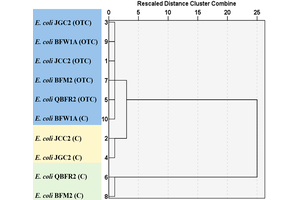
Aquaculture's rapid expansion raises significant concerns regarding antibiotic resistance, particularly in freshwater systems where Escherichia coli (E. coli) serve as a key indicator of fecal contamination. This study investigates mutation frequencies of E. coli strains from aquatic environments under selective pressure from oxytetracycline and chloramphenicol. Given that E. coli's antibiotic resistance is a growing public health issue, understanding mutation dynamics is crucial. We evaluated mutation frequencies in five E. coli strains isolated from fish, water, and sediment samples. These strains were initially sensitive to chloramphenicol and oxytetracycline. The mutation rates for oxytetracycline ranged between 4.12 x10⁻⁸ and 5.52 x 10⁻⁸, while chloramphenicol exposure led to mutation frequencies from 1.19 x 10⁻⁴ to 9.62 x 10⁻⁵. Cluster analysis using hierarchical methods revealed distinct patterns: E. coli strains exposed to oxytetracycline exhibited more uniform mutation frequencies compared to those exposed to chloramphenicol. The proximity matrix and dendrogram analysis demonstrated that oxytetracycline-treated strains clustered closely together, indicating similar mutational responses. Conversely, chloramphenicol-treated strains displayed greater variability, suggesting that chloramphenicol causes more diverse genetic changes in E. coli. The findings highlight an alarming increase in mutation rates, especially under chloramphenicol exposure, which significantly exceeds typical environmental bacterial mutation rates. These findings indicate a significant risk of antibiotic resistance and underscore the need for strict regulations and regular monitoring in aquaculture to manage it. Future research should investigate the specific mutations, strain genomics, and environmental factors contributing to resistance to address public health concerns related to antibiotic-resistant bacteria.
References
[1] C. J. Rodgers and M. D. Furones (2009). Antimicrobial agents in aquaculture: practice, needs and issues. In: C. Rodgers and B. Basurco (eds) The use of veterinary drugs and vaccines in Mediterranean aquaculture, vol 86. vol A. Zaragoza: CIHEAM, pp41-59. doi: 10.13140/2.1.4697.0560.
[2] F. A. O. (2016). The state of world fisheries and aquaculture. Food and Agriculture Organization of the United Nations, Rome.
[3] F. A. O. (2018). The state of world fisheries and aquaculture,- Meeting the Sustainable Development Goals. FAO, Rome.
[4] B. N. Paul, S. Chanda, N. Sridhar, G. S. Saha and S. S. Giri (2016). Proximate, mineral and vitamin contents of Indian major carp. Indian J. Anim. Nutr., 33: 102-107.
[5] D.O. F. (2022). Department of Fisheries. Handbook of Fisheries Statistics, 2022. Ministry of Fisheries, Animal Husbandry and Dairying, Govt. of India, New Delhi.
[6] T. Hastein, B. Hjeltnes, A. Lillehaug, J. Utne Skare, M. Berntssen and A. K. Lundebye (2006). Food safety hazards that occur during the production stage: challenges for fish farming and the fishing industry. Rev. Sci. Tech., 25: 607-625.
[7] H. S. Kumar, A. Parvathi, I. Karunasagar and I. Karunasagar (2005). Prevalence and antibiotic resistance of Escherichia coli in tropical seafood. World J. Microbiol. Biotechnol., 21: 619-623.
[8] P. Feng, S. D. Weagant and M. A. Grant (2002). Enumeration of Escherichia coli and the coliform bacteria. In: Merker RI (ed) Bacteriological analytical manual, 8th ed., revision A. U.S. Food and Drug Administration, College Park.
[9] I. C. M. S. F. (2002). Microbiological testing in food safety management, vol 7. Kluwer Academic/Plenum Publishers, New York. (ICMSF- International Commission on Microbiological Specifications for Foods).
[10] S. A. Wawire, D. O. Miruka, N. Nelson and A. Ofulla (2013). Antimicrobial susceptibility patterns of Enterobacteriaceae isolated from domesticated animals and the environment in Lake Victoria, Kenya. Ecohydrol. Hydrobiol., 13: 246-252.
[11] S. T. Odonko and J. K. Ampofo (2013). Escherichia coli as an indicator of bacteriological quality of water: an overview. Microbiol. Res., 4: 5-11.
[12] S. M. Chekabab, J. Paquin-Veillette, C. M. Dozois and J. Harel (2013). The ecological habitat and transmission of Escherichia coli O157:H7. FEMS Microbiol. Lett., 341: 1-12.
[13] J.M. Abou-Elela and A.M. Farag (2004). Bacteriological quality and metal contents of Diplodus vuljaris and Siganus rivuloyus in the eastern harbour water: A comparative study of freshly harvested and market fish. Egypt J. Aquat. Res., 30: 216-225.
[14] P. S. Jayasinghe and R. M. A. G. G. Rajakaruna (2005). Bacterial contamination of fish sold in fish market in the Central Province of Sri Lanka. J. Nat. Sci. Found. Sri Lanka, 33: 219-221.
[15] L. Novotny, L. Dvorska, A. Lorencova, V. Beran and I. Pavlik (2004). Fish: a potential source of bacterial pathogens for human beings. Vet. Med.-Czech, 49: 343-358.
[16] K. Nagamatsu, T. J. Hannan, R. L. Guest, M. Kostakioti, M. Hadjifrangiskou, J. Binkle and K. Dodson et al., (2015). Dysregulation of Escherichia coli α-hemolysin expression alters the course of acute and persistent urinary tract infection. Proc. Natl. Acad. Sci., 112: E871-E880.
[17] M. V. Cardozo, C. A. Borges, L. G. Beraldo, R. P. Maluta, A. S. Pollo, M. M. Borzi and L. F. dos Santos et al., (2018). Shigatoxigenic and atypical enteropathogenic Escherichia coli in fish for human consumption. Braz. J. Microbiol., 49: 936-941.
[18] E. C. D. C./E. M. E. A. (2009). The bacterial challenge: time to react: European Centre for Disease Prevention and Control and European Medicines Agency. chrome-extension://efaidnbmnnnibpcajpcglclefindmkaj/https://www.ecdc.europa.eu/sites/default/files/media/en/publications/Publications/0909_TER_The_Bacterial_Challenge_Time_to_React.pdf.
[19] F. M. Aarestrup, H. C. Wegener and P. Collignon (2008). Resistance in bacteria of the food chain: epidemiology and control strategies. Expert Rev. Anti-Infect. Ther., 6: 733-750.
[20] D. F. Maron, T. J. Smith and K. E. Nachman (2013). Restrictions on antimicrobial use in food animal production: an international regulatory and economic survey. Glob. Health, 9: 48. doi: 10.1186/1744-8603-9-48.
[21] A. Pruden, D. J. Larsson, A. Amézquita, P. Collignon, K. K. Brandt, D. W. Graham and E. Topp (2013). Management options for reducing the release of antibiotics and antibiotic resistance genes to the environment. Environ. Health Perspect., 121: 878-885.
[22] H. Sorum (2006). Antimicrobial drug resistance in fish pathogens, In: F. M. Aarestrup (ed.), Antimicrobial resistance in bacteria of animal origin. ASM Press, Washington, DC., pp213-238.
[23] H. Y. Done, A. K. Venkatesan and R. U. Halden (2015). Does the recent growth of aquaculture create antibiotic resistance threats different from those associated with land animal production in agriculture? AAPS J., 17: 513-524.
[24] E. Gullberg, S. Cao, O. G. Berg, C. Ilbäck, L. Sandegren, D. Hughes, and D. I. Andersson (2011). Selection of resistant bacteria at very low antibiotic concentrations. PLoS Pathog., 7: e1002158. doi: 10.1371/journal.ppat.1002158.
[25] L. L. Founou, R. C. Founou and S. Y. Essack (2016). Antibiotic resistance in the food chain: a developing country perspective. Front. Microbiol., 7: 1881. doi: 10.3389/fmicb.2016.01881.
[26] M. M. Mehendiratta, M. Khan, P. Mehndiratta and M. Wasay (2014). Stroke in Asia; geographical variations and temporal trends. J. Neurol. Neurosurg. Psychiatry, 85: 1308-1312.
[27] F. Prestinaci, P. Pezzotti and A. Pantosti (2015). Antimicrobial resistance: a global multifaceted phenomenon. Pathog. Glob. Health, 109: 309-318.
[28] J. Alexander, D. Benford, A. Boobis, S. Ceccatelli, J.-P. Cravedi, A. D. Domenico, D. Doerge et al., (2009). Marine biotoxins in shellfish-Summary on regulated marine biotoxins scientific opinion of the panel on contaminants in the food chain. EFSA J., 1306: 1-23.
[29] A. M. Hammerum and O. E. Heuer (2009). Human health hazards from antimicrobial-resistant Escherichia coli of animal origin. Clin. Infect. Dis., 48: 916-921.
[30] M. U. Rasheed, N. Thajuddin, P. Ahamed, Z. Teklemariam and K. Jamil (2014). Antimicrobial drug resistance in strains of Escherichia coli isolated from food sources. Rev. Inst. Med. Trop. Sao Paulo, 56: 341-346.
[31] L.-N. Xia, L. Li, C.-M. Wu, Y.-Q. Liu, X.-Q. Tao, L. Dai and Y.-H. Qi et al., (2010). A survey of plasmid-mediated fluoroquinolone resistance genes from Escherichia coli isolates and their dissemination in Shandong, China. Foodborne Pathog. Dis., 7: 207-215.
[32] A. R. Vieira, P. Collignon, F. M. Aarestrup, S. A. McEwen, R. S. Hendriksen, T. Hald and H. C. Wegener (2011). Association between antimicrobial resistance in Escherichia coli isolates from food animals and bloodstream isolates from humans in Europe: an ecological study. Foodborne Pathog. Dis., 8: 1. doi: 10.1089/fpd.2011.0950.
[33] A. Szmolka and B. Nagy (2013). Multidrug-resistant commensal Escherichia coli in animals and its impact on public health. Front. Microbiol., 4: 258. Doi: 10.3389/fmicb.2013.00258.
[34] A. P. Magiorakos, A. Srinivasan, R. B. Carey, Y. Carmeli, M. E. Falagas, C. G. Giske and S. Harbarth et al., (2011). Multidrug-resistant, extensively drug-resistant and pandrug-resistant bacteria: an international expert proposal for interim standard definitions for acquired resistance. Clin. Microbiol. Infect., 18: 268-281.
[35] J. L. Martinez (2008). Antibiotics and antibiotic resistance genes in natural environments. Science, 321: 365-367.
[36] K. Kummerer (2009). Antibiotics in the aquatic environment–a review–part I. Chemosphere, 75: 417-434.
[37] E. Marti and J.L. Balcazar (2013). Antibiotic resistance in the aquatic environment. In: M. Petrovic, D. Barcelo, S. Pérez (Eds.) Comprehensive analytical chemistry. Elsevier, pp671-684.
[38] A. C. Barnes, S. G. B. Amyes, T. S. Hastings and C. S. Lewin (1991). Fluoroquinolones display rapid bactericidal activity and low mutation frequencies against Aeromonas salmonicida. J. Fish Dis., 14: 661-667.
[39] S. Watford and S.J. Warrington (2017). Bacterial DNA mutations. In: StatPearls [Internet]. Treasure Island (FL): StatPearls Publishing LLC. https://pubmed.ncbi.nlm.nih.gov/29083710/ (accessed on 15 January 2025).
[40] A. M. George and S. B. Levy (1983). Amplifiable resistance to tetracycline, chloramphenicol, and other antibiotics in Escherichia coli: involvement of a non-plasmid-determined efflux of tetracycline. J. Bacteriol., 155: 531-540.
[41] E. Denamur and I. Matic (2006). Evolution of mutation rates in bacteria. Mol. Microbiol., 60: 820-827.
[42] J. Blazquez (2003). Hypermutation as a factor contributing to the acquisition of antimicrobial resistance. Clin. Infect. Dis., 37: 1201-1209.
[43] A. Giraud, I. Matic, M. Radman, M. Fons and F. Taddei (2002). Mutator bacteria as a risk factor in the treatment of infectious diseases. Antimicrob. Agents Chemother., 46: 863-865.
[44] M. Hastie, D. D. Torrico, G. Hepworth, R. Jacob, M. Ha, R. Polkinghorne and R. D. Warner (2022). Combining hierarchical clustering and preference mapping differentiates consumer preference for dry aged mutton. Meat Sci., 192: 108890. doi: 10.1016/j.meatsci.2022.108890.
[45] J. Palczak, D. Blumenthal and J. Delarue (2020). Influence of sensory complexity on preferences for novel gourmet dairy desserts. Does Berlyne’s theory apply to desserts? Food Qual. Prefer., 84: 103957.
[46] N.V. Lu, R. Tansuchat, T. Yuizono and V.N. Huynh (2020). Incorporating active learning into machine learning techniques for sensory evaluation of food. Int. J. Comput. Intell. Syst., 13: 655-662.
[47] I. Lee and J. Yang (2009). Common clustering algorithms. In: S. D. Brown, R. Taule and B. Walczak (Eds.), Comprehensive Chemometrics, Elsevier, Oxford, England, pp577-618.
[48] A. Saxena, M. Prasad, A. Gupta, N. Bharill, O. P. Patel, A. Tiwari and M.J. Er (2017). A review of clustering techniques and developments. Neurocomputing, 267: 664-681.
[49] G. James, D. Witten, T. Hastie and R. Tibshirani (2021). Unsupervised learning. In: An Introduction to Statistical Learning with Applications in R, 2nd ed., Springe.
[50] G. James, D. Witten, T. Hastie and R. Tibshirani (2013). Classification. In: J. Gareth, D. Witten, T. Hastie and R. Tibshirani (Eds.), An Introduction to Statistical Learning with Applications in R. Springer-Verlag New York.
[51] A. Kassambara (2017). Practical Guide to Cluster Analysis in R: Unsupervised Machine Learning, 1st ed. STHDA.
[52] A. Gere (2023). Recommendations for validating hierarchical clustering in consumer sensory projects. Curr. Res. Food Sci., 6: 100522. doi: 10.1016/j.crfs.2023.100522.
[53] P.J. Rousseeuw (1987). Silhouettes: a graphical aid to the interpretation and validation of cluster analysis. J. Comput. Appl. Math., 20: 53-65.
[54] W.M. Rand (1971). Objective criteria for the evaluation of clustering methods. J. Am. Stat. Assoc., 66: 846–850.
Downloads
Published
Issue
Section
License
Copyright (c) 2025 Author (s)

This work is licensed under a Creative Commons Attribution-NonCommercial-NoDerivatives 4.0 International License.
Copyright © The Author(s). Effective from 1 July 2026, articles published in Emergent Life Sciences Research (ELSR) are distributed under the Creative Commons Attribution 4.0 International License (CC BY 4.0), which permits use, sharing, distribution, reproduction, and adaptation in any medium or format, provided that appropriate credit is given to the original author(s) and the source, a link to the license is provided, and any changes made are indicated.
Articles published before 1 July 2026 remain subject to the license applicable at the time of their original publication, including the Creative Commons Attribution-NonCommercial-NoDerivatives 4.0 International License (CC BY-NC-ND 4.0), where applicable.