Evaluation of phytochemical contents and antioxidant activities of crude seed extracts of Musa balbisiana Colla accessions of northeast India
DOI:
https://doi.org/10.31783/ELSR.2025.1120105Keywords:
antioxidant potential, DPPH, FRAP, Musa balbisiana, phytochemical, northeast IndiaAbstract
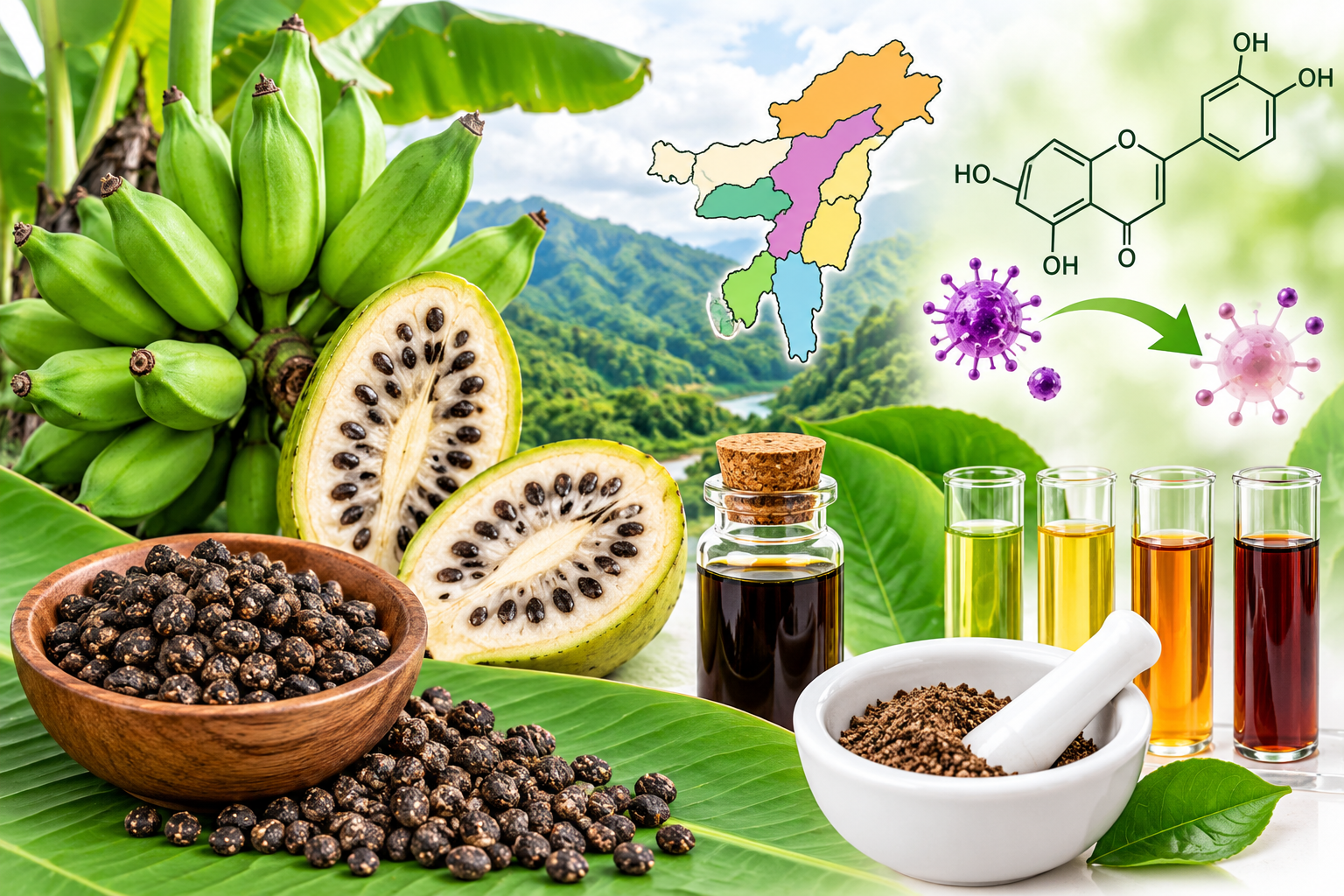
Northeast Indian region is known for presence of diverse and unique banana (Musa spp.) accessions and its seeded wild relatives including the seeded M. balbisiana (BB genome). These bananas are used for various purposes such as food, medicinal, handicrafts, fabrics, etc. In the present study carried out with 6 different M. balbisiana seed extracts collected from different states of northeast India, phytochemical contents such as total phenol, total tannin and total flavonoid were evaluated along with DPPH radical scavenging activity and Ferric reducing antioxidant power for evaluating the antioxidant potential. Variable contents of total phenol, total tannin and total flavonoid long with antioxidant potential were observed. Overall, the findings indicated possible application of the huge banana resources including the wild seeded accessions for various economic and useful value-added food, nutraceutical and herbal products.
References
[1] OECD (2009). Consensus document on the biology of bananas and plantains (Musa spp.). Series on Harmonisation of Regulatory Oversight in Biotechnology No. 48. Environment, Health and Safety Publications, Paris, France.
[2] S. Uma and S. Sathiamoorthy (2002). Names and synonyms of bananas and plantains of India. National Research Centre for Banana, ICAR, Tiruchirapalli, India, pp62.
[3] J. S. Heslop-Harrison and T. Schwarzacher (2007). Domestication, genomics and the future for banana. Ann. Bot., 100: 1073-1084.
[4] N. W. Simmonds (1962). The evolution of the bananas. Longman Group Ltd., London, UK.
[5] K. Shepherd (1999). Cytogenetics of the genus Musa. International Network for the Improvement of Banana and Plantain, Montpellier, France, pp154.
[6] X. L. Wang, T. Y. Chiang, N. Roux, G. Hao and X. J. Ge (2007). Genetic diversity of wild banana (Musa balbisiana Colla) in China as revealed by AFLP markers. Genet. Resour. Crop Evol., 54: 1125-1132.
[7] J. V. Buren (1970). Fruit phenolics. In: A. C. Hulme (ed) The biochemistry of fruits and their products. vol 1. Academic Press, London, pp269-304
[8] P. Yingming, L. Ying, W. Hengshan and L. Min (2004). Antioxidant activities of several Chinese medicinal herbs. Food Chem., 88: 347-350.
[9] M. Alothman, R. Bhatt and A. A. Karim (2009). Antioxidant capacity and phenolic content of selected tropical fruits from Malaysia, extracted with different solvents. Food Chem., 115: 785-788.
[10] V. L. Singleton and J. A. J. Rossi (1965). Colorimetry of total phenolics with phosphomolybdic-phosphotungstic acid reagents. Am. J. Enol. Vitic., 16: 144-158.
[11] V. Dewanto, X. Wu, K. K. Adom and R. H. Liu (2002). Thermal processing enhances the nutritional value of tomatoes by increasing total antioxidant activity. J. Agric. Food Chem., 50: 3010-3014.
[12] H. P. Makkar, M. Bluemmel, N. K. Borowy and K. Becker (1993). Gravimetric determination of tannins and their correlations with chemical and protein precipitation methods. J. Sci. Food Agric., 61: 161-165.
[13] C. Vasco, J. Ruales and A. Kamal-Eldin (2008). Total phenolic compounds and antioxidant capacities of major fruits from Ecuador. Food Chem., 111: 816-823.
[14] S. R. Fatemeh, R. Saifullah, F. M.A. Abbas and M. E. Azhar (2012). Total phenolics, flavonoids and antioxidant activity of banana pulp and peel flours: influence of variety and stage of ripeness. Int. Food Res. J., 19: 1041–1046.
[15] B. Sultana, F. Anwar, M. R. Asi and S. A. S. Chatha (2008). Antioxidant potential of extracts from different agro wastes: stabilization of corn oil. Grasas Aceites, 59: 205-217.
[16] R. H. Liu (2013). Health-promoting components of fruits and vegetables in the diet. Adv. Nutr., 4: 384S-392S.
[17] S. S. Pekkarinen, H. Stöckmann, K. Schwarz, M. Heinonen and A. I. Hopia (1999). Antioxidant activity and partitioning of phenolic acids in bulk and emulsified methyl linoleate. J. Agric. Food Chem., 47: 3036-3043.
[18] S. Nieto, A. Garrido, J. Sanhueza, L. Loyola, G. Morales, F. Leighton and A. Valenzuela (1993). Flavonoids as stabilizers of fish oil: an alternative to synthetic antioxidants. J. Am. Oil Chem. Soc., 70: 773-778.
[19] B. J. F. Hudson and J. I. Lewis (1983). Polyhydroxy flavonoid antioxidant for edible oils. phospholipids as synergists. Food Chem., 10: 111-120.
[20] S. Siji and P. V. Nandini (2016). Phytochemical analysis of selected banana varieties. Int. J. Adv. Eng. Manag. Sci., 2: 964-968.
[21] M. Parimala and F. G. Shoba (2013). Phytochemical analysis and in vitro antioxidant activity of hydro alcoholic seed extract of Nymphaea nouchali Burm. Asian Pac. J. Trop. Biomed., 3: 887-895.
[22] P. Khawas, A. J. Das, N. Sit, L. S. Badwaik and S. C. Deka (2014). Nutritional composition of culinary Musa AAB at different stages of development. Am. J. Food Sci. Technol., 2: 80-87.
[23] M. Jackson (2003). Potential mechanisms of action of bioactive substances found in foods. In: G. Goldberg (ed.), Plants: Diet and health. Blackwell Publishing, Oxford, UK, pp65-75.
[24] J. L. Donovan, C. Manach, R. M. Faulks and P. A. Kroon (2006). Absorption and metabolism of dietary plant secondary metabolites. In: A. Crozier, M.N. Clifford and H. Ashihara (eds.), Plant secondary metabolites: occurrence, structure and role in the human diet. Blackwell Publishing, Oxford, UK, pp303-351.
[25] M. Afolayan, S. Abubakar, A. Adedayo, I. Doyinsola and F. Adebisi (2014). In vitro antioxidant, antimicrobial and phytochemical properties of wild banana [Ensete gilletii (E.A.J. DE Wildman)] seeds extract. Int. J. Adv. Chem., 2: 59-61.
[26] M. M. Schmidt, R. C. Prestes, E. H. Kubota, G. Scapin and M. A. Mazutti (2015). Evaluation of antioxidant activity of extracts of banana inflorescences (Musa cavendishii). CyTA. J. Food, 13: 498-505.
[27] B. Hsu, I. M. Coupar and K. Ng (2006). Antioxidant activity of hot water extract from the fruit of the Doum palm, Hyphaene thebaica. Food Chem., 98: 317-328.
Downloads
Published
Issue
Section
License
Copyright (c) 2025 Author (s)

This work is licensed under a Creative Commons Attribution-NonCommercial-NoDerivatives 4.0 International License.
Copyright © The Author(s). Effective from 1 July 2026, articles published in Emergent Life Sciences Research (ELSR) are distributed under the Creative Commons Attribution 4.0 International License (CC BY 4.0), which permits use, sharing, distribution, reproduction, and adaptation in any medium or format, provided that appropriate credit is given to the original author(s) and the source, a link to the license is provided, and any changes made are indicated.
Articles published before 1 July 2026 remain subject to the license applicable at the time of their original publication, including the Creative Commons Attribution-NonCommercial-NoDerivatives 4.0 International License (CC BY-NC-ND 4.0), where applicable.