Phytochemical, morphological and pharmacological aspects of Hybanthus enneaspermus: A review
DOI:
https://doi.org/10.31783/ELSR.2025.1120618Keywords:
bioactive compounds, ethnobotany, medicinal plant, traditional usesAbstract
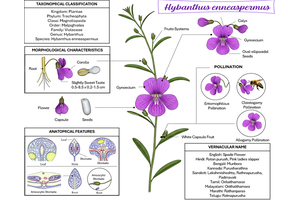
At this time, the world faces a critical challenge from various diseases due to high pollution and rapid industrial growth. Nowadays, in advanced treatment, various synthetic drugs are available. A synthetic drug not only cures diseases, but also has severe side effects on the human body and has high-cost value. A lot of examples reported that synthetic drugs are associated with side effects. As a result, Global Medicinal plants create huge demand due to low cost, fewer side effects. It has been continuously tried to minimize critical disorders in developed countries by utilizing secondary and primary plant bioactive phytochemical compounds. In this perspective, Hybanthus enneaspermus is an important multipurpose medicinal herb or a shrub. This plant belongs to the Violaceae family, commonly known as Ratanpuru, and has pink-colored flowers. It has been used as a medicinal herb since ancient times. The plant is used as an anti arthritic, anti-inflammatory, anti-microbial, anti-diabetic, antioxidant, and anti-ulcer. With potent antioxidant, nephroprotective, anti-inflammatory, antimicrobial, antidiabetic, anti-arthritic, anti-allergic, hepatoprotective, and anti-ulcer properties, Hybanthus enneaspermus's pharmacological potential is summed up in this study. Numerous extracts exhibit notable bioactive qualities, such as ethanolic, aqueous, and ethyl acetate fractions. According to these results, Hybanthus enneaspermus has a variety of therapeutic uses and can be a useful natural resource for creating innovative herbal medications.
References
[1] T. Anand and K. Gokulakrishnan (2012). GC–MS analysis and anti-microbial activity of bioactive components of Hybanthus enneaspermus. Int. J. Pharm. Pharm. Sci., 4: 456-60.
[2] D. K. Patel, R. Kumar, D. Laloo and S. Hemalatha (2011). Evaluation of phytochemical and antioxidant activities of the different fractions of Hybanthus enneaspermus (Linn.) F. Muell. (Violaceae). Asian Pac. J. Trop. Med., 4: 391-396.
[3] L. C. Kulkarni, P. Bhat and G. R. Hegde (2016). Preliminary pharmacognostic and phytochemical evaluation of Hybanthus stellarioides (Domin) PI Forst. Int. J. Appl. Res., 2: 450-454.
[4] A. Karimi, M. Majlesi and M. Rafieian-Kopaei (2015). Herbal versus synthetic drugs; beliefs and facts. J. Nephropharmacol. 4: 27-30.
[5] B. Nisar, A. Sultan, and S. L. Rubab (2018). Comparison of medicinally important natural products versus synthetic drugs-a short commentary. Nat. Prod. Chem. Res, 6: 308. doi: 10.4172/2329-6836.1000308.
[6] C. Garofalo, S. Borrelli, M. E. Liberti, M. Andreucci, G. Conte, R. Minutolo and M. Provenzano et al., (2019). SGLT2 inhibitors: nephroprotective efficacy and side effects. Medicina, 55: 268. doi: 10.3390/medicina55060268.
[7] A. Konar and R. Chatterjee (2022). Solanum Xanthocarpum-A critical approach to the lesser known aspects of the Herb. Int. J. Sci. Res. in Biological Sciences. 9: 52-56
[8] A. Mazumder, A. Singh and S. Jha (2021). A review on metformin: Clinical significance and side effects. Int. J. Pharma. Res., 13: 60-69.
[9] D.K. Patel, R. Kumar, K. Sairam and S. Hemalatha (2013). Hybanthus enneaspermus (L.) F. Muell: a concise report on its phytopharmacological aspects. Chin. J. Nat. Med., 11: 199-206.
[10] A. K. N. Ramya and R. Devika (2022). A current pharmacological impacts and perspective of Hybanthus enneaspermus (Linn.) F. Muell. Pharmacognosy Res., 4: 342-349.
[11] P. Ghosh, A. Konar, S. Halder, D. S. Shivaranjani and J. Kaur (2024). Impact of nanotechnology on the environment: A review. Environ. Sci. Arch., 3: 152-163.
[12] P. B. Rajsekhar, R. S. A. Bharani, K. J. Angel, M. Ramachandran and S. P. V. Rajsekhar (2016). Hybanthus enneaspermus (L) F. Muell: A phytopharmacological review on herbal medicine. J. Chem. Pharm. Res, 8: 351-355.
[13] M. K. Krupashree, R. Renuka and S. Rajesh (2018). Phytochemical investigation of Hybanthusenneaspermus and its cell culture. J. Pharmacogn. Phytochem., 7: 2847-2851.
[14] M. Setty, V. B. Narayanaswamy, K. K. Sreenivasan and A. Shirwaikar (2007). Free radical scavenging and nephroprotective activity of Hybanthus enneaspermus (L) F. Muell. Pharmacologyonline, 2: 158-171.
[15] A. Konar, S. Pokhrel, S. Halder, R. Chatterjee and Adhikari (2023). Dendrobium longicornu orchid has potential pharmaceutical properties in Nepal. Int. J. Sci. Res. in Biological Sciences, 10: 37-41
[16] C. I. Peng and Y. F. Chen (1986). Hybanthus Jacq. (Violaceae), a new generic record for the flora of Taiwan. Bot. Bull. Acad. Sin., 26: 213-220.
[17] E. M. Bennett (1972). A revision of the Australian species of Hybanthus Jacquin (Violaceae). Nuytsia, 1: 218-241.
[18] T. R. Shantha, S. Pashupathy, J. K. P. Shetty, B. Vijayalakshmi, P. Kandavel and T. Bikshapathy (2001). Pharmacognostical studies on orilaitamarai-Hybanthus enneaspermus (L) f. Muell-(violaceae). Anc. Sci. Life, 21: 38-50.
[19] A. Konar, J. Kaur, S. Chatterjee, A. Roy, D.D. Dalal and P. Ghosh (2023). A critical approach of medicinal plants to impede COVID-19. World J. Pharm. Res., 12: 753-765.
[20] A. Konar, S. Halder, J. Kaur, S. DS, S. Ghosh, S. Chakraborty and P. Ghosh (2024). Miraculous responses of Gloriosa superba L. in the treatment of colon cancer: A brief review. Int. J. Biosci. Biochem., 6: 44-50.
[21] M. Rajadurai, V.G. Vidhya, M. Ramya and A. Bhaskar (2009). Ethno-medicinal plants used by the traditional healers of pachamalai hills, Tamilnadu, India. Ethno-Med., 3: 39-41.
[22] A. Maruthupandian and V. R. Mohan (2010). Observations of ethnomedicinal plants from Sirumalai hills in Western Ghats of Tamil Nadu, India. J. Herbal Med. Toxicol., 4: 89-92.
[23] A. Konar, K. Mukherjee, P. Ghosh and M. El-Shazly (2022). Traditional Medicinal Plants Used in Different Districts of West Bengal by the Tribal Communities. J Pharmacogn Phytochem, 11: 104-110
[24] M. A. Dikwa, M. R. Asinmi, M. B. Falana, Q. O. Nurudeen, M. A. Akanji (2023). Aqueous extract of Hybanthus enneaspermus exhibited aphrodisiac potentials in fluoxetine-induced sexually-impaired female rats. Mediterr J Pharm Pharm Sci., 3: 61-72
[25] K. Thamilmani, K. Anbu and P. Subramanian (2007). C: N ratio and mineral profile of some folklore medicinal plants of aphrodisiac importance from Tamil Nadu India, Biochem. Cell Arch., 11: 85-92.
[26] K. R. Retnam and A. J. DeBritto (1998). Preliminary phytochemical screening of three medicinal plants of Tirunelveli hills. J. Econ. Tax. Bot., 22: 677-681.
[27] N. Savithramma, M. L. Rao and G. Bhumi (2011). Phytochemical screening of Thespesia populnea (L.) Soland and Tridax procumbens L. J. Chem. Pharm. Res., 3: 28-34
[28] A. Konar and A. Mondal (2022). Ethnobotanical use of plants in Birbhum district, West Bengal, India. J. Med. Plants, 10: 82-86.
[29] N.K. Dubey, R. Kumar and P. Tripathi (2004). Global promotion of herbal medicine: India's opportunity. Curr. Sci., 86: 37-41.
[30] P. Ghosh, A. Konar, S. Chatterjee, A. Roy, D. D. Dalal and S. Mukherjee (2023). Role of natural nutraceuticals in management of oxidative stress related diseases. Ed: H. Joshi In: Advances in Biotechnology and Bioscience, 13: 117-145. ISBN: 978-93-5570-664-5.
[31] F. O. Awobajo, I. I. Olatunji-Bello, O. A. Adegoke and T. O. Odugbemi (2009). Phytochemical and antimicrobial screening of Hybanthus enneaspermus and paquetina nigricense. Rec. Res. Sci. Tech., 1: 159-60
[32] O. Benavente-García, J. Castillo, F. A. Marin, A. Ortuño and J. A. Del Río (1997). Uses and properties of citrus flavonoids. J. Agric. Food Chem., 45: 4505-4515.
[33] P. Ghosh, A. Konar, S. Chatterjee, A. Roy, D. D. Dalal (2023). Role of plant pigments on human health and environment. Ed: R. JayaKumar, R. R. Duvvuru, A. Kumar, M. M. Laddunvri, In: Research Trends in Multidisciplinary Research, 44: 113-138. ISBN: 978-93-5570-685-0.
[34] A. Konar, P. Ghosh, D. S. Shivaranjani and T. Tabia (2025). Evaluation of ethnobotanical, phytochemical and pharmacological properties of Cassia fistula Linn. flower. TANZ Res. J., 11: 523-539.
[35] A. Konar (2021). Regulatory effect of G-protein in transpiration. Int. J. Scientific Res. Eng. Manag., 5: 1-7.
[36] P. Ganguly, A. Konar, P. Garai, S. Mahapatra, T. Tabia, P. Ghosh (2025). Nutritional and health perspectives of Mango peel. Int. J. Agric. Food Sci., 7: 297-303.
[37] S. Sundaram, A. Radhakrishnan, G. V. Kanniappan, S. K. Bhaskaran, C. P. Palanisamy and P. Kannappan (2015). Comparative study on antioxidant activity of crude and alkaloid extracts of Hybanthus enneaspermus Linn) F. Mull. Anal. Chem. Lett., 5: 291-299.
[38] P. Ghosh, A. Dutta, M. Biswas, S. Biswas, L. Hazra, S.K. Nag and S. Sil et al., (2019). Phytomorphological, chemical and pharmacological discussions about Commelina benghalensis Linn. (Commelinaceae): A review. The Pharma Innov. J., 8: 12-18.
[39] K. T. Raju, B. N. Rani, K. Kamala and G. Sujatha (2015). Studies on phytochemical, antioxidant, proximate and elemental analysis of Hybanthus enneaspermus (L) F. Muell. leaf. World J. Pharm. Res., 4: 1244-1253.
[40] A. Konar, J. Kaur, D.S. Shivaranjani, S. Chakraborty and P. Ghosh (2024). Role of Vernonia cinerea in breast cancer: A review. Int. J. Pharmacol. Clinic. Res., 6: 49-54.
[41] S. Sirappuselvi & M. Chitra (2012). In vitro antioxidant activity of Cassia tora Lin. Int. Res. J. Biol. Sci., 1: 57-61.
[42] H. Roy, A. K. Chakraborty and U. Pattanayak (2010). In-vitro antioxidant activity of hydro-alcoholic extract of leaves of Hybanthus enneaspermus (Linn.). J. Pharm. Res., 3: 2623-2624.
[43] S. M. Matalqah and D. M. Al-Tawalbeh (2019). Medicinal plants potential against diabetes mellitus: Review. Int. J. Pharmacognosy, 6: 39-53.
[44] S. Poddar, T. Sarkar, S. Choudhury, S. Chatterjee and P. Ghosh (2020). Indian traditional medicinal plants: A concise review. Int. J. Bot. Stud., 5: 174-190.
[45] S. Banik, R. Mukherjee, P. Ghosh, S. Karmakar and S. Chatterjee (2018). Estimation of plant pigments concentration from tulsi (Ocimum sanctum Linn.): a six months study. J. Pharmacogn. Phytochem. 7: 2681-2684.
[46] R. Sundararajan, A. Bharampuram and R. Koduru (2014). A review on phytoconstituents for nephroprotective activity. Pharmacophore, 5: 160-182.
[47] G. A. Porter and W. M. Bennett (1981). Nephrotoxic acute renal failure due to common drugs. Am. J. Physiol., 241: F1-F8.
[48] M. Setty, V. B. Narayanaswamy, K. K. Sreenivasan and A. Shirwaikar (2007). Free radical scavenging and nephroprotective activity of Hybanthus enneaspermus (L) F. Muell. Pharmacologyonline, 2: 158-171.
[49] S. Tripathy, S. Parchuri and D. Pradhan (2011). Preliminary investigation of the anti-inflammatory properties of Hybanthus enneaspermus. Int. J. Univ. Pharm. Life Sci., 1: 239-248.
[50] Pranabesh Ghosh, Chandrima Das, Swagata Biswas, Sudip Kumar Nag, Alolika Dutta, Maitrayee Biswas and Sayantan Sil et al., (2020). Phytochemical composition analysis and evaluation of in vitro medicinal properties and cytotoxicity of five wild weeds: A comparative study. F1000Research, 9: 493. doi: 10.12688/f1000research.22966.1.
[51] K. R. Retnam and A. J. De Britto (2007). Antimicrobial activity of a medicinal plant Hybanthus enneaspermus (Linn.) F. Muell. Nat. Prod. Radiance, 6: 366-368
[52] S. Sahoo, D. M. Kar, S. Mohapatra, S. P. Rout and S. K. Dash (2006). Antibacterial activity of Hybanthus enneaspermus against selected urinary tract pathogens. Indian J. Pharm. Sci., 68: 653-655
[53] S. Singh, M. Ramaiah, M. Devgan and B. K. Sarkar (2017). Phytochemical and comparative antioxidant evaluation by DPPH and reducing power assay of Hybanthus enneaspermus. Acta Sci Pharmaceut Sci., 1: 01-4.
[54] V. Vennila and V. Pavithra (2015). In-vitro alpha amylase and alpha glucosidase inhibitory activity of various solvent extracts of Hybanthus enneaspermus Linn. World J. Pharm. Pharm. Sci., 4: 1425-1437.
[55] M. P. Anupa, S. Chinju and M. Murugan (2016). Qualitative phytochemical screening and in vitro antioxidant activity of Hybanthus enneaspermus. Int. J. Pharmacogn. Phytochem. Res., 8: 1046-1049.
[56] S. S. Laev and N. F. Salakhutdinov (2015). Anti-arthritic agents: progress and potential. Bioorg. Med. Chem., 23: 3059-3080.
[57] T. Kamatchi, D. Sudarsan, R. T. Tharisanan and K. Karthikeyan (2023). A facile one-pot green-mediated approach of plasmonic (Ag and Au) nanoparticles fabricated by Hybanthus enneaspermus flower extracts for catalytic, anti-bacterial and anti-arthritic activity. Chem. Pap., 77: 5007-5019.
[58] S. Tripathy, S. P. Sahoo, D. Pradhan, S. Sahoo and D. K. Satapathy (2009). Evaluation of anti-arthritic potential of Hybanthus enneaspermus. Afr. J. Pharm. Pharmacol., 3: 611-614.
[59] J. Kaur, A. Konar, R. Chatterjee and S. Singh (2023). Review on the anti-cancerous properties of Oldenlandia diffusa Roxb. Int. J. Pharmacognosy Pharm. Sci., 5: 1-7.
[60] S. H. Bhanu, B. Meena and C. Pallavi (2011). Suppression of paracetamol toxicity by antitoxidant principles of Hybanthus enneaspermus (L.) F. Muell. in mice blood and liver. Int. Jr. Pharm. & Pharm. Sci., 4: 90-94.
[61] A. Sarkar, P. Ghosh, P. Poddar, T. Sarkar, S. Choudhury and S. Chatterjee (2020). Phytochemical, botanical and ethnopharmacological study of Scoparia dulcis Linn. (Scrophulariaceae): A concise review. The Pharma Innov. Journal, 9: 30-35.
[62] D. A. Lewis and P. J. Hanson (1991). Anti-ulcer drugs of plant origin. In: Progress in Medicinal Chemistry; Eds: G. P. Ellis, G. B. West, Elsevier Science Publishers B. V.: Amsterdam, The Netherlands, 28: 201-231.
[63] S. P. Sahoo, B. B. Subudhi, S. Ramchandran, M. D. Dhanraju and B. Kumaraswamy (2012). Evaluation of anti-ulcer and anti-secretory activity of Hybanthus enneaspermus. Int. J. Pharm. Res. Allied Sci., 1: 85-88.
Downloads
Published
Issue
Section
License
Copyright (c) 2025 Author (s)

This work is licensed under a Creative Commons Attribution-NonCommercial-NoDerivatives 4.0 International License.
Copyright © The Author(s). Effective from 1 July 2026, articles published in Emergent Life Sciences Research (ELSR) are distributed under the Creative Commons Attribution 4.0 International License (CC BY 4.0), which permits use, sharing, distribution, reproduction, and adaptation in any medium or format, provided that appropriate credit is given to the original author(s) and the source, a link to the license is provided, and any changes made are indicated.
Articles published before 1 July 2026 remain subject to the license applicable at the time of their original publication, including the Creative Commons Attribution-NonCommercial-NoDerivatives 4.0 International License (CC BY-NC-ND 4.0), where applicable.