The science of intermittent fasting: Mechanisms and health effects
DOI:
https://doi.org/10.31783/elsr.2026.1210110Keywords:
gut brain axis, insulin-sensitivity, metabolic diseases, non-communicable diseases, obesityAbstract
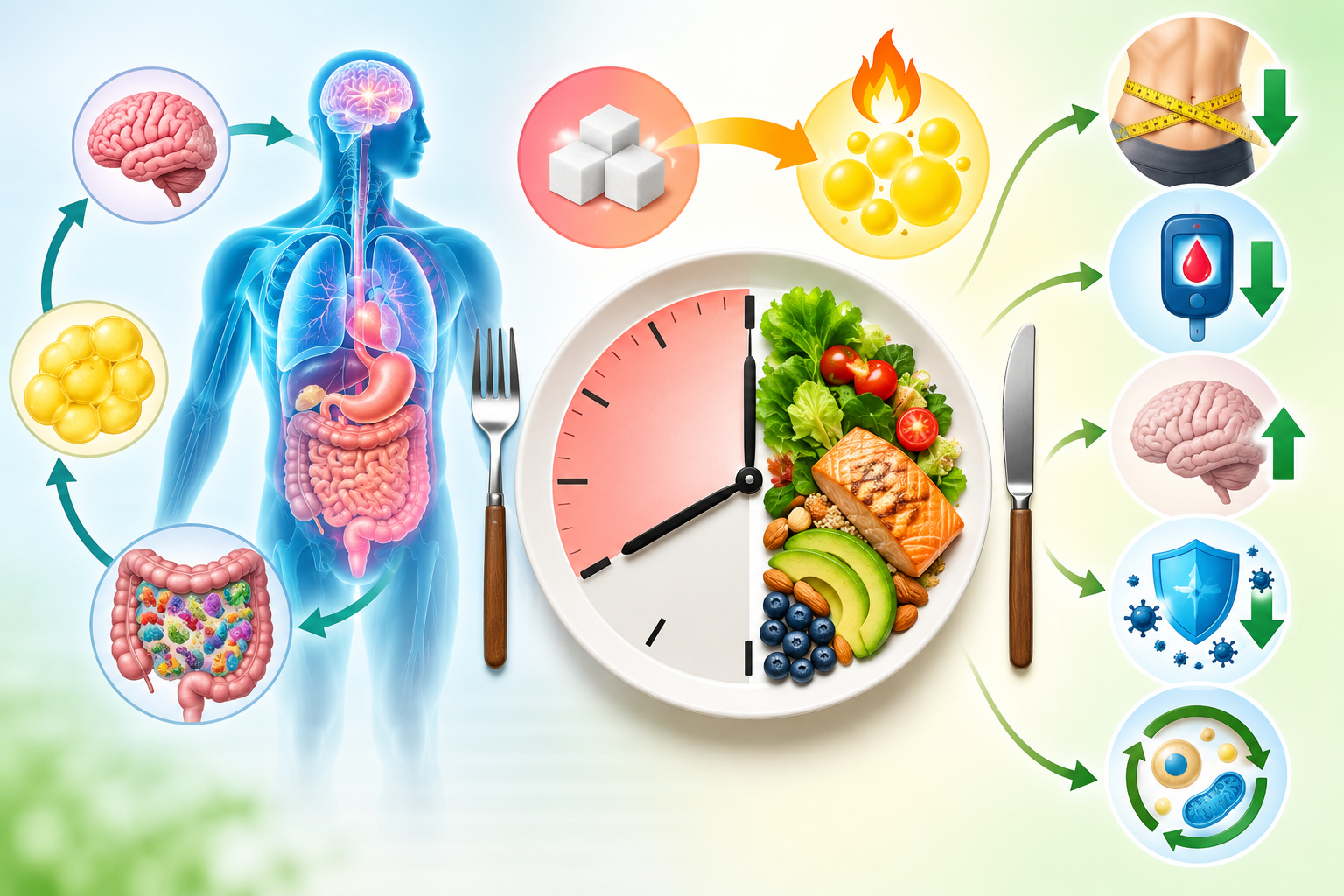
In recent years, life has gradually shifted towards a more sedentary and convenient lifestyle. This shift is one of the major contributing factors for widespread health related problems. The World Health Organization (WHO) also highlights the global increase in non-communicable and metabolic disorders in the world. This is largely attributed to unhealthy dietary intake, sedentary lifestyle, lack of physical activity etc. One of the major health problems is obesity and overweight, which is no longer confined to high-income countries, but low-income and middle-income countries are also experiencing the same trend. Intermittent Fasting (IF) is emerging as one promising strategy for weight management and overall health. Intermittent fasting can be done in many ways, like Intermittent Energy Restriction (IER) and Time-Restricted Fasting (TRF). There are various animal and human studies suggesting that Time-Restricted Fasting (TRF) has more pronounced health benefits. The results depicted weight loss, increased insulin sensitivity, improved cognitive function, a change in gut microbe composition, tissue repair, and reduced oxidative stress and inflammatory markers. These effects are the result of key biological mechanisms of Intermittent Fasting (IF) such as metabolic switching of glucose to fat, modulated circadian rhythm pattern, and gut-brain axis. In various studies, it is claimed that intermittent fasting in combination with continuous energy restriction was found to mask the independent effect of intermittent fasting.
References
[1] L. K. Heilbronn, S. R. Smith, C. K. Martin, S. D. Anton and E. Ravussin (2005). Alternate day fasting in nonobese subjects: effects on body weight, body composition, and energy metabolism. Am. J. Clin. Nutr., 81: 69-73.
[2] V. D. Longo and S. Panda (2016). Fasting, circadian rhythms, and time-restricted feeding in healthy lifespan. Cell Metab., 23: 1048-1059.
[3] R. Antoni, K. L. Johnston, A. L. Collins and M. D. Robertson (2016). Investigation into the acute effects of total and partial energy restriction on postprandial metabolism among overweight/obese participants. Br. J. Nutr., 115: 951-959.
[4] K. Gabel, K. K. Hoddy and K. A. Varady (2019). Safety of 8-h time-restricted feeding in adults with obesity. Appl. Physiol. Nutr. Metab., 44: 107-109.
[5] N. M. Byrne, A. Sainsbury, N. A. King, A. P. Hills and R. E. Wood (2018). Intermittent energy restriction improves weight loss efficiency in obese men: The MATADOR study. Int. J. Obes., 42: 129-138.
[6] C. A. Rynders, E. A. Thomas, A. Zaman, Z. Pan, V. A. Catenacci and E. L. Melanson (2019). Effectiveness of intermittent fasting and time-restricted feeding compared to continuous energy restriction for weight loss. Nutrients, 11: 2442. doi: 10.3390/nu11102442.
[7] M. P. Mattson, K. Moehl, N. Ghena, M. Schmaedick and A. Cheng (2018). Intermittent metabolic switching, neuroplasticity and brain health. Nat. Rev. Neurosci., 19: 63-80.
[8] M. Mosley and M. Spencer (2013). The FastDiet: Lose Weight, Stay Healthy, and Live Longer with the simple secret of intermittent fasting. Atria: New York, USA. ISBN: 978-1-4767-3496-5.
[9] B. D. Horne, J. B. Muhlestein and J. L. Anderson (2015). Health effects of intermittent fasting: hormesis or harm? A systematic review. Am. J. Clin. Nutr., 102: 464-470.
[10] K. A. Varady, C. S. Hudak and M. K. Hellerstein (2009). Modified alternate-day fasting and cardioprotection: relation to adipose tissue dynamics and dietary fat intake. Metabolism. 58: 803-811.
[11] K. A. Varady, D. J. Roohk and M. K. Hellerstein (2007a). Dose effects of modified alternate-day fasting regimens on in vivo cell proliferation and plasma insulin-like growth factor-1 in mice. J. Appl. Physiol., 103: 547-551.
[12] K. A. Varady and M. K. Hellerstein (2007b). Alternate-day fasting and chronic disease prevention: a review of human and animal trials. Am. J. Clin. Nutr., 86: 7-13.
[13] K. A. Varady, D. J. Roohk, B. K. McEvoy-Hein, B. D. Gaylinn, M. O. Thorner and M. K. Hellerstein (2008). Modified alternate-day fasting regimens reduce cell proliferation rates to a similar extent as daily calorie restriction in mice. FASEB J., 22: 2090-2096.
[14] J. D. Gotthardt, J. L. Verpeut, B. L. Yeomans, J. A. Yang, A. Yasrebi, T. A. Roepke and N. T. Bello (2016). Intermittent fasting promotes fat loss with lean mass retention, increased hypothalamic norepinephrine content, and increased neuropeptide Y gene expression in diet-induced obese male mice. Endocrinology. 157: 679-691.
[15] P. M. Joslin, R. K. Bell and S. J. Swoap (2017). Obese mice on a high-fat alternate-day fasting regimen lose weight and improve glucose tolerance. J. Anim. Physiol. Anim. Nutr., 101: 1036-1045.
[16] W. Yang, M. Cao, X. Mao, X. Wei, X. Li, G. Chen and J. Zhang et al., (2016). Alternate-day fasting protects the livers of mice against high-fat diet–induced inflammation associated with suppression of Toll-like receptor-4/nuclear factor κB signaling. Nutr. Res., 36: 586-593.
[17] A. Di Francesco, C. Di Germanio, M. Bernier and R. De Cabo (2018). A time to fast. Science, 362: 770-775.
[18] S. D. Anton, K. Moehl, W. T. Donahoo, K. Marosi, S. A. Lee, A. G. Mainous and C. Leeuwenburgh et al., (2018). Flipping the metabolic switch: understanding and applying the health benefits of fasting. Obesity. 26: 254-268.
[19] R. Fernández-Verdejo, J. T. Mey and E. Ravussin (2023). Effects of ketone bodies on energy expenditure, substrate utilization, and energy intake in humans. J. Lipid Res., 64: 100442. doi: 10.1016/j.jlr.2023.100442.
[20] V. D. Longo, M. D. Tano, M. P. Mattson and N. Guidi (2021). Intermittent and periodic fasting, longevity and disease. Nat. Aging. 1: 47-59.
[21] M. Alirezaei, C. C. Kemball, C. T. Flynn, M. R. Wood, J. L. Whitton and W. B. Kiosses (2010). Short-term fasting induces profound neuronal autophagy. Autophagy. 6: 702-710.
[22] K. Davies (2000). Oxidative stress, antioxidant defenses, and damage removal, repair, and replacement systems. IUBMB Life. 50: 279-289.
[23] L. A. Pham-Huy, H. He and C. Pham-Huy (2008). Free radicals, antioxidants in disease and health. Int. J. Biomed. Sci., 4: 89-96.
[24] F. M. Menzies, A. Fleming, A. Caricasole, C. F. Bento, S. P. Andrews, A. Ashkenazi and J. Fullgrabe et al., (2017). Autophagy and neurodegeneration: pathogenic mechanisms and therapeutic opportunities. Neuron, 93: 1015-1034.
[25] S. Panda, J. B. Hogenesch and S. A. Kay (2002). Circadian rhythms from flies to human. Nature. 417: 329-335.
[26] K. A. Lamia, U. M. Sachdeva, L. Di Tacchio, E. C. Williams, J. G. Alvarez, D. F. Egan and D. S. Vasquez et al., (2009). AMPK regulates the circadian clock by cryptochrome phosphorylation and degradation. Science. 326: 437-440.
[27] I. W. K. Kouw, L. K. Heilbronn and A. R. H. van Zanten (2022). Intermittent feeding and circadian rhythm in critical illness. Curr. Opin. Crit. Care, 28: 381-388.
[28] H. K. Pedersen, V. Gudmundsdottir, H. B. Nielsen, T. Hyotylainen, T. Nielsen, B. A. H. Jensen and K. Forslund et al., (2016). Human gut microbes impact host serum metabolome and insulin sensitivity. Nature, 535: 376-381.
[29] J. F. Cryan and T. G. Dinan (2012). Mind-altering microorganisms: the impact of the gut microbiota on brain and behaviour. Nat. Rev. Neurosci., 13: 701-712.
[30] T. R. Sampson and S. K. Mazmanian (2015). Control of brain development, function, and behavior by the microbiome. Cell Host Microbe., 17: 565-576.
[31] P. A. Muller, M. Schneeberger, F. Matheis, P. Wang, Z. Kerner, A. Ilanges and K. Pellegrino et al., (2020). Microbiota modulate sympathetic neurons via a gut–brain circuit. Nature. 583: 441-446.
[32] M. S. Thion, F. Ginhoux and S. Garel (2018). Microglia and early brain development: an intimate journey. Science, 362: 185-189.
[33] J. M. Yano, K. Yu, G. P. Donaldson, G. G. Shastri, P. Ann, L. Ma and C. R. Nagler et al., (2015). Indigenous bacteria from the gut microbiota regulate host serotonin biosynthesis. Cell. 161: 264-276.
[34] C. B. Christiansen, M. B. N. Gabe, B. Svendsen, L. O. Dragsted, M. M. Rosenkilde and J. J. Holst (2018). The impact of short-chain fatty acids on GLP-1 and PYY secretion from the isolated perfused rat colon. Am. J. Physiol. Gastrointest. Liver Physiol., 315: G53-G65. doi: 10.1152/ajpgi.00346.2017.
[35] H. W. Chen, P. K. Nwe, Y. Yang, C. E. Rosen, A. A. Bielecka, M. Kuchroo and G. W. Cline et al., (2019). A forward chemical genetic screen reveals gut microbiota metabolites that modulate host physiology. Cell. 177: 1217-1231.
[36] S. Adesso, T. Magnus, S. Cuzzocrea, M. Campolo, B. Rissiek, O. Paciello and G. Autore et al., (2017). Indoxyl sulfate affects glial function increasing oxidative stress and neuroinflammation in chronic kidney disease: interaction between astrocytes and microglia. Front. Pharmacol., 8: 370. doi: 10.3389/fphar.2017.00370.
[37] J. H. Mao, Y. M. Kim, Y. X. Zhou, D. H. Hu, C. H. Zhong, H. Chang and C. J. Brislawn et al., (2020). Genetic and metabolic links between the murine microbiome and memory. Microbiome. 8: 53. doi: 10.1186/s40168-020-00817-w.
[38] R. Wan, S. Camandola and M. P. Mattson (2003). Intermittent food deprivation improves cardiovascular and neuroendocrine responses to stress in rats. J. Nutr., 133: 1921–1929.
[39] J. Zhang, Z. Zhan, X. Li, A. Xing, C. Jiang, Y. Chen, W. Shi and L. An (2017). Intermittent fasting protects against Alzheimer’s disease possibly through restoring aquaporin-4 polarity. Front. Mol. Neurosci., 10: 395. doi: 10.3389/fnmol.2017.00395.
[40] J. Gudden, A. A. Vasquez and M. Bloemendaal (2021). The effects of intermittent fasting on brain and cognitive function. Nutrients. 13: 3166. doi: 10.3390/nu13093166.
[41] S. Welton, R. Minty,T. O’Driscoll, H. Willms, D, Poirier, S. Madden and L. Kelly (2020). Intermittent fasting and weight loss: systematic review. Can Fam Physician., 66: 117-125.
[42] G. M. Tinsley and P. M. La Bounty (2015). Effects of intermittent fasting on body composition and clinical health markers in humans. Nutr. Rev., 73: 661-674.
[43] R. V. Seimon, J. A. Roekenes, J. Zibellini, B. Zhu, A. A. Gibson and A. P. Hills and R. E. Wood (2015). Do intermittent diets provide physiological benefits over continuous diets for weight loss? A systematic review of clinical trials. Mol. Cell. Endocrinol., 418: 153-172.
[44] A. Chadt and H. Al-Hasani (2020). Glucose transporters in adipose tissue, liver, and skeletal muscle in metabolic health and disease. Pflugers Archiv-Eur. J. Physiol., 472: 1273-1298.
[45] S. Carter, P. M. Clifton and J. B. Keogh (2016). The effects of intermittent compared to continuous energy restriction on glycaemic control in type 2 diabetes: a pragmatic pilottrial. Diabetes Res. Clin. Pract., 122: 106-112.
[46] B. T. Corley, R. W. Carroll, R. M. Hall, M. Weatherall, A. Parry-Strong and J. D. Krebs (2018). Intermittent fasting in type 2 diabetes mellitus and the risk of hypoglycaemia: a randomized controlled trial. Diabet. Med., 35: 588-594.
[47] H. Kahleova, L. Belinova, H. Malinska, O. Oliyarnyk, J. Trnovska, V. Skop and L. Kazdova et al., (2014). Eating two larger meals a day (breakfast and lunch) is more effective than six smaller meals in a reduced-energy regimen for patients with type 2 diabetes: a randomised crossover study. Diabetologia. 57: 1552-1560.
[48] S. Carter, P. M. Clifton and J. B. Keogh (2018). Effect of intermittent compared with continuous energy restricted diet on glycemic control in patients with type 2 diabetes: a randomized noninferiority trial. JAMA Netw. Open. 1: e180756. doi: 10.1001/jamanetworkopen.2018.0756.
[49] T. G. Arnason, M. W. Bowen and K. D. Mansell (2017). Effects of intermittent fasting on health markers in those with type 2 diabetes: a pilot study. World J. Diabetes. 8: 154-164.
[50] K. A. Varady, V. T. Dam, M. C. Klempel, M. Horne, R. Cruz, C. M. Kroeger and S. Santosa (2015). Effects of weight loss via high-fat vs. low-fat alternate-day fasting diets on free fatty acid profiles. Sci. Rep., 5: 7561. doi: 10.1038/srep07561.
[51] M. C. Klempel, C. M. Kroeger, S. Bhutani, J. F. Trepanowski and K. A. Varady (2012). Intermittent fasting combined with calorie restriction is effective for weight loss and cardio-protection in obese women. Nutr. J., 11: 98. doi: 10.1186/1475-2891-11-98.
[52] K. T. Kibret, A. Peeters, T. K. Tegegne, Y. M. Mesfin and M. Nichols (2025). Intermittent fasting for the prevention of cardiovascular disease risks: systematic review and network meta-analysis. Curr. Nutr. Rep., 14: 93. doi: 10.1007/s13668-025-00684-7.
[53] J. M. Bruun, J. W. Helge, B. Richelsen and B. Stallknecht (2006). Diet and exercise reduce low-grade inflammation and macrophage infiltration in adipose tissue but not in skeletal muscle in severely obese subjects. Am. J. Physiol. Endocrinol. Metab., 290: E961-E967.
[54] B. F. Zamarron, T. A. Mergian, K. W. Cho, G. Martinez-Santibanez, D. Luan, K. Singer and J. L. DelProposto et al. (2017). Macrophage proliferation sustains adipose tissue inflammation in formerly obese mice. Diabetes. 66: 392-406.
[55] A. Zubrzycki, K. Cierpka-Kmiec, Z. Kmiec and A. Wronska (2018). The role of low-calorie diets and intermittent fasting in the treatment of obesity and type-2 diabetes. J. Physiol. Pharmacol., 69: 663-683.
[56] Y. E. Kang, J. M. Kim, K. H. Joung, J. H. Lee, B. R. You, M. J. Choi and M. J. Ryu et al., (2016). The roles of adipokines, proinflammatory cytokines, and adipose tissue macrophages in obesity-associated insulin resistance in modest obesity and early metabolic dysfunction. PLoS One, 11: e0154003. doi: 10.1371/journal.pone.0154003.
[57] X. Wang, Q. Yang, Q. Liao, M. Li, P. Zhang, H. O. Santos and H. Kord-Varkaneh et al. (2020). Effects of intermittent fasting diets on plasma concentrations of inflammatory biomarkers: a systematic review and meta-analysis of randomized controlled trials. Nutrition. 79-80: 110974. doi: 10.1016/j.nut.2020.110974.
[58] B. Liu, A. T. Hutchison, C. H. Thompson, K. Lange and L. K. Heilbronn (2019). Markers of adipose tissue inflammation are transiently elevated during intermittent fasting in women who are overweight or obese. Obes. Res. Clin. Pract., 13: 408-415.
Downloads
Published
Issue
Section
License
Copyright (c) 2026 Author (s)

This work is licensed under a Creative Commons Attribution-NonCommercial-NoDerivatives 4.0 International License.
Copyright © The Author(s). This is an open access article distributed under the terms of the Creative Commons Attribution-NonCommercial-NoDerivatives 4.0 International License (CC BY-NC-ND 4.0), which permits unrestricted non-commercial use, distribution, and reproduction in any medium, provided the original author(s) and source are properly credited, and the work is not modified or adapted.