Selection of diverse parents based on genetic distances and cluster analysis in Gossypium hirsutum L.
DOI:
https://doi.org/10.31783/ELSR.2026.1211116Keywords:
clustering, cotton, genetic diversity, seed cotton yield, selection of parentsAbstract
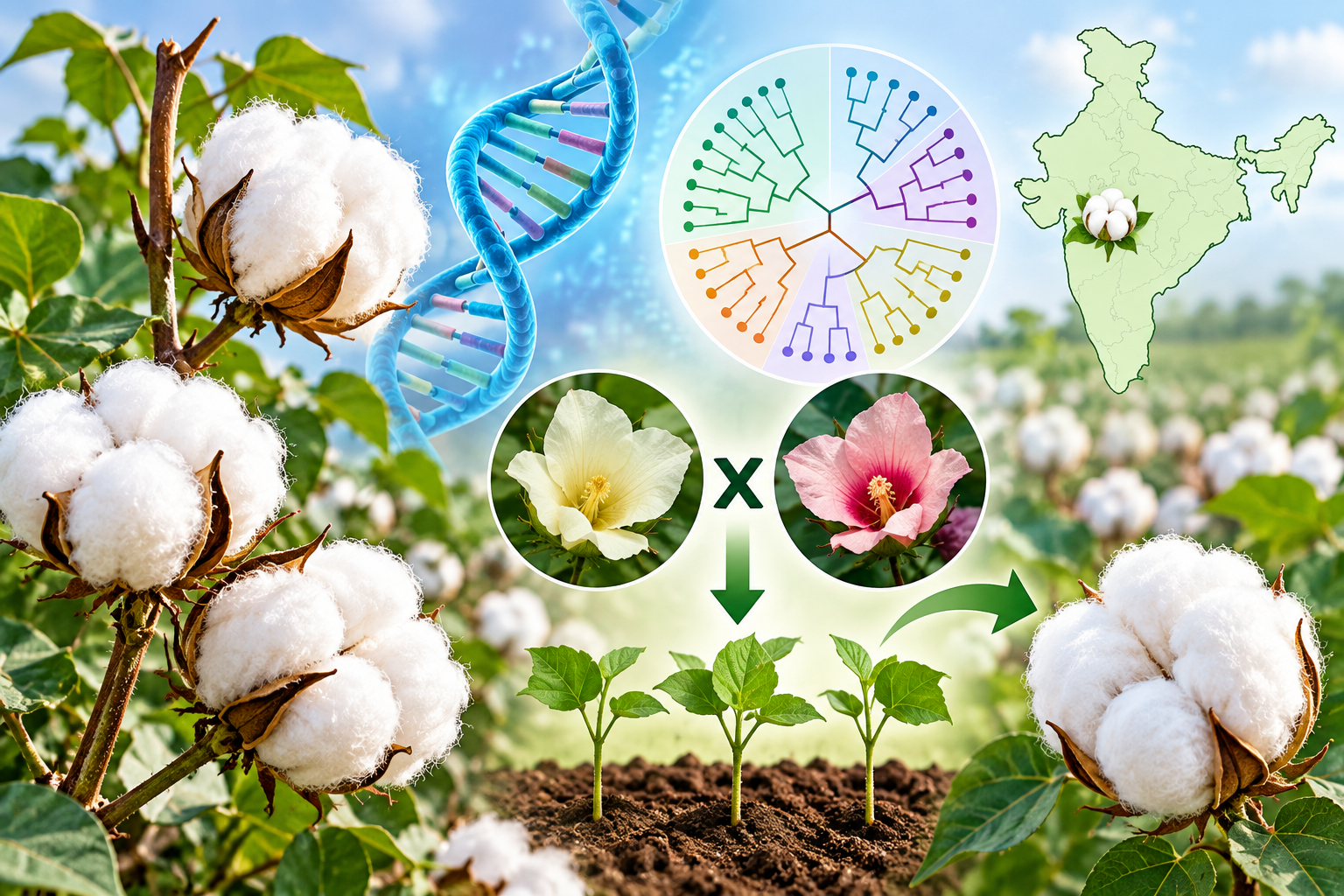
India holds the title of the largest cotton producer globally and is the sole nation that grows all four cultivated species of cotton. This study was conducted with objectives to estimate the magnitude of genetic diversity among a set of elite germplasm lines and to identify parents for a further cotton improvement program. In the present investigation, a set of thirty elite genotypes of Gossypium hirsutum L. were evaluated in a randomized block design with eleven morphological traits. Based on genetic diversity values, the thirty genotypes were categorized into ten diverse clusters despite their geographical origin or ancestry. The clusters I, II, and IX were comprised of the maximum genotypes, while four clusters, viz., cluster III, IV, VI, and VIII, were single genotype clusters. The highest magnitude of intra cluster distance was exhibited in cluster II (27.38), the cluster combination of cluster III and cluster VIII exhibited the highest inter cluster distance (36.11). Based on benchmark value of the average inter-cluster distance of 15.73, the seventy parental cross combinations along with their reciprocals were suggested as per the cluster combinations that were above the average genetic distance value. In the present investigation with respect to agro-ecological conditions of Akola, the four genotypes AKH 8828, NH-659, RAH 1066, and SCS 1207 emerged as the potent donors for important quantitative characters for the future cotton improvement program.
References
[1] M. Reddychennaiahgari, V. Ujjainkar, A. Akhare and A. Kharkar (2025). Relation of seed vigour to yield performance in different seed lots of cotton (Gossypium hirsutum L.). Int. J. Res. Pub. Rev., 6: 5636-5642.
[2] C. L. Brubaker, A. H. Paterson and J. F.Wendel (1999). Comparative genetic mapping of allotetraploid cotton and its diploid progenitors. Genome, 42: 184-203.
[3] P. Fryxell (1979). The natural history of the cotton tribe (Malvaceae, Tribe Gossypieae); Texas A & M University Press: College Station, TX, USA., pp245.
[4] J. F. Wendel, C. Brubaker, I. Alvarez, R. Cronn and J. M. Stewart (2009). Evolution and natural history of the cotton genus. In A. H. Paterson (Ed.), Genetics and Genomics of Cotton, Springer Science and Business Media LLC, New York, pp3-22.
[5] J. F. Wendel and R. C. Cronn (2003). Polyploidy and the evolutionary history of cotton. Adv. Agron., 78: 139-186.
[6] Anonymous (2025). Report on Cotton and product updates., USDA Foreign Agriculture Service.
[7] R. Asha, M. L. Ahamed, D. R. Babu and P. A. Kumar (2013). Multivariate analysis in upland cotton (Gossypium hirsutum L.), Madras Agric. J., 100: 333-335
[8] V. V. Ujjainkar (2022). Similarity coefficient analysis using UPGMA based on polymorphism of isozyme and DNA markers in Cotton. Int. J. Res. Appl. Sci. Eng. Technol., 10: 961-977.
[9] V. Ujjainkar (2025). D2 statistics technique: methodology and applications in plant breeding. Int. J. Res. Rev., 12: 127-139.
[10] V. G. Panse and P. V. Sukhatme (1978). Statistical method for agricultural workers ICAR Publication. New Delhi
[11] C. R. Rao (1952). Advanced statistical methods in biometrical research. John Wiley and Sons Inc., New York.
[12] M. R. Anderberg (1973). Cluster analysis for application. Academic Press, New York
[13] J. J. Gauswami., M. G. Valu and G. N. Odedara (2021). Correlation, path analysis and D2 analysis study of seed cotton yield and fibre quality traits in American cotton (Gossypium hirsutum L.). J. Pharmocogn. Phytochem., 10: 222-230
[14] B. M. Naik, Y. Satish and D. R. Babu (2016). Genetic diversity analysis in American cotton (Gossypium hirsutum L.)., Electron. J. Plant Breed., 7: 1002-1006.
[15] S. D. Pathan, S. N. Devkule, H. V. Kalpande, A. M. Dethe and V. N. Chinchane (2025). Character association study in cotton (Gossypium hirsutum L.). Int. J. Adv. Biochem. Res., SP-9: 151-157
[16] V. V. Ujjainkar (2022). Study of environmental influence on genetic diversity estimates (D2) of parental lines in upland cotton (Gossypium hirsutum L.). Int. J. Curr. Microbiol. App. Sci., 11: 212-221.
[17] C. Pavan, R. Chapara, M. S. Rani, G. A. D. Grace, M. James and Priyadharshini (2025). Genetic diversity studies for seed cotton yield and fiber quality parameters in diverse cotton genotypes. Plant Arch., 25: 2645-2651.
[18] A. Manivannan and B. Dharajothi (2019). Multivariate Analysis based Characterization of Cotton Germplasm. Int. J. Curr. Microbiol. App. Sci., 8: 480-487.
[19] S. Vachhani, S. R. Patel, S. G. Patel, H. N. Patel, A. Dinisha and A. Nayak (2025). Multivariate analysis in cotton. Pharma Innovation., 14: 8-11.
Downloads
Published
Issue
Section
License
Copyright (c) 2026 Author (s)

This work is licensed under a Creative Commons Attribution-NonCommercial-NoDerivatives 4.0 International License.
Copyright © The Author(s). This is an open access article distributed under the terms of the Creative Commons Attribution-NonCommercial-NoDerivatives 4.0 International License (CC BY-NC-ND 4.0), which permits unrestricted non-commercial use, distribution, and reproduction in any medium, provided the original author(s) and source are properly credited, and the work is not modified or adapted.