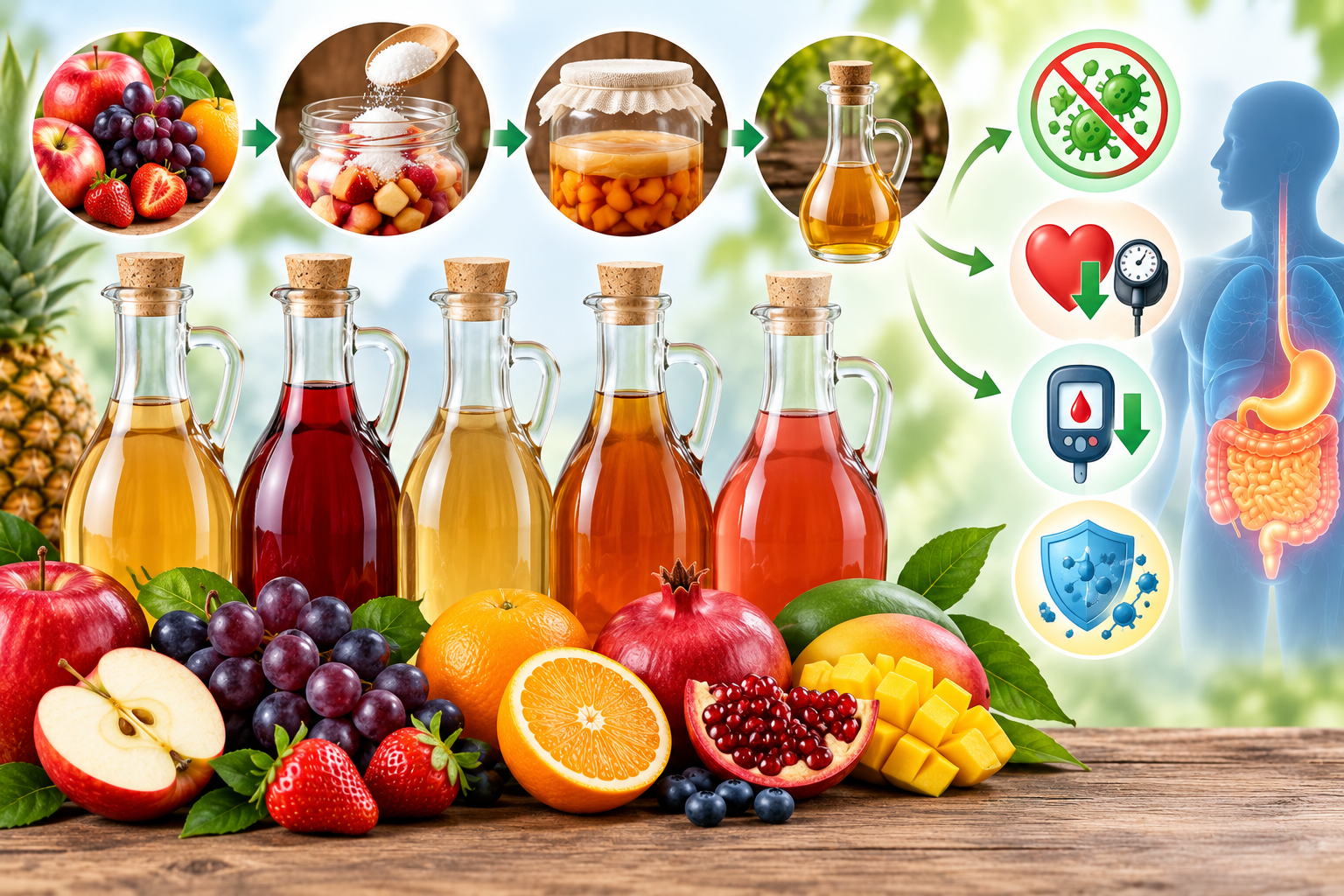
Fruit vinegars through time: Production, diversity, and health benefits
DOI:
https://doi.org/10.31783/elsr.2026.1211725Keywords:
acetic acid, acetic fermentation, acetobacter, pickle, vinegarAbstract
Vinegar has been used for centuries as both a natural preservative and a condiment. It primarily consists of acetic acid, ranging from 4% to 18% per 100 ml, and is known for its distinct flavor and aroma. Table vinegar holds 4% acetic acid, whereas pickles with vinegar can have concentrations as high as 18%. Natural vinegar is considered a grander food additive compared to synthetic vinegar because it preserves nutrients from its fruit sources and is believed to provide medicinal benefits, such as relieving aches and aiding digestion. Vinegar also possesses various functional and therapeutic properties, including antibacterial, antihypertensive, antidiabetic, and antioxidant effects. This review paper emphasizes the significance of vinegar and its production from a variety of fruit sources.
References
[1] N. H. Budak, E. Aykin, A. C. Seydim, A. K. Greene, Z. B. Guzel-Seydim (2014). Functional properties of vinegar. J. Food Sci., 79: R757-R764.
[2] M. Kara, A. Assouguem, O. M. A. Kamaly, S. Benmessaoud, H. Imtara, H. Mechchate and C. Hano et al., (2021). The impact of apple variety and the production methods on the antibacterial activity of vinegar samples. Molecules, 26: 5437. doi: 10.3390/molecules26185437.
[3] L. Na, X. Chu, S. Jiang, C. Li, G. Li, Y. He and Y. Liu et al., (2016). Vinegar decreases blood pressure by down-regulating AT1R expression via the AMPK/PGC-1α/PPARγ pathway in spontaneously hypertensive rats. Eur. J. Nut., 55: 1245-1253.
[4] N. A. Yusoff, M. F. Yam, H. K. Beh, K. N. Abdul Razak, T. Widyawati, R. Mahmud and M. Ahmad et al., (2015). Antidiabetic and antioxidant activities of Nypa fruticans Wurmb. vinegar sample from Malaysia. Asian Pac. J. Trop. Med., 8: 595-605.
[5] C. S. Johnston and C. A. Gaas (2006). Vinegar: medicinal uses and antiglycemic effect. Medscape J. Med., 8: 61.
[6] S. Hailu, S. Admassu, K. Jha (2012). Vinegar Production Technology–An Overview. Beverage Food World. 2: 29-32.
[7] P. S. Bensi, S. Divakar and J. Merrylin (2025). Exploring the rich heritage and health benefits of diverse fruit wines and their production. J. Food Sci. Technol., 62: 999-1006.
[8] L. Q. Zhao and L. Li (2005). The history, present status, development trend of the production technology of Chinese vinegar. China Condiment. 1: 3-6. (In Chinese language).
[9] J. F. Bourgeois and F. Barja (2009). The history of vinegar. Archives Des Sci., 62: 147-160.
[10] J. R. Partington (1964). Early Organic Chemistry. In A History of Chemistry. pp233-264. Palgrave, London.
[11] C. Gilmartin (2024). Vinegar: The complete guide to making our own. The Crowood Press.
[12] L. Pasteur (1864). Mémoire sur la fermentation acétique. Annales scientifiques de l’École Normale Supérieure, 1: 115–158.
[13] W. J. D. Toit and I. S. Pretorius (2002). The occurrence, control and esoteric effect of acetic acid bacteria in winemaking. Ann. Microbiol., 52: 155-179.
[14] J. M. Pilcher (2012). The Oxford handbook of food history. Oxford University Press. USA, pp508.
[15] S. Ghosh, R. Chakraborty, A. Chatterjee and U. Raychaudhuri (2014). Optimization of media components for the production of palm vinegar using response surface methodology. J. Inst. Brew., 120: 550-558.
[16] H. Men, H. Liu, L. Wang and X. Zhou (2010). Optimization of electronic nose sensor array and its application in the classification of vinegar. Adv. Mat. Res., 121: 27-32.
[17] S. V. Bhat, R. Akhtar and T. Amin (2014). An overview on the biological production of vinegar. Int. J. Fermented Foods, 3: 139-155.
[18] E. Mudura, T. E. Coldea, C. Socaciu, F. Ranga, C. R. Pop, A. M. Rotar and A. Pasqualone (2018). Brown beer vinegar: A potentially functional product based on its phenolic profile and antioxidant activity. J. Serb. Chem. Soc., 83: 19-30.
[19] P. Giudici, M. Gullo, L. Solieri, P. M. Falcone (2009). Technological and microbiological aspects of traditional balsamic vinegar and their influence on quality and sensorial properties. Adv. Food Nutr. Res., 58: 137-182.
[20] G. L. Chen, F. J. Zheng, J. Sun, Z. C. Li, B. Lin and Y. R. Li (2015). Production and characteristics of high quality vinegar from sugarcane juice. Sugar Tech, 17: 89-93.
[21] V. K. Joshi and S. Sharma (2009). Cider vinegar: Microbiology, technology and quality. In: L. Solieri, P. Giudici (Eds.), Vinegars of the World, Springer Milan, Milano, pp197-207. doi: 10.1007/978-88-470-0866-3_12.
[22] Z. Yu, Y. Tan, S. Luo, J. Zhou, T. Xu, J. Zou and L. Ke et al., (2022). Food nanoparticles from rice vinegar: isolation, characterization, and antioxidant activities. NPJ Sci. Food, 6: doi: 10.1038/s41538-021-00118-y.
[23] R. M. Callejón, M. L. Morales, A. C. S. Ferreira, A. M. Troncoso (2008). Defining the typical aroma of sherry vinegar: sensory and chemical approach. J. Agric. Food Chem., 56: 8086-8095.
[24] K. Horiuchi, K. Tohru and K. Masayoshi (2000). Effective onion vinegar production fermentation system by a two-step. J. Biosci. Bioeng., 90: 289-293.
[25] E. C. Ilha, E. Sant’Anna, R. C. Torres, A. C. Porto, E. M. Meinert (2000). Utilization of bee (Apis mellifera) honey for vinegar production at laboratory scale. Acta. Cient. Venez., 51: 231-235.
[26] A. O. Adebayo-Oyetoro, E. Adenubi, O. O. Ogundipe, B. O. Bankole and S. A. O. Adeyeye (2017). Production and quality evaluation of vinegar from mango. Cogent Food and Agric., 3: 1278193. doi: 10.1080/23311932.2016.1278193.
[27] S. Yikmis (2019). Optimization of uruset apple vinegar production using response surface methodology for the enhanced extraction of bioactive substances. Food. 8: 107. doi: 10.3390/foods8030107.
[28] P. Chauhan (2017). Studies on utilization of wild apricot for vinegar production. Ph.D Thesis, Shoolini University of Biotechnology and Management Sciences, H.P, India. https://shodhganga.inflibnet.ac.in/handle/10603/221386.
[29] P. Saha and S. Banerjee (2013). Optimization of process parameters for vinegar production using banana fermentation. Int. J. Res. Engng. Technol., 2: 501-514.
[30] S. M. Alawad, A. M. E. Sulieman, M. A. Osman and H. A. Mudawi (2015). Production and quality evaluation of vinegar from tamarind (Tamarindus indica L.) fruit pulp. Gezira J. Eng. Appl. Sci., 10: 35-46.
[31] G. S. Kocher, K. L. Kalra and R. P. Phutela (2006). Comparative production of sugarcane vinegar by different immobilization techniques. J. Inst. Brew., 112: 264-266.
[32] Y. Chen, Y. Bai, D. S. Li, C. Wang, N. Xu, Y. Hu (2017). Improvement of the flavor and quality of watermelon vinegar by high ethanol fermentation using ethanol-tolerant acetic acid bacteria. Int. J. Food Eng., 13: 20160222. doi: 10.1515/ijfe-2016-0222.
[33] J. Y. Lee, H. D. Cho, J. H. Jeong, M. K. Lee, Y. K. Jeong, K. H. Shim and K. I. Seo (2013). New vinegar produced by tomato suppresses adipocyte differentiation and fat accumulation in 3T3-L1 cells and obese rat model. Food Chem., 141: 3241-3249.
[34] C. Cejudo-Bastante, E. Durán-Guerrero, C. García-Barroso, R. Castro-Mejías (2018). Comparative study of submerged and surface culture acetification process for orange vinegar. J. Sci. Food Agric., 98: 1052-1060.
[35] J. Kongkiattikajorn (2014). Antioxidant Properties of Roselle Vinegar Production by Mixed Culture of Acetobacter aceti and Acetobacter cerevisiae. Kasetsart J (Nat Sci), 48: 980-988.
[36] S. Kharchoufi, J. Gomez, C. Lasanta, R. Castro, F. Sainz and M. Hamdi (2018). Benchmarking laboratory‐scale pomegranate vinegar against commercial wine vinegars: antioxidant activity and chemical composition. J. Sci. Food Agric., 98: 4749-4758.
[37] S. Hong, K. Soe, T. Lee, I. Kim, Y. Lee and B. Lim (2018). Cognitive improving effects by highbush blueberry (Vaccinium crymbosum L.) vinegar on scopolamine-induced amnesia mice model. J. Agric. Food Chem., 66: 99-107.
[38] Ç. Gokirmakli, N. H. Budak, Z. B. Guzel-Seydim, A. C. Seydim, B. E. Filiz and I. D. Karakulak (2019). Antioxidant properties of strawberry vinegar. Int. J. Food Eng., 5: 171-174.
[39] A. De Leonardis, F. Masino, V. Macciola, G. Montevecchi, A. Antonelli and E. Marconi, (2019). A study on acetification process to produce olive vinegar from oil mill waste waters. Eur. Food Res. Technol., 245: 2123-2131.
[40] J. M. Gonza lez-saiz, I. Esteban-Díez, C. Sánchez-Gallardo and C. Pizarro (2008). Monitoring of substrate and product concentrations in acetic fermentation processes for onion vinegar production by NIR spectroscopy: value addition to worthless onions. Anal. Bioanal. Chem., 391: 2937-2947.
[41] A. Roda, D. De Faveri, R. Dordoni and M. Lambri (2014). Vinegar production from pineapple wastes–Preliminary saccharification trials. Chem. Eng. Trans., 37: 607-612.
[42] A. Roda, L. Lucini, F. Torchio, R. Dordoni, D. M. De Faveri and M. Lambri (2017). Metabolite profiling and volatiles of pineapple wine and vinegar obtained from pineapple waste. Food Chem., 229: 734-742.
[43] M. A. Othaman, S. A. Sharifudin, A. Mansor, A. A. Kahar and K. Long (2014). Coconut water vinegar: New alternative with improved processing technique. J. Eng. Sci. Technol., 9: 293-302.
[44] S. Sakanaka and Y. Ishihara (2008). Comparison of antioxidant properties of persimmon vinegar and some other commercial vinegars in radical-scavenging assays and on lipid oxidation in tuna homogenates. Food Chem., 107: 739-744.
[45] I. Cleenwerck, K. Vandemeulebroecke, D. Janssens and J. Swings (2002). Re-examination of the genus Acetobacter, with descriptions of Acetobacter cerevisiae sp. nov. and Acetobacter malorum sp. nov. . Int. J. Syst. Evol. Microbiol., 52: 1551-1558.
[46] W. Tesfaye, M. L. Morales, M. C. García-Parrilla and A. M. Troncoso (2003). Optimising wine vinegar production: fermentation and ageing. Appl. Biotechnol. Food Sci. Policy. 1: 109-114.
[47] M. L Morales, G. A. González, J. A. Casas and A. M. Troncoso (2001). Multivariate analysis of commercial and laboratory produced sherry wine vinegar: influence of acetification and aging. J. Food Technol., 212: 676-682.
[48] F. D. Gonelimali, J. Lin, W. Miao, J. Xuan, F. Charles, M. Chen, S. R. Hatab (2018). Antimicrobial properties and mechanism of action of some plant extracts against food pathogens and spoilage microorganisms. Front. Microbiol., 9: 1639. doi: 10.3389/fmicb.2018.01639.
[49] I. Y. Sengun and M. Karapinar (2004). Effectiveness of lemon juice, vinegar and their mixture in the elimination of Salmonella typhimurium on carrots (Daucus carota L.). Int. J. Food Microbiol., 96: 301-305.
[50] N. K. Hindi (2013). In vitro antibacterial activity of aquatic garlic extract, apple vinegar and apple vinegar-garlic extract combination. Am. J. Phytomedicine Clinical Therapeutics, 1: 42-51.
[51] T. P. Bhagavathi, P. S. Bensi and P. S. Geetha (2017). Sensory quality assessment of pineapple–Garcinia cambogia squash, principal component analysis. J. Pharmacogn. Phytochem., 6: 1332-1359.
[52] N. H. Budak and Z. B. Guzel‐Seydim (2010). Antioxidant activity and phenolic content of wine vinegars produced by two different techniques. J. Sci. Food Agric., 90: 2021-2026.
[53] M. Leeman, E. Ostman and I. Björck (2005). Vinegar dressing and cold storage of potatoes lowers postprandial glycaemic and insulinaemic responses in healthy subjects. Eur. J. Clin. Nutr., 59: 1266-1271.
[54] S. Nishidai, Y. Nakamura, K. Torikai, M. Yamamoto, N. Ishihara, H. Mori and H. Ohigashi (2000). Kurosu, a traditional vinegar produced from unpolished rice, suppresses lipid peroxidation in vitro and in mouse skin. Biosci. Biotechnol. Biochem., 64: 1909-1914.
[55] A. Mimura, Y. Suzuki, Y. Toshima, S. I. Yazaki, T. Ohtsuki, S. Ui and F. Hyodoh (2004). Induction of apoptosis in human leukemia cells by naturally fermented sugar cane vinegar (kibizu) of Amami Ohshima Island. Biofactors, 22: 93-97.
[56] V. L. Mermel (2004). Old paths new directions: the use of functional foods in the treatment of obesity. Trends Food Sci. Tech., 15: 532-540.
[57] E. Ok, G. M. Do, Y. Lim, J. E. Park, Y. J. Park, O. Kwon (2013). Pomegranate vinegar attenuates adiposity in obese rats through coordinated control of AMPK signaling in the liver and adipose tissue. Lipids Health Dis., 12: 163. doi: 10.1186/1476-511X-12-163.
[58] H. N. Budak, D. K. Doquc, C. M. Savas, A. C. Seydim, T. Kok Tas, M. I. Ciris, Z. B. Guzel-Seydim (2011). Effects of apple cider vinegars produced with different techniques on blood lipids in high-cholesterol-fed rats. J. Agric. Food Chem., 59: 6638-6644.
Downloads
Published
Issue
Section
License
Copyright (c) 2026 Author (s)

This work is licensed under a Creative Commons Attribution-NonCommercial-NoDerivatives 4.0 International License.
Copyright © The Author(s). This is an open access article distributed under the terms of the Creative Commons Attribution-NonCommercial-NoDerivatives 4.0 International License (CC BY-NC-ND 4.0), which permits unrestricted non-commercial use, distribution, and reproduction in any medium, provided the original author(s) and source are properly credited, and the work is not modified or adapted.